

Bird of the month: Hooded Robin
Posted on 14 April, 2021 by Ivan
Welcome to our fourteenth Bird of the month, a partnership between Connecting Country and BirdLife Castlemaine District. Each month we’re taking a close look at one special local bird species. We’re excited to join forces to deliver you a different bird each month, seasonally adjusted, and welcome suggestions from the community. We are lucky to have the talented and charismatic Jane Rusden from BirdLife Castlemaine District writing about our next bird of the month, with assistance from the brilliant Damian Kelly.
Hooded Robin (Melanodryas cucullata)
It’s a good day birding if you spot a Hooded Robin in Central Victoria, with its striking black and white feathers and the iconic black hood of the male bird. They are a quiet bird, and uncommon with a conservation status of ‘threatened’ due to loss of habitat, sadly making them harder to find. Unobtrusively, they love a fence wire to perch on while they scan the ground for insects…and then pounce, returning to their perch to swallow hapless insect prey, which is typical robin behaviour.
The Hooded Robin is one of Connecting Country’s Feathered Five, a local indicator species that is easy to identify (although females are easily confused with Jacky Winter, as they look very similar), relatively widespread in the region, and ground-foraging. Foraging on the ground makes them susceptible to pressures typically faced by woodland birds, such as predation by foxes and cats, and the loss of leaf litter, branches and other essential components of a ‘messy’ bush habitat that humans too often remove. Other threats are drought and changing fire regimes.

Female Hooded Robin (photo by Damian Kelly)
To find our more about the Feathered Five, see Connecting Country’s woodland bird webpage – click here
Unlike some of the more common robins, which belong to the genus Petroica, the Hooded Robin is in the genus Melanodryas, and is larger in body size and does not move around seasonally.
In our research Damian and I found some conflicting evidence of flocking behaviour. It is agreed that Hooded Robins will forage with other insectivores such as Flame and Scarlet Robins. However, some sources say they occur as pairs or single birds, whereas other sources report seeing them in family groups, which means four or five Hooded Robins. On reflection, Damian and I believe we’ve seen pairs or single birds on the edge of their range, at places like Rise and Shine Bushland Reserve south of Newstead VIC. However, we’ve seen larger groups of birds in more arid environments like Goschen Bushland Reserve near Swan Hill VIC, and the West McDonald Ranges near Alice Springs in the Northern Territory. This would fit with the literature, however, we’d be very interested in what others have observed.
Various sources note the distinctive pre-dawn call of the Hooded Robin, their very quiet nature during daylight, and that they can be heard calling at night, particularly under a bright moon.

Male Hooded Robin (photo by Damian Kelly)
To listen to the call of the Hooded Robin, please visit Graeme Chapman’s website – click here
A big thank you to contributors to this edition of Bird of the Month – Jane Rusden and Damian Kelly – for their amazing knowledge and skills.
Volunteering Innovation Fund: open to 22 April 2021
Posted on 14 April, 2021 by Ivan
The Volunteering Innovation Fund encourages innovation and inspires more Victorians to volunteer for nature. This Victorian Government initiative aims to include people from all walks of life to volunteer in our parks and forests, benefiting the environment, volunteers and the community.
Connecting Country was fortunate to recently secure a small grant though this program, which will enable us to deliver a guided bird walk near Castlemaine VIC. The fund is currently open to the community until Thursday 22 April 2021. Please read on for more details from Parks Victoria.

The Volunteering Innovation Fund is part of the Victoria’s Great Outdoors program (image by Parks Victoria)
Round 2 of the Volunteering Innovation Fund is now open with funding up to $50,000 available per project!
Parks and forests in Victoria are supported by many passionate volunteers. The Volunteering Innovation Fund is building on this incredible work and inviting everyone to enjoy Victoria’s Great Outdoors through volunteering. We are looking for innovators, nature-lovers and community-minded people to support, expand and diversify environmental volunteering.
For Round 2 we will be asking the public to vote on the most innovative, creative and game-changing applications that will increase the number, diversity and offering of volunteering opportunities in Victoria’s Great Outdoors. This is an opportunity to generate widespread excitement about the Volunteering Innovation Fund and increase community involvement and interest in Victorian environmental volunteering. We will also award funding to one application as a ‘Judges Choice’. The ‘Judges Choice’ will be awarded to an application that is scored highly by the Assessment Panel, but did not score the most public votes.
Round 2 closes 5 pm Thursday 22 April 2021, so to learn more about the project, read the funding guidelines and review the criteria for applicants visit: http://parks.vic.gov.au/volunteering-innovation-fund.
Need inspiration? Take a look at the successful projects from Round 1 on the Parks Victoria website.
Parks Victoria is encouraging applications from far and wide. To help get the word out we have attached a briefing pack with Frequently Asked Questions and Social Media content (including relevant images) that we would appreciate you using to share with your networks.
If you have any queries, please email VolunteeringFund@parks.vic.gov.au
Stay safe and well,
Volunteering Innovation Fund Team – Parks Victoria
1300 375 323
VolunteeringFund@parks.vic.gov.au
Mini marsupials meander in Muckleford
Posted on 14 April, 2021 by Ivan
We recently received some delightful photos from our valued Connecting Country volunteer, Lou Citroen, featuring a playful yellow-footed antechinus (Antechinus flavipes). We love the photos Lou, thank you! The antechinus was spotted on Castlemaine-Maldon track near Sawmill Rd, in the Muckleford region of central Victoria.
The yellow-footed antechinus is also known as ‘mardo’ and is a small marsupial found throughout our region and along the great dividing range in Victoria, New South Wales and Queensland. At first glance, they appear similar to an introduced house mouse, but an antechinus has a much pointier, long, narrow snout, unlike a mouse, which has a round head and nose. They are also larger than a house mouse, about 20 to 30 centimetres long, including their tail, and tend to hop about more on their hind legs.
Their diet is mostly invertebrates, eggs, nectar and sometimes small vertebrates.
Please enjoy these photos from Lou, and a map of observance records in our region from the Atlas of Living Australia.

Yellow-footed antechinus in Muckleford (photo by Lou Citroen)

Yellow-footed antechinus in Muckleford. Photo by Lou Citroen

Yellow-footed antechinus in Muckleford (photo by Lou Citroen)

Recorded submitted to various biodiversity databases for yellow-footed antechinus (image from Atlas of Living Australia)
North Central Regional Catchment Strategy: comment by 20 April 2021
Posted on 14 April, 2021 by Ivan
The North Central Catchment Management Authority (CMA) has been busy with the renewal of their Regional Catchment Strategy (RCS) for 2021-27. The draft RCS is now open for comment, which can be completed online, or in person at a drop-in session around the region. The draft is open for comment from 10 March to 20 April 2021. The RCS is an important document, and sets the priorities for North Central CMA for 2021-27, identifying key assets, and actions within and around these assets.
Please read on to find out how to be involved in review of the draft RCS, and how to make comments and ensure our region has adequate representation in their funding model.
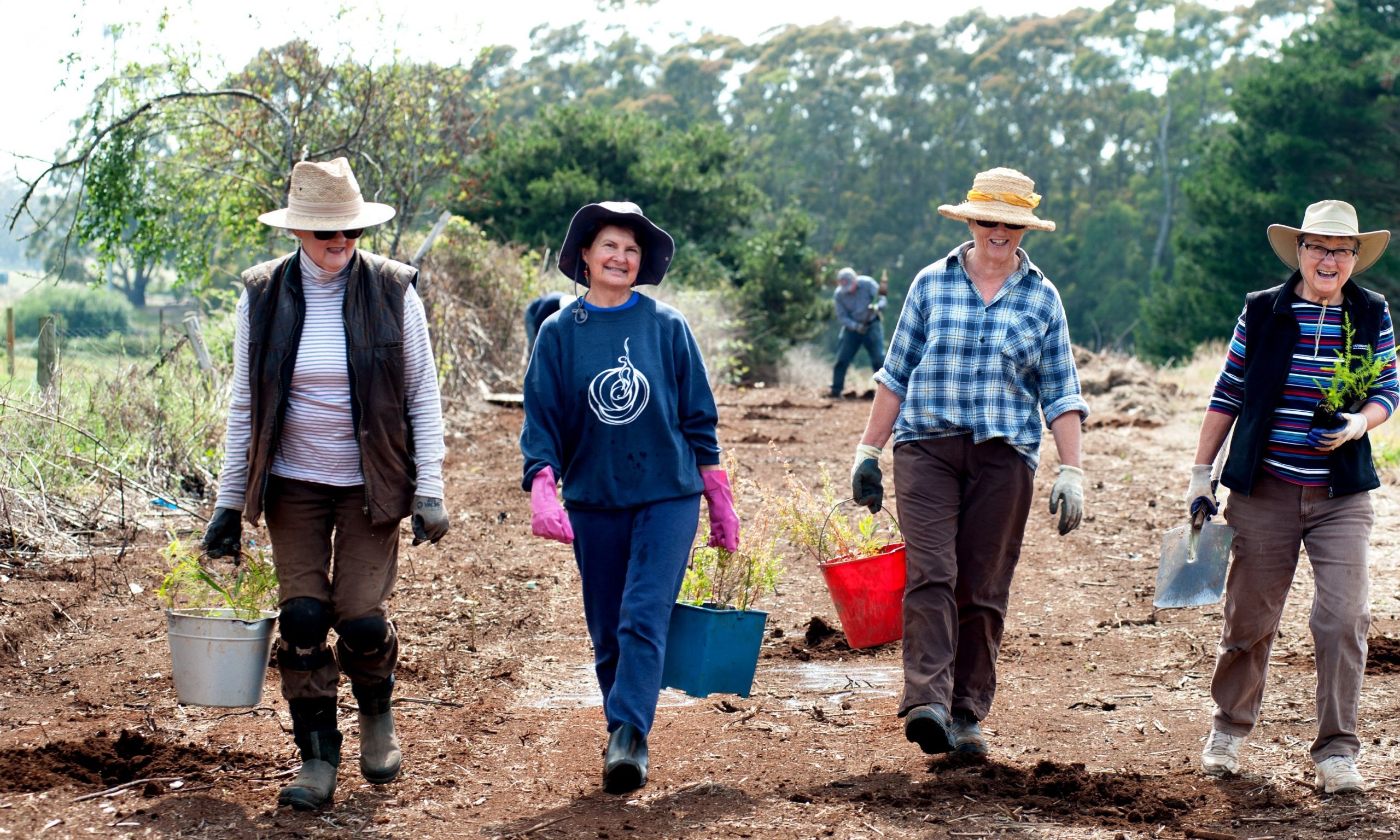
Many natural assets are identified for protection and support under the RCS (photo by Sandy Scheltema)
Be part of the conversation
The draft North Central Regional Catchment Strategy (RCS) is open for comment from 10 March to 20 April 2021. The RCS sets the direction for natural resource management for the next six years.
The draft is available (click here) and they are encouraging comments via the online feedback form. You can provide your comments directly via the ‘Have your say’ function on the website.
North Central CMA are also holding drop-in sessions across the region, and one online, so the community can review and discuss the draft with the North Central Catchment Management Authority team. All are welcome and no RSVPs are required.
For details see the flyer – click here
Drop-in sessions are from 4 to 7 pm. No need to register.
On-line session is on 29 March 2021 from 7 to 8.30 pm.
We encourage and welcome your feedback on this important strategy for our region.
Caring for old trees on 24 April 2021 – book now!
Posted on 8 April, 2021 by Ivan
Connecting Country is excited to announce that tickets are now available for the second event of our 2021 autumn workshop series. ‘Caring for old trees‘ will be hosted by two local leading naturalists, Jarrod Coote and Tanya Loos, who coincidentally both previously worked with Connecting Country. The event will be held in-person at the stunning Hillside Acres farm, in North Harcourt, Victoria.
This event is part of our ‘Healthy Landscapes’ project, funded through the Australian Government’s Smart Farms program.
The workshop will cover:
- How to look after older trees in the landscape.
- Why they are important to farming and biodiversity.
- Methods of protection and providing succession.
We will also have the opportunity to tour of some beautiful large old trees at Hillside Acres. Old trees provide vital farm infrastructure, as well as habitat for many birds, arboreal mammals, microbats, and insects. The workshop will explore how to ensure that old trees remain part of our local landscape, and how to ensure the next generation of old trees.

The event will be on Saturday 24 April 2021 from 10 am to 12 noon in North Harcourt, VIC. It’s sure to be popular and tickets are limited. To book please – click here
Due to COVID-19 limitations, catering for this event is BYO. Please come equipped for potential weather extremes, wear sturdy shoes and bring adequate water and nourishment.
Our Healthy Landscapes project is about helping our local farmers and other landholders to manage their land sustainably for the benefit of wildlife, themselves and the broader landscape. We are also developing a Healthy Landscapes guide book, especially targeted to the Mount Alexander region of central Victoria. This event is part of a series of educational workshops for landholders on sustainable land management.
Our special presenters
Jarrod Coote
Jarrod is an environmental educator and practical ecologist. He runs Hillside Acres farm and has developed a sound knowledge of flora and fauna identification, ecology and habitat requirements. He has taught at education institutions and is a former Connecting Country employee. Jarrod has a passion for sustainable farming and land management, as well as birds and indigenous flora species.
Tanya Loos
Tanya is a superstar of many aspects of ecology and is best known for her ability to explain the intricacies and beauties of the natural world to the community. Tanya has previously worked with Connecting Country and Birdlife Australia, and is an expert in birds, mammals and community engagement. Her experience includes ecological consulting, project planning, client liaison and delivering training. She is also an author, blogger, and well-known advocate for environmental stewardship and sustainable land management.
Ecological Society of Australia features Connecting Country
Posted on 7 April, 2021 by Frances
Connecting Country was honoured to have our work featured in the March 2021 issue of the Ecological Society of Australia Bulletin. Please read on to enjoy our article. For a link to the published article, along with many other interesting articles about new ecological research – click here
A Collaborative Effort: Landscape restoration and Wildlife Monitoring in Central Victoria
Jess Lawton & Frances Howe
Connecting Country
Connecting Country is a community organisation working to restore landscapes across the Mount Alexander region of central Victoria. This area largely comprises the Goldfields bioregion, and its box-ironbark forests and woodlands have a long history of land clearing for mining, timber harvesting and agriculture. The region retains about 35% of native vegetation cover, which has been degraded through inappropriate grazing, erosion, pest animals and weed invasion.
The region is home to species listed as threatened under Victorian and Commonwealth legislation, including the charismatic Brush- tailed phascogale (Phascogale tapoatafa) and extremely restricted Southern shepherd’s purse (Ballantinia antipoda), along with the threatened Victorian temperate woodland bird community.
The local community is highly engaged, demonstrating above average levels of volunteering and a strong interest in nature conservation. Many community members actively contribute to landscape restoration. Changing demographics in the region mean larger farms are often converted to lifestyle properties, with many landholders keen to manage their properties for wildlife.
Landscape restoration
Since beginning in 2007, Connecting Country has worked with over 200 landholders and community groups to rehabilitate 10,000 hectares of habitat. Our work is based on four key areas:
- Supporting Landcare through our Landcare Facilitator and around 30 local Landcare and Friends groups.
- Restoring landscapes through on-ground actions such as fencing existing habitat, revegetation, and weed and pest animal control.
- Engaging community through environmental education, workshops, information-sharing, social media and volunteer involvement.
- Monitoring biodiversity with a focus on woodland birds and arboreal mammals.
Collaborating with scientists

Connecting Country volunteers monitoring nest boxes in the Mount Alexander region.
We welcome and actively seek input from scientists when establishing and reviewing our monitoring programs. This advice has helped us to stratify our site locations, establish an appropriate number of sites, and monitor sites regularly and consistently over the long term.Connecting Country recognises that long-term monitoring is essential to identify whether restoration work is effective in improving biodiversity. Since 2010, we have monitored wildlife at approximately 200 sites across the Mount Alexander region, with a focus on woodland birds as indicators of habitat quality, and the Brush-tailed Phascogale as a flagship for conservation.
Our phascogale monitoring program involves nest boxes established at 100 survey sites, primarily on private land. Sites are stratified across five geographic subregions, to represent both large (> 50 ha) and small (< 50 ha) patches of forest, and gullies and slopes. We have surveyed these sites five times since 2010, and will survey them again in autumn 2021. Our woodland bird monitoring program was established with a similar approach to allow comparison of restoration sites with cleared and remnant vegetation sites.
Setting up monitoring programs with help from scientists has enabled data analysis and the ability to draw more meaningful conclusions about habitat use by species at our restoration sites. Our nest box data has been analysed as part of a PhD project. We have shared our data with researchers from La Trobe University, Federation University and the University of Melbourne, as well as public databases including the Victorian Biodiversity Atlas and Birdata.
Collaborating with community
Connecting Country’s monitoring programs were initially implemented by paid staff, but increasingly involve volunteers. Since 2018 we have moved to a new model where coordinated teams of skilled citizen scientists monitor woodland birds and nest boxes. Feedback from our funders indicates they prefer to invest in citizen science projects, and we find it increasingly difficult to find funding for in-house monitoring.
We work hard to keep data collection as consistent as possible with previous surveys. We take care to enlist volunteers who are skilled at identifying birds both by sight and from their calls, consistent with the skill levels of previous staff. We train volunteers in how to conduct surveys, liaise with landholders, navigate to sites, follow safety procedures, record data correctly and enter data into public databases.
The dedication of our volunteers is inspirational. However, there are challenges. We find that recruitment and training volunteers takes considerable time and is an ongoing process. We must keep our volunteers safe and healthy, provide regular reminders and follow up to volunteers, and answer their questions. When data is collected by many people, it must be checked carefully. It is essential for volunteer retention that volunteers feel appreciated, so we host thank-you events and take opportunities to celebrate our volunteers.
Volunteers report they enjoy monitoring, feel they are connecting with their natural environment, and value learning about scientific monitoring methods. Several volunteers have formed friendships with landholders and take opportunities to share their knowledge and enthusiasm for nature. We are incredibly grateful for the rich resource of skills and enthusiasm that our growing team of about 30 volunteers bring to our monitoring programs, and look forward to learning as much as we can from our data in the future.
For more information, contact Connecting Country here: info@connectingcountry.org.au
This article was first published in the ESA Bulletin March 2021.
Seeking homes for nest boxes – Campaspe Valley Landcare Group
Posted on 7 April, 2021 by Asha

Rob Chapman with one of the nest boxes he’s made (photo from Campaspe Valley Landcare Group)
Campaspe Valley Landcare Group (CVLG) has been awarded a grant to support the conservation of Brush-tailed Phascogales (also known as Tuans) in the group’s boundaries, which encompass Redesdale, Mia Mia, Barfold and Langley in central Victoria.
The project includes the manufacture, placement and monitoring of approximately 50 Tuan nest boxes in the CVLG area during 2021, to support the conservation of this threatened native mammal. The lack of hollow-bearing trees is of particular concern for the conservation of the Tuan. This project proposes to address the lack of suitable hollows, using purpose-built nesting boxes.
CVLG is calling for property owners with suitable habitats to volunteer forested areas for one or two Tuan boxes to be installed. CVLG will take responsibility for the placements, and will be occasionally monitoring the nest boxes over a twelve-month period to assess Tuan population changes.
Tuans are carnivorous and largely insectivorous, so the ideal habitat includes forested areas and lots of coarse woody debris. The fallen logs, branches and other woody material on the forest floor provide shelter and food for Tuans and for their prey.
You would be a prime candidate for this project if your property:
- Is combined with any adjoining forest land (Tuans do not recognise title boundaries) totals 50 hectares or more.
- Has an abundance of fallen timber, logs, and a dense and diverse shrub layer.
- Lacks large, old and hollow-bearing trees in the forest.
The specific siting requirements are the placement of the nest boxes two metres or more above the ground, facing south-east, so as to avoid the cold, driving winds of winter and the hot northerlies of summer.
Tuan nest box manufacture is well underway, and we hope to secure volunteers and install them by the end of June 2021.
If you would like to volunteer your location for this project and ‘foster’ a Tuan family, please contact Phil Don of CVLG on 0408 988 701.
Bird of the month: Superb Fairy-wren
Posted on 30 March, 2021 by Ivan
Welcome to our thirteenth Bird of the month, a partnership between Connecting Country and BirdLife Castlemaine District. Each month we’re taking a close look at one special local bird species. We’re excited to join forces to deliver you a different bird each month, seasonally adjusted, and welcome suggestions from the community. We are lucky to have the talented and charismatic Jane Rusden from BirdLife Castlemaine District writing about our next bird of the month, with assistance from the brilliant Damian Kelly and Ash Vigus.
Superb Fairy-wren (Malurus cyaneus)
My grandfather, Claude Austin, passed on his passion for birds and conservation to my very young eyes and ears. One of my earliest and ongoing observations was that, despite downsizing from farm, to rural home on acres, to house in the city, there were always Superb Fairy-wrens, also known as Blue Wrens, in his garden. And so it became a life goal for me to create safe and suitable habitat for these tiny but charismatic and adaptable birds in my own garden. These days, living on a bush property, they provide a daily delight as they robustly sing to the world with all their might, jump over each other like circus tumblers and snuggle up in gorgeous family groups. However, I doubt that in his day, Pop knew of their saucy sex life. If he did he certainly wasn’t telling me.
Superb Fairy-wrens love dense bushes. They sing from the highest point and dive into them for cover from predators, while using the surrounding open ground to forage in a social unit, at a frenetic pace. Their diet consists of predominantly insects, but also flower petals and succulent fruits.
During spring and summer the male Superb Fairy-wren makes up for it’s tiny size, with vivid and iridescent blue and black breeding plumage making them quite conspicuous. However, during the non-breeding months they go through eclipse where they look quite motley, adopting mouse brown plumage like the female, but retaining the black bill and very dark blue tail.
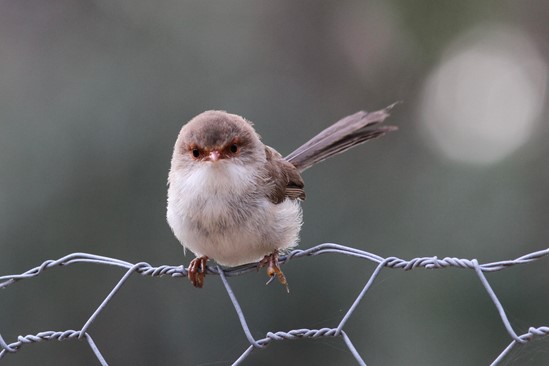
Female Superb Fairy-wren (photo by Jane Rusden)
Damian Kelly’s discovered the following facts about Super Fairy-wrens during his research.
Generally you will see a male in company with a group of brown birds, both male and female. In the past this misled people into thinking that the male was polygamous and held sway over his ‘harem’.
This was all turned on its head by banding studies first by E and J Bradley and then Ian Rowley. What appears to be a territorial patriarchal group is in fact a matriarchal group. Groups comprise usually one coloured male, a bunch of brown males and one female. All birds assist in the feeding of the young. Any females hatched are driven from the group once mature.
To add to the intrigue, eggs in a nest are not all fathered by the coloured male – often separate eggs are fertilised by several different males. Various studies have found that over 40% of young in a territorial group were fathered by a male other than the dominant coloured male. This behaviour is true not only of the Superb Fairy Wren, but also the Splendid Fairy Wren.
BirdLife Australia’s ‘Birds in Backyards’ web page has this to say: ‘Male Superb Fairy-wrens have been labelled as ‘the least faithful birds in the world’. Females may be courted by up to 13 males in half an hour, and 76% of young are sired by males from outside the social group.’

Male Superb Fairy-wren in breeding plumage (photo by Ash Vigus)
Superb Fairy-wrens can be parasitised at times by cuckoos such as Horsefields, Shining, Fantailed and Black-eared.
To listen to the call of the Superb Fairy Wren, please visit Graeme Chapman’s website – click here
A big thank you to contributors to this edition of Bird of the Month – Jane Rusden, Damian Kelly and Ash Vigus – for their amazing knowledge and skills.
References:
- HANZAB. The Fairy-Wrens by Richard Schodde.
- BirdLife Australia’s Birds in Backyards web page – click here
Caring for old trees – 24 April 2021
Posted on 24 March, 2021 by Ivan
Save the date! We have announced our second education event for 2021 and it is sure to be terrific, hosted by two local leading naturalists and ecological experts, Jarrod Coote and Tanya Loos. The event will be in-person, face-to-face (for a change!) at the stunning Hillside Acres farm, in North Harcourt, Victoria.
The event is part of our ‘Healthy Landscapes’ project, funded through the Australian Government’s Smart Farms program.
Our project is about helping our local farmers and other landholders to manage their land sustainably for the benefit of wildlife, themselves and the broader landscape. We are also developing a Healthy Landscapes guide book, especially targeted to the Mount Alexander region of central Victoria. This event is part of a series of educational workshops for landholders on sustainable land management.
The event will cover topics such as how to look after old trees in the landscape, why they are important to farming and biodiversity, methods of protection and succession, and include a tour of some old trees at Hillside Acres. Old trees provide vital farm infrastructure, as well as habitat for many birds, arboreal mammals, microbats and insects. The workshop will explore how to ensure that old trees remain part of our healthy landscapes, and how to ensure the next generation of old trees.

Old trees are important natural assets in our landscape (photo by Connecting Country)
This free event will be held on Saturday 24 April 2021 from 10 am to 12 pm in North Harcourt, VIC.
Online booking will be available shortly. There will be strict limits on booking , due to COVID restrictions. It’s sure to be very popular.
Our special presenters
Jarrod Coote
Jarrod is an environmental educator and practical ecologist. He currently runs Hillside Acres farm and has developed a sound knowledge of flora and fauna identification, ecology and habitat requirements. He has taught at education institutions and is a former Connecting Country employee . Jarrod has a passion for sustainable farming and land management, as well as birds and indigenous flora species.
Tanya Loos
Tanya is a superstar of many aspects of ecology and is best known for her ability to explain the beauties of the natural world to the community. Tanya has previously worked with Connecting Country and Birdlife Australia, and is an expert in birds, mammals and community engagement. Her roles include ecological consulting, project planning, client liaison and delivering training. She is also an author, blogger, and well-known advocate for environmental stewardship and sustainable land management.
Stay tuned for further details coming soon!
Healthy dams for habitat event, a healthy success
Posted on 24 March, 2021 by Ivan
On 18 March 2021, a large crowd of people gathered on their computers, tablets and phones, to enjoy Connecting Country’s ‘Healthy dams for habitat’ online event. The event was hosted by Connecting Country and presented by local wetland consultant, Damien Cook. The free online event featured a presentation by Damien on how to create and improve dams to supply clean water and habitat for a variety of native plants and animals. The event was part of our ‘Healthy Landscapes’ project, funded through the Australian Government’s Smart Farms program.
This was the first of three educational events for the autumn 2021, with two further events planned for April and May 2021. The aim of the workshop series is to help our local farmers and other landholders to manage their land sustainably for the benefit of wildlife, primary production and the broader landscape. We will also develop a Healthy Landscapes guide book, especially targeted to the Mount Alexander region of central Victoria, which will be delivered in the coming months.
We were excited to sell a total of 201 tickets to the event, but it was difficult to tell exactly how many people attended, due to attendees sharing a screen with family members. The event finished with a 15 minute ‘Q and A’ session, which delivered further discussion around beneficial fauna in dams, how to filter water before entering a dam using plants, and also where to purchase common wetland species suitable for dams. There was plenty of interest in the event, with further requests for a recording of the event, plant lists and advice regarding wetland creation.
If you missed the ‘Healthy dams for habitat event’ a recording is now available on Vimeo – click here
Our evaluation survey indicated that attendees were keen for more information on how to create clean water and habitat in their existing dams, so we are providing some additional information. We will follow up with an aquatic plant list for our region and further videos in another post in the near future.
Additional resources
Damien mentioned a number of useful resources during the event, which provide great starting resources for improving the habitat value of a dam:
- Farm Dams – Planning, Construction & Maintenance. Landlinks Press. CSIRO Publishing. Lewis B (2002)
- Wildlife on Farms: how to conserve native animals. CSIRO Publishing. Lindenmeyer D, Claridge A, Hazell D, Michael D, Crane M, MacGregor C and Cunningham R (2003)
- Flora of Melbourne: Guide to the Indigenous Plants of the Greater Melbourne Area, 4th Edition
Enhancing farm dams
We also recommend ‘Enhancing farm dams’, a booklet produced by the Australian National University and an excellent resource for anyone starting improvements to their existing dams.
To download your copy – click here
The ‘Enhancing farm dams’ brochure includes the following illustration highlighting some achievable actions and beneficial dam improvements.

Rise and shine for BirdLife Castlemaine AGM – 3 April 2021
Posted on 17 March, 2021 by Ivan
Our friends and partners at BirdLife Castlemaine District Branch are holding their annual general meeting (AGM) on Saturday 3 April 2021 at the lovely Rise and Shine Bushland Reserve in Sandon VIC. The AGM will be held in conjunction with their monthly bird walk, which will explore the excellent bird habitat in the reserve.
For further details from BirdLife Castlemaine please read on or visit their website – click here

Rise and Shine Bushland Reserve is well known for its excellent birding opportunities (photo by Geoff Park)
Please be advised that the 2021 Annual General Meeting of BirdLife Castlemaine District Branch will be held on:
Saturday 3 April 2021 at 11.30 am
Rise and Shine Bushland Reserve, Sandon VIC
The meeting will follow the monthly bird walk to be held at Rise and Shine Bushland Reserve. BYO drink and chair – food for morning tea will be provided.
A nomination form for committee positions is attached. A proxy voting form is also attached. Please consider nominating for the committee. Also attached is the agenda for the 2021 AGM and the unconfirmed 2020 AGM minutes.
Nomination forms and proxy voting forms should be emailed to castlemaine@birdlife.org.au
OR mailed to:
Secretary, BirdLife Castlemaine District Branch, 25A Church Street, Maldon, VIC 3463.
Nominations will also be accepted on the day of the AGM.
Please also note that a BirdLife Castlemaine District Branch committee meeting will be held on Sunday 11 April, 10.00 am in Hawkins Road, Campbells Creek VIC.
Best wishes,
Judy Hopley
Secretary
BirdLife Castlemaine District Branch
Pioneering climate future plots for our region
Posted on 15 March, 2021 by Ivan
Connecting Country has secured funding through the Ross Trust to establish two climate future plots of 500 plants right here in Mount Alexander region during 2021-23.
We will focus on two species from our local area: Silver Banksia (Banksia marginata) and Sweet Bursaria (Bursaria spinosa).

Sweet Bursaria in flower (photo by Tanya Loos)

Silver Banksia in flower (photo by Bonnie Humphreys)
We are looking to include a variety plant provenances, grown from seed from areas that are hotter and drier, as well as areas that are cooler and wetter. Even though our climate is predicted to become hotter and drier, there may be other genetic information stored within a particular provenance, such as ability to survive an insect attack, or frost resilience, which plants from the hotter and drier area do not have.
To select our provenances we are looking at the Bureau of Meteorology’s climate predictions for our region. We have paired these predictions with species distribution and the availability of seed for our chosen plants.
Our climate future plots will create seed production areas and provide climate-adapted seed for use in future revegetation projects. They will also help to identify individuals and provenances most suited to survive in our changing climatic conditions.
Monitoring will allow us to assess and track the plants. Randomisation of provenances will help mix up pollen so it is more likely to be shared between plants when they flower and reproduce. This sharing of diverse genetic information may help the plants adapt as our climate changes.
Landholder expressions of interest
We are currently looking for a landholder interested in hosting a climate future plot for Sweet Bursaria on their property. Not every property is suitable for a climate future plot. It requires a long-term commitment and there are some important criteria that must be met for site selection. These criteria are provided below.
If you meet the criteria and are keen to host a climate future plot for Sweet Bursaria, please fill in our expression of interest form – click here
Please return your expression of interest form to Bonnie at Connecting Country via email (bonnie@connectingcountry.org.au). Expressions of interest close on 30 March 2021.
Criteria for site selection
Criteria for the ideal climate future plot are:
Land with:
- Minimum of 3 hectares (7.5 acres) of clear space for Sweet Bursaria planting in a square block (excluding existing vegetation and structures).
- Proximity to Castlemaine in central Victoria (maximum 20 km), with easy vehicle access to the site for installation, monitoring, maintenance and community involvement.
- Suitable conditions for the target species to facilitate healthy growth.
- No livestock grazing.
- Legal protection through land tenure, nature covenant or planning scheme (e.g., zoning and overlays that restrict development).
Landholders with:
- Long-term commitment to retaining their property and the plots intact.
- Demonstrated history of managing the property for biodiversity conservation and restoration.
- Capacity to understand the climate future plot concept and scientific importance of correct plot maintenance.
- Capacity to commit to future land management actions (e.g., weed and rabbit control, grazing exclusion, maintaining plant guards).
- Willingness to allow ongoing access for Connecting Country and volunteers for monitoring, maintenance, seed collection and community education.
Learn more about climate future plots
For more information on climate future plots, see:
- https://www.greeningaustralia.org.au/climate-future-plots/
- https://connectingcountry.org.au/what-is-a-climate-future-plot/
Escaping the trap to reduce platypus deaths
Posted on 10 March, 2021 by Frances
Our colleagues at the Australian Platypus Conservancy published the following update on progress following the ban on opera house yabby nets. Evidence so far indicates the ban is working to reduce platypus and rakali deaths caused by these nets. Please read on for details.
To read the full version of ‘Platypus News & Views’, the newsletter of the Australian Platypus Conservancy (Issue 83 – February 2021) – click here
To learn more about the Australian Platypus Conservancy – click here
To read Connecting Country’s previous post on this issue – click here

Two platypus that drowned in an opera house trap in 2015 (photo: Australian Platypus Conservancy)
ESCAPING THE TRAP
Since 1 July 2019, the Victorian government has banned recreational use of opera house traps and other enclosed nets to capture crayfish or yabbies in all public and private waters throughout the state. The new rule aims to reduce the number of platypus, rakali (or water-rats), turtles and other air-breathing animals drowning as bycatch in enclosed traps. So how successful has this move been in reducing deaths of non-target species?
Based on records collated by Mike Sverns (DELWP Major Operations and Investigations Unit), only one platypus reportedly died in an opera house trap in the first 18 months after the Victorian ban was implemented (in King Parrot Creek in September 2019), with two rakali mortalities reported in the same period (in the Barwon River in April 2020). On average, eight times as many platypus and four times as many rakali reportedly died each year in enclosed traps set in Victorian waters in the 36 months preceding the ban.
It’s also worth noting that the ban on opera house trap use has been strongly supported by nearly everyone in the Victorian community, including recreational angling groups. To encourage persons to make an early switch to wildlife-friendly open-top yabby nets, the Victorian Fisheries Authority funded a Yabby Net Swap Program, whereby anglers could swap up to three opera house traps for one open-top yabby net. This program was very successful, with 20,000 open-top yabby nets distributed to persons across the state between December 2018 and February 2019.
Legislation banning use of opera house traps in the Australian Capital Territory came into effect in 2020. The ACT also followed Victoria’s lead in announcing that opera house traps could be exchanged for open-top lift nets at participating fishing tackle shops (with a limit of two new free nets per person). Elsewhere in Australia opera house traps cannot be legally deployed in Tasmania or Western Australia. New South Wales has announced they will eventually be banned throughout the state but (as far as we know) still hasn’t seta date for this to occur.
Even though Victoria’s ban has been an unqualified success in many ways, some illegal usage is likely to continue for some time due to the huge numbers of opera house traps that were previously purchased. More than 60 enclosed nets have been seized by Victorian fisheries and wildlife officers since mid-2019, including 23 opera house traps confiscated from a single person, resulting in a substantial fine. Unfortunately, it could be many years before these traps finally disappear from Victorian waters, as illustrated by a drum net being removed from the Goulburn River in May 2020, two decades or more after its use was outlawed.
Therefore, please continue to watch for use of illegal yabby traps and nets and report them at once to your state/territory fisheries hotline (13FISH in Victoria). Also, do whatever you can to encourage New South Wales, Queensland, South Australia and the Northern Territory to take action to ban all use of enclosed yabby nets and traps within their respective borders.
Australian Platypus Conservancy
2021 bird walks with BirdLife Castlemaine
Posted on 4 March, 2021 by Ivan
Our friends and project partners at BirdLife Castlemaine District have shared their latest ‘Bird Walks Calendar 2021’, which sets out all the excellent monthly bird walks they have planned for the rest of 2021. If you have not attended one of their bird walks, then make 2021 the year to enjoy the pleasure of a guided bird walk with friendly local experts. Please read on for details, provided by BirdLife Castlemaine District.
March 2021 bird walk
Date: Saturday 6 March 2021 at 9 am
Leader: Damian Kelly
Location: Glamorgan Reef Bushland Reserve, Yandoit VIC
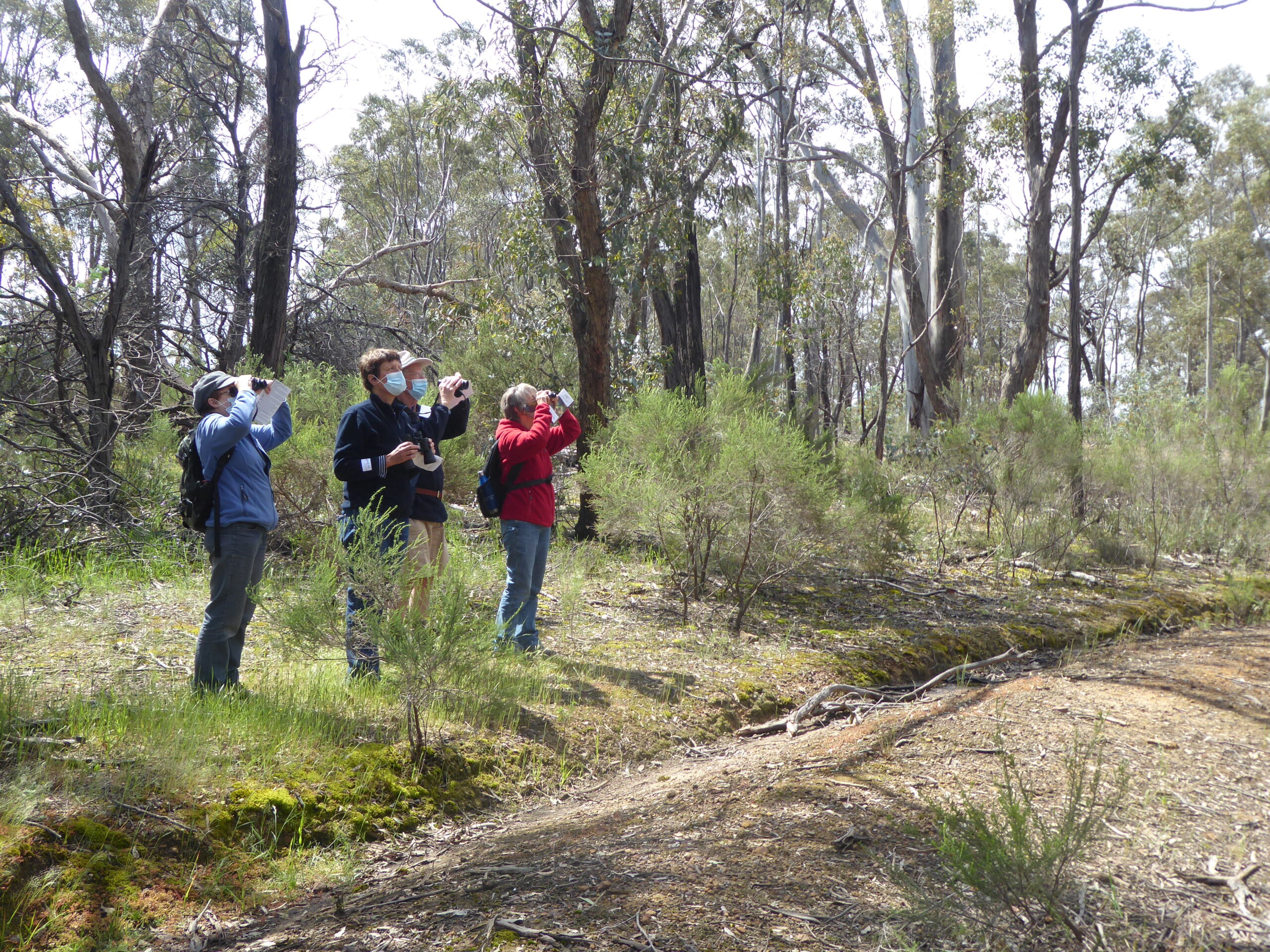
Monthly bird walks can be a healthy stroll with lovely people, with birds providing a natural bonus (photo by Frances Howe)
Dear members and friends,
Please find attached the BirdLife Castlemaine District Branch 2021 Calendar with brief details of our monthly bird walks and the bird camp to be held in September.
Full details about each walk will be posted on the BirdLife Castlemaine District. Facebook page and included in our eNews prior to each walk. If you are interested in the bird camp, contact details are on the calendar.
Thanks to Bob Dawson, BCD’s Bird walk coordinator and to those who have already led walks or will be doing so as the year progresses. All levels of experience welcome – walks are a great chance to learn from and have fun with fellow birdwatchers. Full details about each walk will be posted on the BirdLife Castlemaine District Facebook page and included in our eNews prior to each walk.
Walks will be cancelled if, during the walk period, severe weather warnings are in place; temperatures over 35oC or persistent rain is forecast; a Total Fire Ban has been declared for the day. Please check your email and/or Facebook on the evening before a walk, in case the event has been cancelled.
For more information, please email castlemaine@birdlife.org.au or call/text Jane Rusden (0448 900 896), Judy Hopley (0425 768 559) or Bob Dawson (0417 621 691). Please also note that walks or other activities will need to follow all Victorian Government Covid-19 restrictions and recommendations and will only go ahead if the restrictions permit.
To download BirdLife Castlemaine’s 2021 calendar – click here
Healthy dams for habitat 2021 – more tickets now available
Posted on 4 March, 2021 by Ivan
Sold out in a week! We did not expect the 100 tickets for our ‘Healthy dams for habitat’ event to book out so quickly, but they did. So we have upgraded our Zoom account and now have another few hundred tickets available.
To book – click here
‘Healthy dams for habitat‘ is hosted by local leading naturalist and wetland expert, Damien Cook. The free online event will feature a presentation by Damien on how to create and improve dams to supply clean water and habitat for a variety of native plants and animals. The event is part of our ‘Healthy Landscapes’ project, funded through the Australian Government’s Smart Farms program.
The event will aim to help our local farmers and other landholders to manage their land sustainably for the benefit of wildlife, primary production and the broader landscape. We will also develop a Healthy Landscapes guide book, especially targeted to the Mount Alexander region of central Victoria, and deliver two further educational workshops for landholders on sustainable land management.

The online event will be held on Thursday 18 March 2021 from 7-8 pm. It’s sure to be popular and tickets are limited. To book – click here
Damien Cook
Damien has been a keen naturalist for 30 years and has developed a sound knowledge of flora and fauna identification, ecology and habitat requirements. He is a recognised expert in wetland, riparian and terrestrial ecology, particularly in the factors affecting the establishment and management of aquatic and wetland plants, and also the revegetation of terrestrial ecosystems. Damien is also Co-director of Rakali Ecological Consulting, a company based in central Victoria that specialise in ecological assessment (flora and fauna), mapping and land management planning for a variety of ecosystems, including wetland and terrestrial vegetation in south-eastern Australia. Damien’s roles include ecological consulting, project planning, client liaison and delivering training. Damien is also a shareholder in Australian Ecosystems Pty Ltd, an ecological restoration company with its own large scale indigenous plant nursery.

There are excellent examples of healthy dams in our region (photo by Bonnie Humphreys)
Bird monitoring 2020 results are in!
Posted on 4 March, 2021 by Jess
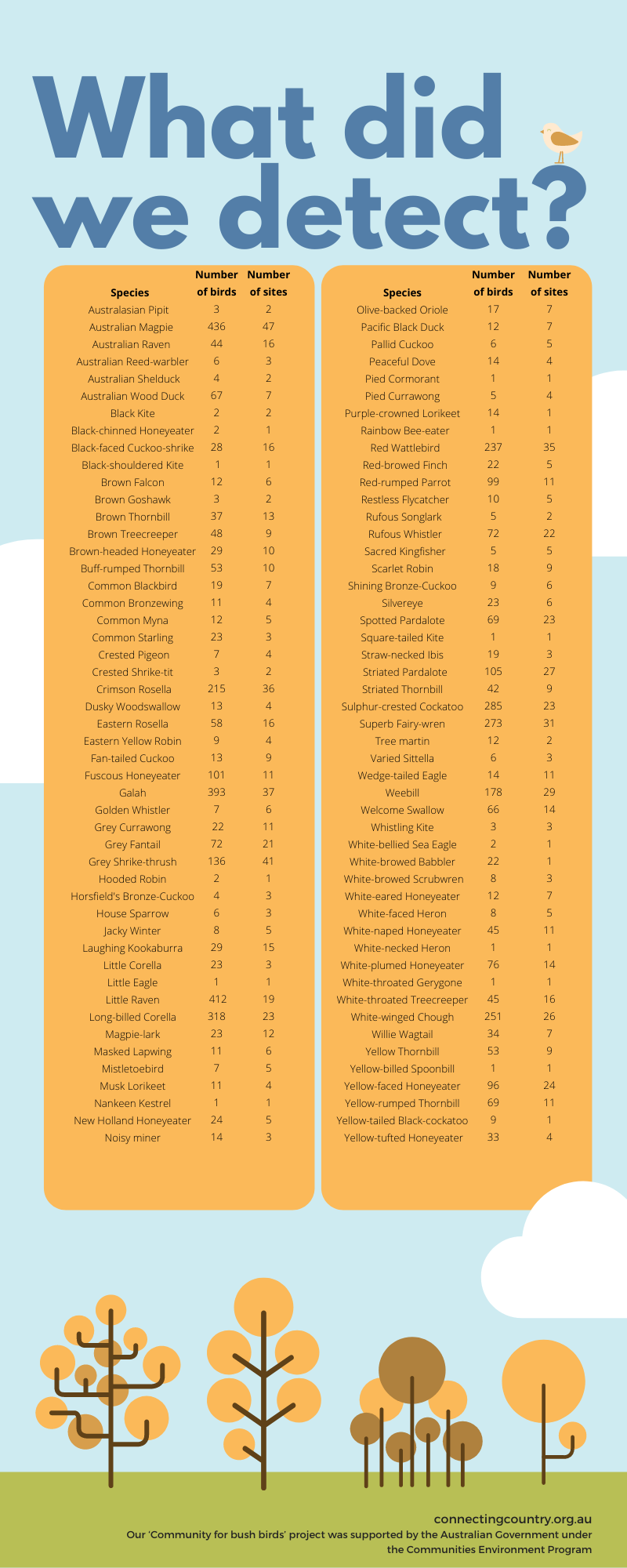
Connecting Country’s long-term bird monitoring program was established to investigate the relationship between habitat restoration and woodland bird populations across the Mount Alexander region in central Victoria. In 2020 sites were monitored by our team of tenacious volunteers, who managed to survey most of our sites, despite challenges associated with COVID-19 and lockdowns. The 2020 monitoring season was supported by the Australian Government’s Communities Environment Program. This was the second time our monitoring was 100% completed by volunteers.

The adorable Jackie Winter, a tiny but stunning bird of our region (photo by Peter Turner)
We are excited to present the following short report summarising the results of our 2020 bird monitoring program. We’re always on the lookout for more volunteer bird monitors! If you have bird identification skills and are interested in joining our bird monitoring program, please email our Monitoring Coordinator, Jess Lawton (jess@connectingcountry.org.au).

To hear more about our woodland birds monitoring program, and why we set up the program please watch the following video.
Landcare video updates – North Harcourt & Sedgwick Landcare
Posted on 4 March, 2021 by Asha
To complement the February 2021 Landcare Link-up, we asked each Landcare and Friends group in the Mount Alexander region (Central Victoria) to film a short video update to share their achievements with the community. As usual, Landcarers rose to the occasion! We will be sharing these videos through a series of blog posts, as well as screening them at the Landcare Link-up and uploading them to our Landcare page.
The next video from North Harcourt & Sedgwick Landcare details their fantastic ‘Pledge to Plant’ project during 2020. They explain how they went about the project and the overwhelming response they received from their community. To watch the video click on the image below or – click here
North Harcourt & Sedgwick Landcare Group focuses on community and shared learning. Their revival in recent years has seen them become a thriving and active group with strong community participation and support. Their current projects include running nature walks, building nest boxes, and providing property advice for local residents.
To learn more or get involved with North Harcourt & Sedgwick Landcare, contact them via email (nhselandcare@gmail.com) or visit their Facebook page – click here
Bird of the month: Fuscous Honeyeater
Posted on 25 February, 2021 by Ivan
Welcome to our twelfth Bird of the month, a partnership between Connecting Country and BirdLife Castlemaine District. Each month we’re taking a close look at one special local bird species. We’re excited to join forces to deliver you a different bird each month, seasonally adjusted, and welcome suggestions from the community. We are lucky to have the talented and charismatic Jane Rusden from BirdLife Castlemaine District writing about our next bird of the month, with assistance from the brilliant Damian Kelly and Ash Vigus.
Fuscous Honeyeater (Lichenostomus fuscus)
Since we’ve all been in lockdown and spending most of our days at home, I thought the ever constant, interactive communities of Fuscous Honeyeater a good place to start this month. Partly because their endearing daily antics are the very opposite of what COVID-19 restrictions do to our own lives.
Visually the Fuscous Honeyeater is nothing to rave about, much like us living through lockdown in our PJ’s. In fact, I tell those new to bird watching, if they see a honeyeater but can’t quite work out what species it is, it’s probably a Fuscous. The small yellow tuft of feathers below the eye, on the jawline, can be very difficult to see, and otherwise they are a nondescript, mid olive-brown bird.
Their habit of foraging for insects on the wing, and lerp, honeydew and nectar in the treetops, makes them difficult to see as they flit about in the foliage. There is nothing to indicate which are male and female, although the male is very slightly larger than the female. Immature and non-breeding birds have a yellow gape, whereas breeding birds have an all-black bill (see photo comparison).

Fuscous Honeyeater with a yellow gape, indicating an immature or non-breeding individual (photo: Jane Rusden)
I find the best way to observe this species is at my birdbaths, which they absolutely love – not surprising as they are known to be drawn to water sources. I’ll often see about five birds gathering in a circle like they are at a noisy party, where they shout at each other all at once, then fly off one after the other in quick succession. There have been some long-term studies that indicate the Fuscous Honeyeater is a semi-colonial species, although they breed in monogamous pairs. They lay 1-3 eggs in a cup shaped nest that appear to be quite flimsy. However, they must be successful breeders and their densities can be up to five birds per hectare in highly suitable habitat.
If you find yourself somewhere on the east coast, between South Australia and Queensland, in a dryer forest, straining to looking at an olive-brown honeyeater that you can’t quite identify, but it’s vigorously chasing other birds through the canopy or shouting at it’s friends … you might be looking at a Fuscous Honeyeater.

Fuscous Honeyeater with a black bill indicating it’s a breeding adult (photo: Jane Rusden)
To listen to the call of the Fuscous Honeyeater, please visit Graeme Chapman’s website – click here
A big thank you to contributors to this edition of Bird of the Month – Jane Rusden and Damian Kelly – for their amazing knowledge and skills.
Clean Up Australia Day – Sunday 7 March 2021
Posted on 25 February, 2021 by Asha
Clean Up Australia is happening this Sunday 7 March 2021, including eight locations across the Mount Alexander region. Clean Up Australia inspires and empowers communities to clean up, fix up and conserve our environment. What was started 30 years ago, by an ‘average Australian bloke’ who had a simple idea to make a difference in his own backyard, has now become the nation’s largest community-based environmental event.

Local Clean Up Australia Day working bees include:
- Friends of Campbells Creek Landcare (note: this working bee is taking place on 28 February 2021) – click here for more information
- Golden Point Landcare – click here for more information
- Muckleford Catchment Landcare – click here for more information
To view a map of Clean Up Australia Day working bees across the country, allowing you to search via postcodes and townships, please click here

Rubbish dumped at Muckleford Bushland Reserve (photo by Muckleford Catchment Landcare Group)
Weed management after fire – resources from WESI
Posted on 18 February, 2021 by Jacqui
After wildfire, our ecosystems are extremely vulnerable to weed invasion. The blank canvas created by wildfire is often a perfect platform for invasive species, with little competition to prevent a blanket of weeds from returning to the landscape, at the expense of many vulnerable native species.
The Weeds at the Early Stage of Invasion (WESI) team recently uploaded four webinars from their recent online forum on weed management after fire. This forum featured four separate webinars with a variety of topics and guest speakers from all over the state, and was very popular with the community and stakeholders. The list of guest speakers and presenters is staggering and the events were very well put together.
Invasive species management, including weed management, is an integral component of any landscape or reserve scale conservation program. The benefits of a preventative and early intervention approach has been adopted in many parts of the world with great success. The WESI Project was created to promote these benefits and enable Victoria to adopt this approach, with a focus on high-risk invasive weeds that are in the early stage of invasion and threaten biodiversity. They work with public land and biodiversity managers all over Victoria. The WESI Project, and several other weed management projects, are funded by the Victorian Government through the Weeds and Pests on Public Land program.
Whether you are managing weeds in fire impacted areas or other areas, we are sure much of the content will be relevant. We highly recommend having a look.
To view the webinar recordings, please click on the following links:
- Webinar 1 – Overview weed management after fire
- Webinar 2 – Prioritisation of weeds after fire
- Webinar 3 – Collaborative projects in weed management after fire
- Webinar 4 – Weed identification and recording after fire
To view the complete webinar series directly on YouTube series – click here
Alternatively, to access the recordings of the four webinars, along with the links posted in the online chat function during each event – click here
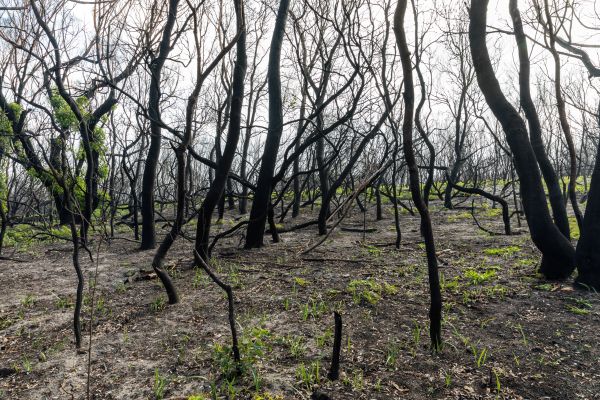
Cape Conran regeneration after a devastating fire in 2020 (photo by Andrew Geschke)