

BirdLife Castlemaine AGM and Geoff Park presentation – 27 October 2018
Posted on 18 October, 2018 by Tanya Loos
The team at BirdLife Castlemaine invites you all to the inaugural Annual General Meeting of the BirdLife Castlemaine District Branch. This historic occasion includes a presentation by the bird-man of Newstead himself, Mr Geoff Park, and a short guided bird walk.
BirdLife Castlemaine AGM and Geoff Park presentation
Saturday 27 October, 2018 at 2.00 pm
Campbells Creek Community Centre, 45 Elizabeth St, Campbells Creek VIC
Please consider nominating for the committee. The positions vacant are Chair, Secretary, Treasurer and three general committee members. Nomination forms and proxy voting forms can be obtained by emailing castlemaine@birdlife.org.au or by phoning Judy Hopley (Acting Secretary) on 5472 1156. Nominations will be accepted at the meeting.

A Yellow-tufted Honeyeater in all its golden glory – one of Geoff Park’s stunning photos
Birdlife Castlemaine supplied the following biography of their guest speaker:
Geoff is a Director of Natural Decisions, an organisation with expertise in environmental and natural resource economics, ecology, land and water management, and agricultural science. With such a busy schedule, somehow Geoff manages to play a pivotal role in the Newstead community where he resides. He’s involved in many local projects that make Newstead the vibrant place it is.
Renowned Australia-wide, Geoff’s blog Natural Newstead website (https://geoffpark.wordpress.com) is insightful, entertaining and a visual feast. It is a joy to read the daily posts and his photographs alone are stunning. For those not already subscribed, it is highly recommended. Together with Chris Tzaros, Geoff runs highly sought after photography courses held in spring and autumn. Despite Geoff’s busy calendar he has always been patient and generous in answering bird queries. Should you run into him bird watching, he’ll be the bloke with the big lens who loves a chat about our feathered friends.
Following the AGM, talk and afternoon tea it is proposed to hold a short birdwatching ramble along nearby Campbells Creek. Thanks to those who have already sent acceptances and apologies. If you haven’t responded please let us know if you plan to attend.
RSVP via email: castlemaine@birdlife.org.au
Jane 00448 900 896 or Judy 5472 1156
Creatures photo exhibition in Castlemaine
Posted on 17 October, 2018 by Frances
F riends of the Box-Ironbark Forests (FOBIF) is holding a ‘Creatures’ photo exhibition. The 24 photos show a small percentage of the many wonderful creatures that inhabit our Box-Ironbark Forests. They were selected from 125 photos submitted by 23 local photographers.
The exhibition runs from 12 October to 29 November 2018 at Togs Place, 58 Lyttleton St, Castlemaine VIC.
Over half of the exhibition photos are of birds and include the critically endangered Swift Parrot, a group of perching Juvenile Scarlet Robins and a Red Wattlebird bathing. The rest show other beautiful local fauna including a macro shot of a Grasshopper Nymph, a watchful Koala and a curious Yellow-footed Antichinus. To see all submitted photos in a FOBIF Flickr album: click here
Friends of the Box-Ironbark Forests has been conducting art and photography exhibitions since 1999. They have all had the same purpose: to honour the native forests of the region, continuing the long tradition of artistic involvement with these forests.

Red Wattlebird photo by Vivienne Hamilton, Castlemaine May 2018

Koala photo by Patrick Kavanagh?, Strangways May 2016

Dusky Woodswallow photo by Geoff Park, Mia Mia area September 2018
This Creatures exhibition aims to give viewers an appreciation of the amazing variety and unique qualities of fauna to be found in our local bushlands. All photos are for sale with proceeds going to Friends of the Box-Ironbark Forests. More than one copy of each photo is available for sale.
For inquiries please contact Bronwyn Silver on 0448 751 111.
Echidna presentation and Newstead Landcare AGM – 18 October 2018
Posted on 16 October, 2018 by Jacqui
Newstead Landcare is delighted to have Dr Kath Handasyde from The University of Melbourne to speak at their AGM at 8 pm this Thursday 18 October 2018 at Newstead Community Centre (9 Lyons St, Newstead VIC).
The AGM will be speedy then we can all enjoy Kath’s presentation about one of only two Australian egg-laying mammals – the Echidna.

Echidna photographed at Strangways by Patrick Kavanagh
Echidnas are our most widely distributed mammals, occurring in all regions of Australia. They are classified as myrmecophages, feeding extensively on social insects, such as ants and termites.
These are a rich and abundant food resource for which echidnas have clear adaptations, such as a long narrow snout, sticky tongue and powerful digging abilities. Echidnas are one of the relatively small number of Australian mammals that undergo hibernation.
Please come along to hear some more about these extraordinary animals in a presentation about their ecology and behaviour.
All welcome! A gold coin donation will be appreciated to help cover costs.
Open house on Forest Fire Management Vic activities – 18 October 2018
Posted on 9 October, 2018 by Frances
Talk to Forest Fire Management Victoria, share your local knowledge and learn more about what they do in Central Victoria
Forest Fire Management Victoria invites you to come and discuss their management activities including:
- The Joint Fuel Management Plan (previously Fire Operations Plan)
- Domestic firewood
- Planned burning and other fuel management activities
- State forest and crown land management
When: Thursday 18 October 2018 from 4.00 – 7.00 pm
Where: Ray Bradfield Room, Castlemaine VIC (next to Victory Park)
For further information visit https://www.ffm.vic.gov.au or email loddonmallee.plannedburning@delwp.vic.gov.au
Woodland birds of central Victoria with Chris Tzaros – 13 October 2018
Posted on 9 October, 2018 by Asha
Axe Creek Landcare invites you to:
Working with Nature — conserving woodland birds with special guest, Chris Tzaros (Birds, bush and beyond)
- Join Axe Creek Landcare for a visual extravaganza of award winning bird photography from wildlife ecologist Chris Tzaros.
- Learn about the habitat requirements of our woodland birds, why some are endangered and what conservation actions you can do to reverse local declines.
- Meet neighbours and people and network to develop ideas for future on-ground activities.
- Join optional local field trip for those interested in learning more in the field.
- Light lunch provided.

When: Saturday 13 October 2018 from 10:00 am – 3:00 pm AEDT
Where: Emu Creek Hall, Cnr Emu Creek and Hargreaves Rd, Emu Creek (via Strathfieldsaye), VIC 3551
Bookings: click here
For more information please contact Adrian Martins on 0427 099 376.
National Waterbug Blitz Workshop
Posted on 27 September, 2018 by Asha
Help monitor the health of waterways in the Mt Alexander region!
North Central Waterwatch, Castlemaine Landcare Group and the Friends of Campbells Creek are working together to engage local community members in monitoring the health of Forest Creek, Barkers Creek and Campbells Creek in the Mt Alexander region. They will be providing an introduction to and training in water quality monitoring and waterbug assessments to those citizen scientists wishing to join the program.
Water quality monitoring looks at the temperature, turbidity, salinity, nutrient and pH levels of water, to helps us understand how conditions change over time. Waterbugs (or macroinvertebrates) are excellent indicators of river health and one way we can measure the success of remediation work over time.
Join these groups, together with John Gooderham (freshwater ecologist and co-author of ‘The Waterbug Book’) for this accredited workshop. You will learn the Agreed Level Taxonomy (ALT) macroinvertebrate method of identifying waterbugs and how to use water quality monitoring equipment. They will demonstrate how we can use this information to assess creek health, and show you how you can be a citizen scientist.
Each year North Central Waterwatch, in partnership with Castlemaine Landcare Group and the Friends of Campbells Creek, will release an Annual River Health Snapshot Report. The report will highlight changes in ecosystem health of these waterways using data collected by citizen scientists.
North Central Waterwatch is hosting a registration day and training session on Campbells Creek – please come along!
Campbells Creek – National Waterbug Blitz
When: Tuesday 16 October 2018 from 10.00 am – 2.30 pm
Where: Campbells Creek Swimming Pool Reserve, Midland Highway, Campbells Creek VIC (across the road from Beards Hardware). A map will be provided following registration.
Cost: Free event, lunch is provided.
To register: Click here or call 03 5448 7124
Bring: If you have them, bring gumboots or waders, waterbug ALT guide, magnifying glasses, camera and smart phone.
Download the Waterbug App from your App store prior to the event.
Threatened fauna forum and our AGM – 10 November 2018
Posted on 20 September, 2018 by Tanya Loos
A date for your diary! Join Connecting Country for an afternoon/evening of science, food and fun.
Hear from two leading scientists and share a yummy vegetarian meal, incorporating our (famously short) AGM.
All welcome!
Threatened fauna forum and AGM
Saturday 10 November 2018 from 4.00 to 7.00 pm
Campbells Creek Community Centre (45 Elizabeth St, Campbells Creek VIC)
Our presenters are both wonderful supporters of Connecting Country. Andrew helped design both of our long term monitoring programs (woodland birds and nest boxes). Jess has incorporated the Connecting Country nest box data into her PhD on Brush-tailed Phascogales. Jess also assisted enormously in our 2018 nest box check.
 Professor Andrew Bennett (La Trobe University & Arthur Rylah Institute): Connecting Country’s woodland bird data – trends and questions
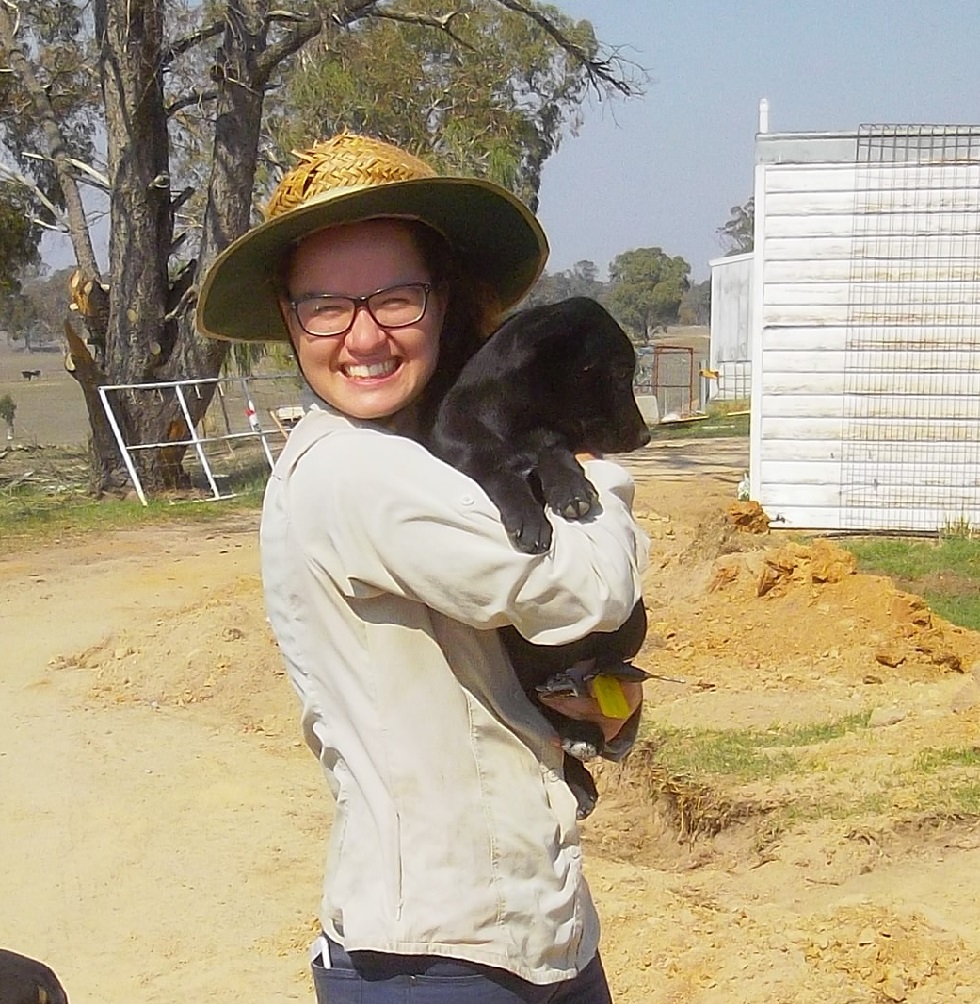
PhD candidate Jess Lawton (La Trobe University): Results of Connecting Country’s Brush-tailed Phascogale monitoring
RSVP is essential if you wish to join us for dinner.
For more information and bookings email tanya@connectingcountry.org.au or phone 5472 1594.
To view our flyer for the event: click here
This threatened species forum is generously supported by the Helen Macpherson Smith Trust via our Habitat Health Check project.

Water workshop with Muckleford Catchment Landcare
Posted on 18 September, 2018 by Asha
Let the rain run in, not off – an introduction to landscape function on a farm in transition
Join Muckleford Catchment Landcare at a workshop on how water functions in our landscape, presented by Muckleford landowner and ecologist, Paul Foreman, and land planning consultant, David Griffith.
Do you have cleared paddocks and want them to be more healthy and productive from both farm and conservation perspectives? Have these experts answer your questions about how you want your property to work.
Date: Sunday 23 September 2018
Time: 10 am to 12 noon
Location: Paul’s property at 678 Lewis Road, Muckleford VIC
Parking behind the house. Morning tea provided.
Please RSVP to Beth via email or call on 0431 219 980.
Learn about landscape connectivity: science and practice
Posted on 18 September, 2018 by Asha
Newstead Landcare are hosting an interesting talk this Thursday.
Dr Jim Radford (Principal Research Fellow from the Research Centre for Future Landscapes, La Trobe University) will talk about the science and practice of connecting landscapes, what works and what we should be aiming for in landscape restoration projects.
Jim will focus on the benefits of revegetation in restoring rural landscapes, guiding principles for landscape restoration, and priorities and guidelines to improve landscape connectivity.
Landscape connectivity: science and practice
Venue: Newstead Community Centre, 9 Lyons Street Newstead VIC
Date: Thursday 20 Sept 2018
Time: 8 pm to 9 pm followed by supper
A gold coin donation would be appreciated to help cover costs.

Fabulous fauna photos required for FOBIF exhibition
Posted on 13 September, 2018 by Tanya Loos
The theme of the next Friends of Box Ironbark Forests (FOBIF) photo exhibition is Creatures, and they are seeking entries now.
TOGS Cafe in Castlemaine will host the exhibition in November 2018.
So if you have a favourite photo/s of wildlife in our region send them along to FOBIF (info@fobif.org.au). Get cracking and select your fave pics: the closing date for the submission of photos is 1 October 2018.
Bronwyn Silver has kindly supplied some beautiful photos of local fauna for some inspiration.
For more info and the submission guidelines, see the FOBIF website here.
-

Koala. Photo by Patrick Kavanagh
-

Red Wattlebird, by Vivienne Hamilton
-

Spotted Pardalote, by Patrick Kavanagh
Baringhup Birds on Farms workshop – a great partnership event
Posted on 13 September, 2018 by Tanya Loos
On 9 September 2018 about forty people gathered on a beautiful property in Baringhup to learn about Birds on Farms. The day was a joint workshop by Connecting Country and Baringhup Landcare, and the participants ranged from Connecting Country regular workshop enthusiasts, bird survey volunteers, farmers from in and around the Baringhup area and Landcare members.
Two bird surveys were conducted down on the bird survey area. Curiously each survey recorded 13 birds, though each time the species composition was different! The surveys may be seen here and here. A few new species were recorded on the day – including the Grey Fantail.
Many thanks to Roy and Caroline Lovel for being such wonderful hosts, and all the many helpers on the day, especially Jackie Brown who helped Roy wash up all the bowls and cups!
Attendee Liz Burns wrote this wonderful summary of the day. Thanks Liz!
Birds On Farms workshop
As a long-term attender of Connecting Country’s field days, it was a pleasure to take up Tanya’s request for someone to write up today’s events. In fact, I could write a book with all the detailed notes that I’ve taken over the years.
As usual, this one hit the mark and maintained the usual high standard.
As a full-time biological farmer who relies upon our native birds for pest control and even some pollination services, and a keen lifelong observer of all the complex relationships in nature, this is a subject dear to my heart. It was even more heartening to meet other like-minded farmers with the added bonus of passionate protectors of very old trees.
To read Liz’s detailed notes of the speakers’ presentations click Birds-On-Farms-Field-Day-write-up
After lunch we did separate farm and birds walks: Roy led a group up to the top of the property, and Tanya and Chris conducted a bird survey on a lower restoration area.
I would like to see the Connecting Country model rolled out across the State, as the best value for money blending of agriculture, environment and Indigenous history, especially as 70% of the State is in private hands and the State does not manage Crown Land very well (in my opinion). If farmers could be helped with managing their land, incorporating environmental and cultural values, we could maximise biodiversity and future food production with a three-way partnership with farmers, environmentalists and Traditional owners.
As usual, the catering, the company and weather was of the highest standard.
Grateful thanks must go to Connecting Country and all involved, but in particular Tanya Loos for yet another fascinating and informative day.
Liz Burns, Trewella Farm, Musk
Please scroll through the following gallery of photos from the day.
-

Roy points out some valuable understorey plants (photo: Frances Howe)
-

The lunch was delicious! (photo: Frances Howe)
-

Colin Jennings and Tanya Loos (photo: Roy Lovel)
-

Looking across the Baringhup Landscape (photo: Frances Howe)
-

On top of the world! (photo: Frances Howe)
-

An incredible outlook (photo: Frances Howe)
-

Chris Timewell talks birds (photo: Tanya Loos)
‘Future-proof your restoration’ seminars
Posted on 6 September, 2018 by Tanya Loos
The recent ‘Future-proof your restoration’ seminars brought the local community together with relevant experts to discuss and share the issues we face in landscape restoration, especially the challenge of our changing climate. Seminar one (Friday 24 August 2018) explored ‘Weeds to watch’. Seminar two (Friday 31 August 2018) addressed ‘Planting for the future’.
Our excellent guest speakers shared a wealth of knowledge and experience, and their expertise was warmly received by an enthusiastic audience at both events.
Thank you to everyone who helped make these seminars successful, including our presenters, the Landcare Steering Group, and volunteers who helped behind the scenes. The seminars were funded by the North Central Catchment Management Authority, through the Victorian Landcare Program, and organised by Asha Bannon, Connecting Country’s Landcare Facilitator.

Everyone gathered to listen to our guests speak about ‘Weeds to watch’
Read on for short summaries of each event, and click on the presentation titles to download a copy of the slides. Keep an eye out for another blog post coming soon, with links to copies of the resources we had available at the events.
Weeds to watch
David started us off by talking about the ecology of weeds, and how they affect us and the environment. He gave useful advice about the most strategic ways to manage weeds effectively. David encouraged us to look at ‘absences’ of weeds on our properties and project areas, to learn to appreciate what we have achieved rather than be overwhelmed by the weeds we have yet to control. John then shared information about grassy weeds – those that are a problem now, and those that are likely to become a bigger issue with climate change. He stressed the importance of early detection and eradication of new and emerging weeds, plus better practices to reduce their spread in the first place. For details see:
- David Cheal – ‘Weed attack strategies and plans’
- John Morgan (LaTrobe University) – ‘Perennial grass weeds that will threaten nature’
Planting for the future
The three presentations were very different and complemented each other beautifully! Jeroen spoke passionately about the urgent need for large-scale landscape restoration, based on his work on Bush Heritage properties in the Wedderburn and St Arnaud area – particularly the Nardoo Hills. Sacha clearly outlined a practical way to approach revegetation that buffers the changing climate, and uses scientific monitoring to guide us in that approach. Brian took us down to the square metre level as he recounted the tale of the restoration of an urban waterway, and the return of bush birds such as Brown Thornbills to the Merri Creek. Brian also talked about the struggle many of us face when it comes to accepting and adapting to the new approaches needed to future-proof our restoration.
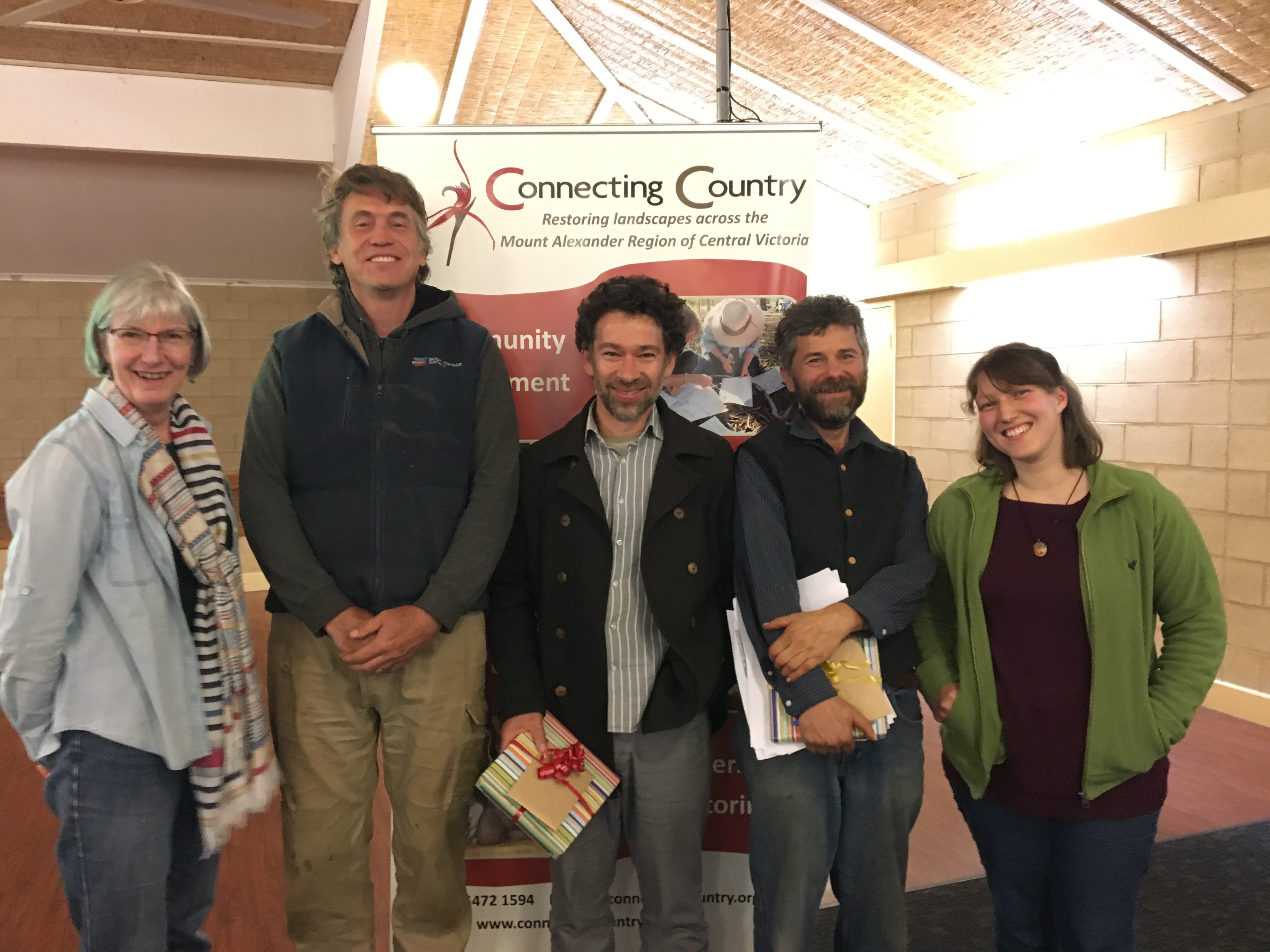
From left to right: Chris from Connecting Country, Jeroen, Sacha, Brian and Asha.
For details see:
- Jeroen VanVeen (Bush Heritage) – ‘Woodland stress: signs of times to come?’
- Sacha Jellinek (Greening Australia) – ‘Developing guidelines for Climate Future Plots in Victoria’
- Brian Bainbridge (Merri Creek Management Committee) – ‘Taking actions from modelling to reality’
Celebrate Landcare Month!
Posted on 30 August, 2018 by Asha
September 2018 is Landcare Month! With Spring here at last, it’s the perfect time to get outside, get your hands dirty, and connect with other community members. We have 30 groups in the Mount Alexander region alone, so it’s easy to find an event or working bee that’s near you and suits your interests.
Visit http://connectingcountry.org.au/events/ to find Landcare events happening near you in September, or contact asha@connectingcountry.org.au for more information.

Bonnie and Sutton Grange Landcarers admiring some Silver Banksias
Baringhup Birds on Farms Workshop – Sunday 9 September
Posted on 22 August, 2018 by Tanya Loos
Join us with Baringhup Landcare and others interested in habitat restoration at Roy and Caroline Lovel’s property to explore the benefits of birds on farms
The Lovels live on a beautiful 60 hectare property at Baringhup, north of Maldon. Over the past 25 years they’ve revegetated much of the property, with a strong emphasis on supporting and sustaining bird habitat.
Research shows that increasing bird populations and diversity enhances productivity of crops, orchards and grazing land. Birds contribute to the long term health of old paddock trees, sustain native vegetation, and bring joy with their colour and song.
- Roy and Caroline Lovel will introduce you to their property and their motivation and vision.
- Colin Jennings will speak about his experience as a landholder with responsibility for private land within Bells Swamp, wildlife corridors, and efforts to balance farm production and the environment.
- Tanya Loos from Connecting Country will take participants on a bird walk visiting the long term bird monitoring site on the Lovel’s property.
- Chris Timewell, coordinator of the Birds on Farms project at BirdLife Australia, will discuss various approaches to improving woodland bird habitat on rural properties.
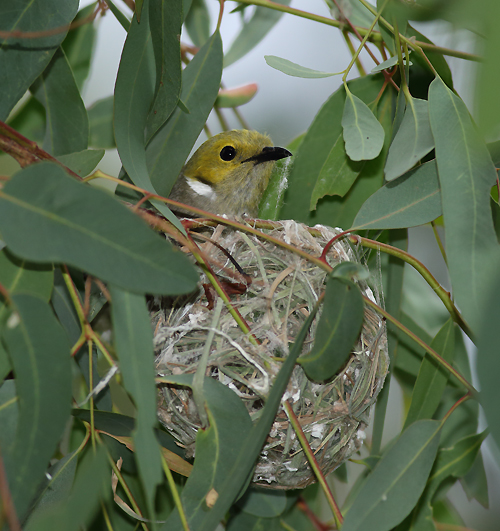
White-plumed honeyeaters are commonly seen in River Red Gum paddock trees. In this photo by Geoff Park, a honeyeater adds cobweb to a delicate cup nest in a eucalypt sapling.
Donations are always welcome, and feel free to bring a plate of nibbles to share.
When: Sunday 9 September from 9:30 am – 2:30 pm
Where: 49 Hayes Rd, Baringhup VIC
This is a free event. We will serve a light lunch of soup and rolls.
What to bring:
*Shoes and clothing appropriate for walking outside in the bush.
*Binoculars if you have them (we’ll also provide some).
RSVP: Bookings and enquiries to Tanya Loos tanya@connectingcountry.org.au or call our office on 5472 1594
FOBIF AGM: Monday 27 August 2018
Posted on 21 August, 2018 by Asha
 Ian Higgins, well known local landcarer and co-founder of Friends of Campbells Creek Landcare, will be the speaker at the upcoming Friends of the Box-Ironbark Forests (FOBIF) AGM on Monday 27 August 2018.
In an article about Ian after he received the Australian Government Individual Landcarer Award in 2017, the Victorian Landcare Magazine wrote:
Higgins’ early interest in native plants has continued through his life. He developed a remarkable knowledge of indigenous flora species, their propagation and revegetation, leading to a 30-year professional career during which he has contributed significantly to revegetation and environmental planning in Victoria, in both professional and voluntary capacities.
You can find out about Ian’s history of involvement in environmental projects here.
Topics he will cover in his FOBIF speech will include:
- Changes in our landscape and vegetation since colonisation, including the profound local impacts of gold mining and the consequences of a European mindset.
- A short history of rehabilitation efforts, including the contribution of Landcare groups.
- Is aiming for something more like the pre-European condition viable? Given that we’ve already lost many components of the ecosystem, together with massive invasions of exotic species and climate change, what should our local landscape and vegetation management goals be?
The meeting will start at 7.30 pm in the Ray Bradfield Room, Castlemaine VIC (next to Mostyn Street IGA supermarket). Information on how to nominate for the FOBIF Committee can be found here. All welcome and supper will be served.
A watery Landcare Link-up
Posted on 8 August, 2018 by Asha
It was a dark and stormy night when Landcarers from around the region gathered in Campbells Creek. Our guest speakers included Trent Gibson (North Central Catchment Management Authority), Barry Floyd (Coliban Water), Brett Thompson (Coliban Water) and Mark Bailey (Goulburn Murray Water).
Trent started us off by talking about some of North Central CMA‘s current local projects. You can CLICK HERE to download his full presentation (2 Mb). Among other things, he talked about the new Castlemaine Creekways Management Plan developed by Mount Alexander Shire in partnership with Friends of Campbells Creek and Castlemaine Landcare Group.
Next we heard from Barry and Brent from Coliban Water, each covering different aspects of their work. They encouraged groups to keep an open mind about where partnerships can come from, and to consider the public health benefits of Landcare work and ways to partner with Coliban Water-funded projects.
Mark from Goulburn Murray Water (GMW) finished the event. He explained that GMW covers an area the size of Tasmania, and encouraged groups to have a look at the plans on the GMW website. During question time, Mark also directed us to the interactive map on the Visualising Victoria’s Groundwater website.
One of the big takeaways from the night was that water management is a complex issue, and we merely scraped the surface in this jam-packed evening. All four speakers stressed their support for government-community partnerships, and an interest in working with more Landcare groups. Speakers emphasised that the way our waterways are managed has changed significantly in the last 30 years, and we need to continue to adapt with the changing climate.
Thank you to all of our guest speakers, and to the representatives from eleven Landcare and Friends groups who came along and contributed to the discussion. Thanks also to the volunteers who helped plan and implement the Link-up, included the Landcare Steering Group, and Daryl for picking up our soup!

Beautiful Baker’s Swamp, by Geoff Park
‘Future-proof your restoration’ seminars
Posted on 7 August, 2018 by Asha

Golden Wattle, by Tanya Loos
Come along and learn about how we can prepare our environment for a changing climate at two upcoming seminars. This is a chance to hear from experts in the field, share ideas, and browse through useful resources.
We have some truly amazing guest speakers lined up to talk about topics that are relevant to Landcare groups and landholders working to restore their land for the environment.
SEMINAR 1: WEEDS TO WATCH
Guest speakers:
- David Cheal – ‘Weed attack strategies and plans’
- John Morgan (LaTrobe University) – ‘Perennial grass weeds that will threaten nature’
When: Friday 24 August 2018, 5:30 pm – 8:30 pm
Where: Campbells Creek Community Centre, 45 Elizabeth St, Campbells Creek VIC
RSVP: by Monday 20 August for catering purposes to asha@connectingcountry.org.au
SEMINAR 2: PLANTING FOR THE FUTURE
Guest speakers:
- Jeroen VanVeen (Bush Heritage) – ‘Woodland stress: signs of times to come?’
- Sacha Jellinek (Greening Australia) – ‘Developing guidelines for Climate Future Plots in Victoria’
- Brian Bainbridge – ‘Taking actions from modelling to reality’
When: Friday 31 August 2018, 5:30 pm – 8:30 pm
Where: Campbells Creek Community Centre, 45 Elizabeth St, Campbells Creek VIC
RSVP: by Monday 27 August for catering purposes to asha@connectingcountry.org.au
CLICK HERE to download the flier, or contact Asha on (03) 5472 1594 or at asha@connectingcountry.org.au for more information.
This event is funded by the North Central Catchment Management Authority, through the Victorian Landcare Program.
Come and hear about Scientific monitoring at Connecting Country: a community effort – Friday 13 July 2018
Posted on 12 July, 2018 by Tanya Loos
Castlemaine Field Naturalists Club is hosting a guest speaker, our very own Tanya Loos, talking about Scientific monitoring at Connecting Country: a community effort.
Woodland birds, arboreal mammals, frogs and reptiles – what can these critters tell us about landscape health? Tanya Loos, Connecting Country’s Monitoring and Engagement Coordinator, talks about the organisation’s long term monitoring programs – how and why they were created, and what we have found so far. There will be a special emphasis on the contribution volunteers have made to the program’s success.
Tanya has worked with Connecting Country for four years, and whilst mainly a birdo, is also a field naturalist and science writer. She lives on a bush block in Porcupine Ridge with her husband, dog and a number of rescue budgies and cockatiels.
The evening event will be from 7.30 pm on Friday 13 July 2018 in the Fellowship Room (behind the Uniting Church on Lyttleton St, Castlemaine VIC, next door to the Castlemaine Art Museum). There is no cost for entry, and both members and visitors of all ages are welcome and encouraged to attend. We look forward to seeing you there.

Cullen speaks to the Wild Melbourne film crew, next to wattles growing from direct seeding.
The talk will be followed by an field excursion at 1.30 pm on Saturday 14 July 2018.
The excursion will be to Cullen Gunn’s property in Otterys Scrub Rd, Walmer. Cullen’s property is a former grazing property with many large old trees, and an extensive revegetation program involving three separate projects with Connecting Country. We will be able to see direct seeding revegetation in various stages of regrowth. The site has a long term bird survey site, and has recently been colonised by a population of Brush-tailed Phascogales, a sure measure of success!
Depart at 1.30 pm from the car park opposite the Castle Motel on Duke St, Castlemaine (next to the Octopus building). Bring afternoon tea, raincoat and suitable footwear.
BirdLife Castlemaine District launch and Swift Parrot conservation
Posted on 10 July, 2018 by Tanya Loos
You have seen it here first, folks! The group’s new logo!
Many excited faces gathered at the Castlemaine Botanic Gardens Tearooms on Saturday 7 July 2018, as we celebrated the launch of BirdLife Australia’s newest branch – BirdLife Castlemaine and District. The launch also incorporated an ‘Act for Birds’ Roadshow – a community forum on how we can encourage stronger environmental laws to help safeguard threatened species such as the Swift Parrot.
We began the afternoon with a Welcome to Country from Uncle Rick and Kane, and Uncle Rick talked about the significance of birds to the Dja Dja Wurrung. Fiona Blandford (Branch Network manager) and Jane Rusden (BirdLife District Convenor) formally launched the new branch, with a lovely nod to Connecting Country and our work to build community interest in birds on our region.
Brendan Sydes (Connecting Country president), in his role as lawyer and CEO of Environmental Justice Australia, gave a rousing introduction to the potential for positive change to environmental laws in this country.
Beth Mellick (of Wettenhall Environment Trust) is the regional coordinator for the local Swift Parrot counts done twice a year. Beth gave a wonderful talk on our local swifties and the power of citizen scientists, including showing an excerpt from Debbie Worland’s DVD, the Swift Parrots of Muckleford in Central Victoria. The DVD shows never-seen footage of Swift Parrots filmed entirely in Muckleford over a five-year period by Debbie Worland, a member of the Castlemaine Field Naturalists Club. For infomation about the DVD, email swiftparrotsofmuckleford@hotmail.com. If you would like to be involved in the Swift Parrot count later this year, email Beth at beth@wettenhall.org.au.
We then heard from our main speaker – Kim Garrett (Conservation Community Organiser for BirdLife Australia). Kim spoke passionately and eloquently on how our current laws are failing threatened species in Australia, and what we as community members can do about it. Many policy and environmental law experts have prepared a detailed case for how environmental laws could be strengthened in our country, and the Act for Birds campaign summarises the case succinctly.
In a nutshell, the campaign calls for us to:
- Create national environment laws that genuinely protect our unique birdlife.
- Establish independent institutions that set national environmental standards, and operate transparently and independently of government.
- Guarantee community rights and participation in environmental decision-making.
To get involved, head on over to www.actforbirds.org to sign the petition and get some tips on engaging with your local member.
The Swift Parrot is Critically Endangered and numbers are still declining due to serious loopholes in current environmental laws. The current laws are up for a twenty year review, so now is an ideal time to act.
Please enjoy this gallery of photos of some of the attendees. Many thanks to the staff from BirdLife for travelling to Castlemaine to share in the excitement, to the committee and volunteers of BirdLife District Castlemaine for planning and logistics, Uncle Rick and Kane, the presenters, and to Jane Rusden for pulling the whole event together!
The contact email for the new branch is castlemaine@birdlife.org.au and our new Facebook page is BirdLife-Castlemaine-District
-

Fiona Blandford launches the new branch to a full house!
-

Bird survey volunteer Sue Boekel and presenter Kim Garrett
-

BirdLife Castlemaine District secretary and convenor!
-

Beth Mellick and Chris Timewell
-

Screen printing fun… of birds of course 🙂
-

The press shot – by Albert Wright.
For a great overview of the Swift Parrot and the ‘Act for Birds’ campaign, see this article in the Bendigo Advertisor: renewed-focus-to-save-castlemaines-migratory-parrots/
BirdLife Celebration and Roadshow – 7 July 2018
Posted on 28 June, 2018 by Frances
BirdLife is coming to town, so put 12:30 – 3:00 pm on Saturday 7 July in your diaries folks. Join us at the Tearoom in Castlemaine Botanic Gardens (2 Walker Street, Castlemaine VIC). There will be celebrations, information on how we, the grassroots, can really make a difference, and an art activity for the kids.
BirdLife is bring its ‘Act for Birds’ Roadshow to Castlemaine, with plenty of ideas on how you and I can make a real difference for the natural environment.
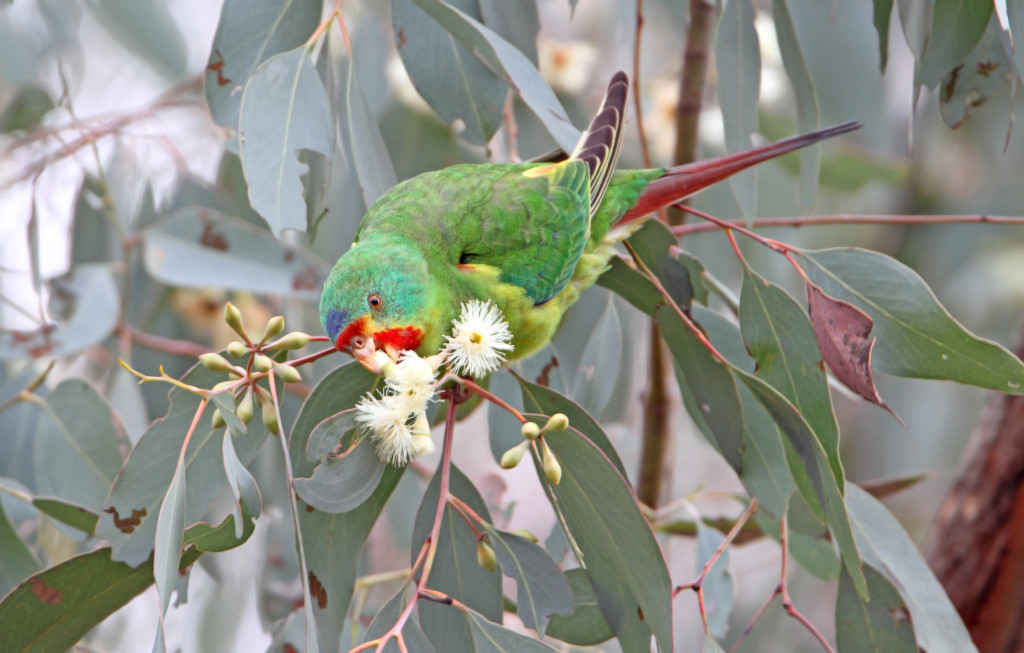
The stunning Swift Parrot needs our help to save it from extinction. (Photo by Chris Tzaros)
Drum roll please …… We have a new group in the area: Castlemaine District BirdLife Branch, for all bird enthusiasts and aspiring bird enthusiasts, as well as those who are just curious or like birds a little bit. On offer will be monthly bird outings, some talks and a chance to meet like-minded people, across all age groups. Come along, find out more and meet some of us.
Jane Rusden, Convener Castlemaine District BirdLife Group