
Fencing Field Day: Friday 27 March
Posted on 5 March, 2026 by Bonnie Humphreys
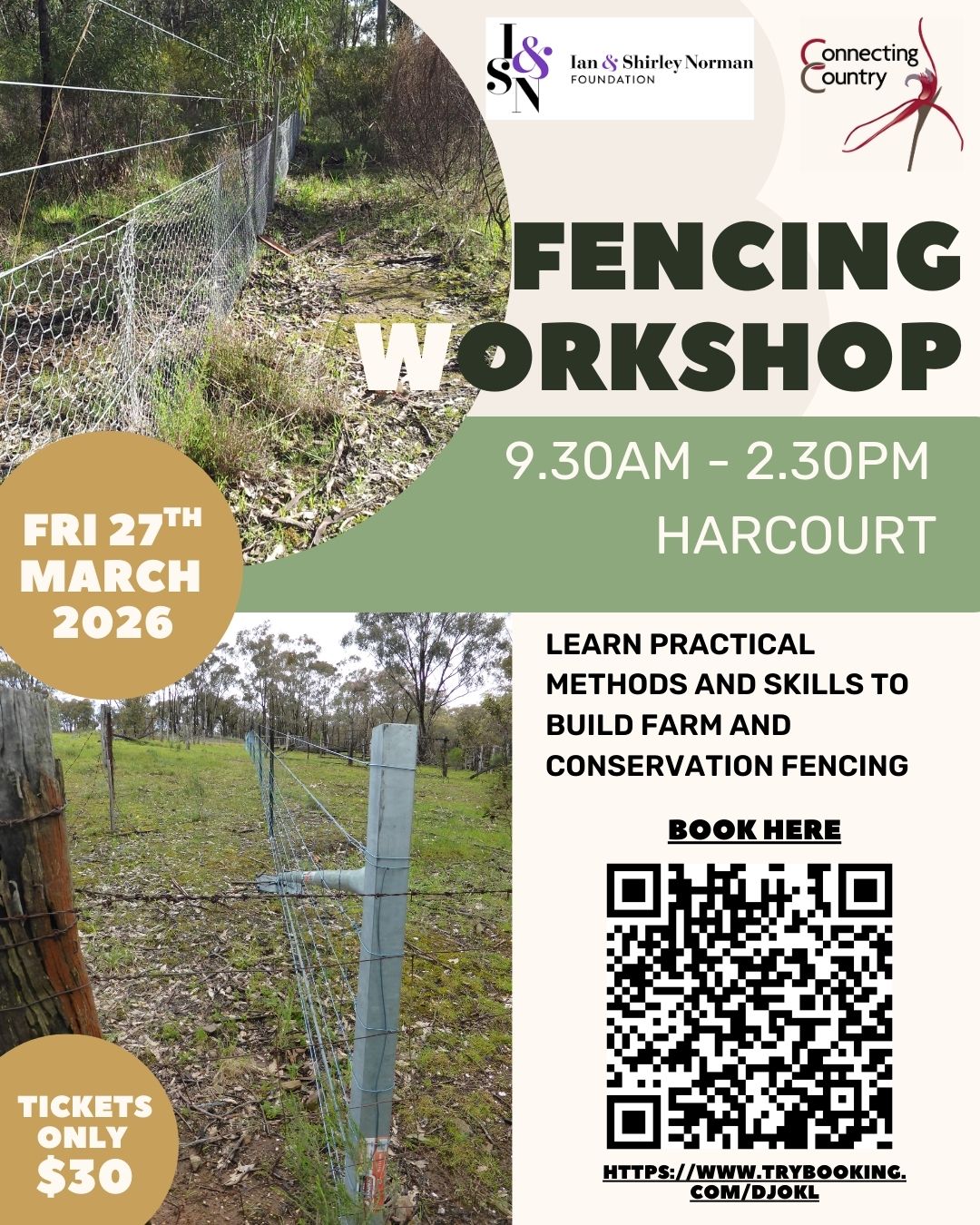
Connecting Country is pleased to be presenting a Fencing Field Day.
Whether you are looking to learn how to fix or maintain your own fences for stock, or build exclusion fences for vegetation, or maybe looking to volunteer to help others build fences, this is the workshop for you.
Working with an experienced local fencer and farmer, this workshop will give participants a practical and hands-on education on aspects of building farm and environmental fencing. There are also opportunities to learn how to retrofit farm fencing to exclude rabbits, or other pest species.
The day will be held at a property in Harcourt where participants will learn from start to finish how to construct a fence, with insights into all those little time saving tricks that experience brings.
Lunch and afternoon tea will be provided.
When: Friday 27 March 9.30 am to 2.30 pm
Where: Harcourt (Venue information provided after booking)
Tickets only $30 Register here
This workshop is funded with support from the Ian and Shirley Norman Foundation.
Bird walk with Birdlife Castlemaine at private property in Yapeen – Saturday 7 March 2026
Posted on 26 February, 2026 by Lori
BirdLife Castlemaine District holds monthly bird walks on the first Saturday morning of each month, and all ages and birding abilities are welcome. Walks last for about two hours.
The March bird walk will be on a very special private property belonging to Max Kay in Yapeen (near Guildford). As well as his role as Connecting Country’s Treasurer, Max has a strong commitment to restoring habitat on his historical farm property. With the help of Connecting Country and other groups, he has set aside areas to protect remnant vegetation, restore creekline and reintroduce understorey plants. Over time these actions have improved habitat for birds and other animals.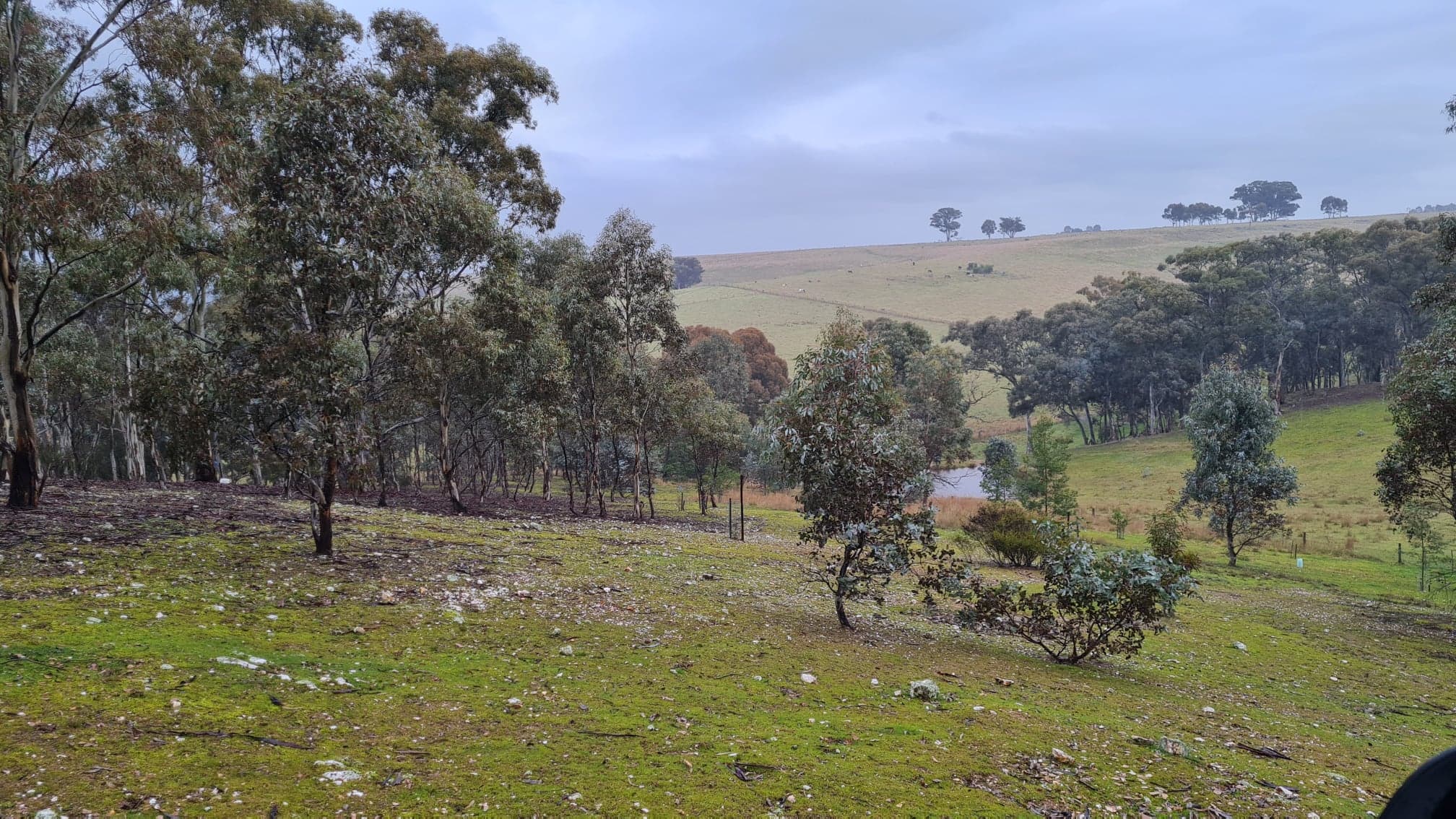 Private properties often give us a unique experience to see birds in areas that are less disturbed, so we’re hoping for some interesting birds. Possible sightings for the area include honeyeaters (Yellow-faced, White-plumed, Yellow-tufted and New Holland Honeyeater) and raptors (Whistling and Black Kite, Goshawk, Sparrowhawk). Thornbills, Pardalotes and many other local species are also possible.
Your walk leaders are Max Kay, Frances Howe and Bob Dawson.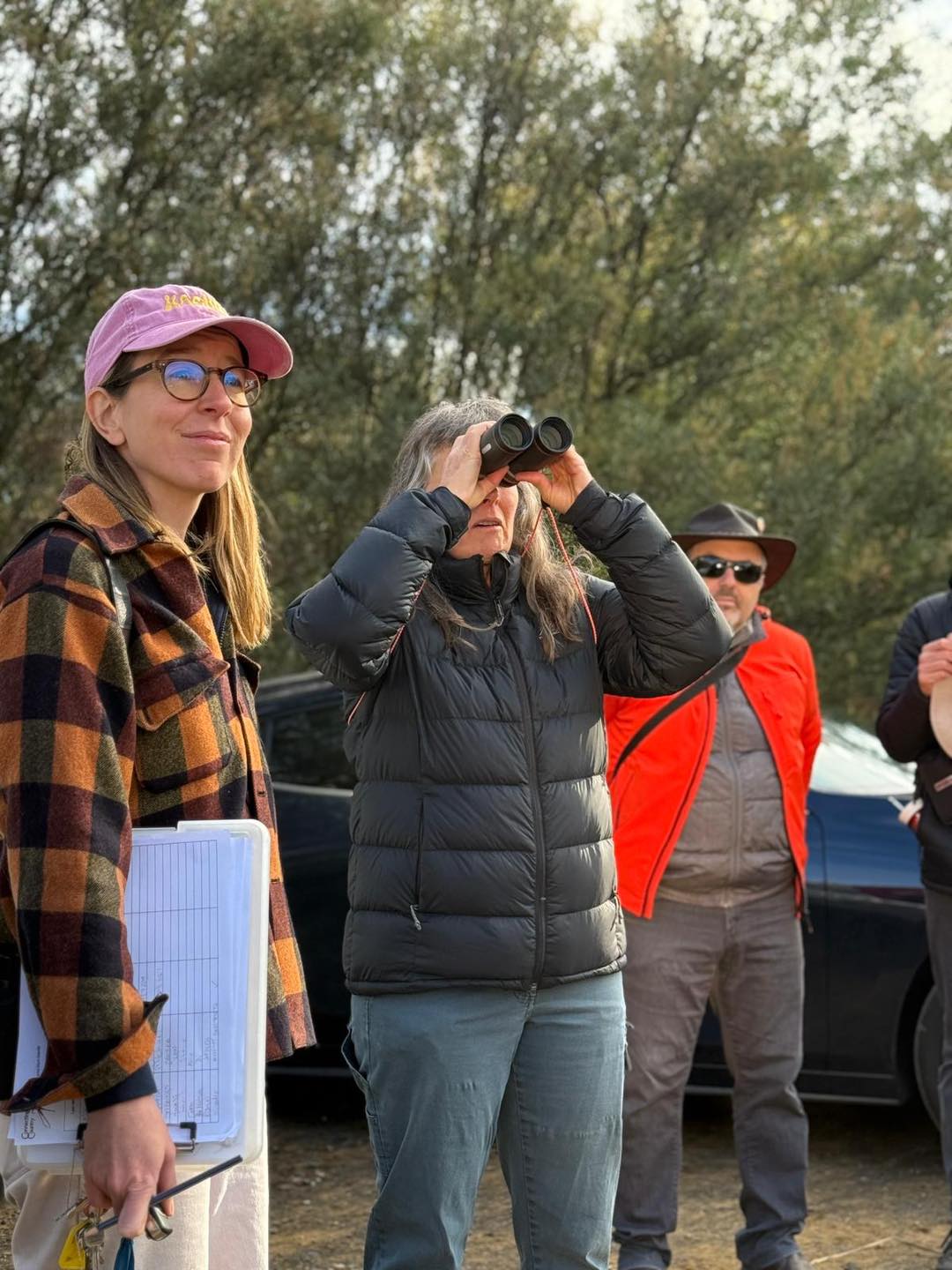
ALL WELCOME!
Where: Max Kay’s property, 7281 Midland Hwy, Yapeen VIC, is located approx. 9.4 km from Castlemaine along the Midland Hwy (A300). Travel toward Guildford and Max’s driveway is on the right, approximately 260 m past the Vaughan Springs turnoff. There is a large white letterbox and a post with numbers 7281 attached. Drive down to the area in front of the house. GPS: -37.13206, 144.17318. Google Maps Link is here.
When: Meet at 9:00 am.
Bring / wear: Water, snacks, binoculars, sunscreen, hat, long trousers and sturdy closed-in shoes (for snake protection).
More info: Jane Rusden 0448 900 896, Bob Dawson 0417 621 691
BirdLife Castlemaine works closely with Connecting Country, including supporting Connecting Country’s long-term woodland bird monitoring. New bird survey volunteers are needed to contribute to this valuable database. Please contact Connecting Country if you’re a birder and interested in helping.
For more information about BirdLife Castlemaine’s activities, please visit the Birdlife Castlemaine District website.
Clean Up Australia Day – Sunday 1st March 2026!
Posted on 26 February, 2026 by Lori

Together, we can make a big, positive impact on our environment – one piece of litter at a time!
Clean Up Australia Day is an annual nationwide event focused on empowering local communities to clean up, fix up and conserve the natural environment.
Registration for Clean Up Australia Day is free for communities and schools (businesses pay a small fee). Registration ensures groups are covered by the public liability insurance, and groups also receive a free Clean Up kit with all the materials required to host a safe and successful event.
Local Landcare and Friends groups of the Mount Alexander/ Leanganook region often host a Clean Up Australia Day event. Please see below a list of local events happening across our region or to find events happening near you – click here .
Campbells Creek and surrounds – Friends of Campbells Creek Landcare Group
Help to clean up rubbish along the creeks & trails, followed by a social morning tea.
Where: meet at the bus shelter next to Winters Flat Footbridge, opposite 61 Johnstone Street (Midland Highway), Castlemaine, and then spread to various locations to gather rubbish and return it to a skip at Winters Flat. e (for google map link: click here)
When: Sunday 1 March 2026, 8am-10am
What to bring: hats, gloves, sturdy clothing, enclosed boots/shoes, sun protection, a rake if you have one, your own water (and a friend). Morning tea provided.
Expedition Pass Reservoir – Golden Point Landcare Group
Did you enjoy the Res this summer? Come along for the annual Clean Up event that keeps the Res clean and beautiful!
Where: Meet at Expedition Pass Reservoir (The Res), Golden Point Rd. Golden Point
When: Sunday 1 March 2026, 10.00 am
What to bring: Hats, sunscreen, sturdy footwear, water bottle, gloves and a friend!
Barkers Creek Reservoir – Harcourt
Did you enjoy the Res this summer? Come along for the annual Clean Up event that keeps the Res clean and beautiful!
Where: Meet at the toilet block at Barkers Creek Reservoir
When: Sunday 1 March 2026, 10.00 am
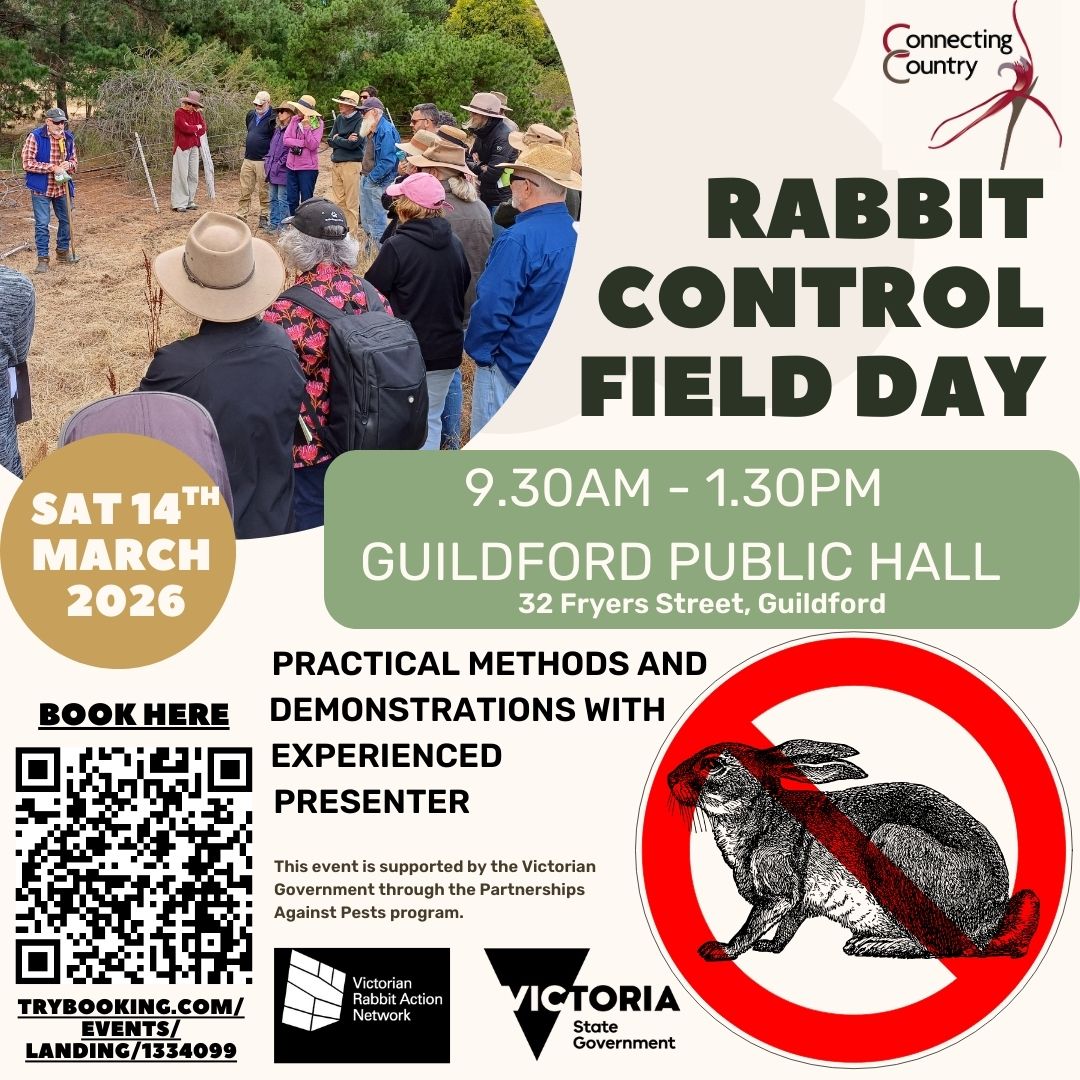
Rabbit Control Field Day – Book Now!
Posted on 23 February, 2026 by Bonnie Humphreys
Connecting Country in partnership with Guildford and Upper Loddon Landcare Group and the Victorian Rabbit Action Network (VRAN) is pleased to present a Rabbit Control Field Day in Guildford.
Saturday 14 March 2026 – 9.30am to 1.30pm
Rabbits have been in our landscape now for over 100 years and we still have not managed to successfully control them. We do however have research into the best methods and the most successful techniques. Now is the best time of year to implement them.
February and March are a particularly good time of year to get on to rabbit control as natural food in the environment is low. Using a range of methods in the right order (‘integrated pest management’) and at the right time of year will ensure you the most success with the least effort.
VRAN have been working on identifying the most successful recipe for control and passing on their knowledge though workshops, practical demonstrations and providing educational resources. We are lucky enough to be able to bring them to Guildford to share this knowledge with you.
There will be a presentation in the morning, followed by a field trip and discussion on site. All located close to the centre of Guildford. Morning tea and lunch will be provided.
We are also inviting local contractors who would like to be part of the event, to get in touch with us at info@connectingcountry.org.au This can be a great opportunity to introduce yourself to local landholders and Landcare representatives.
This event is free but registration is required for catering purposes.
Register: https://www.trybooking.com/DJJOI
Life with Birds: A collaboration with the Newstead Arts Hub and Castlemaine State Festival
Posted on 19 February, 2026 by Hadley Cole
Life with Birds is an immersive celebration of the birds and woodland ecosystems of central Victoria. A distinguished collaboration of writers, artists, photographers, sound recordists, field naturalists and scientists will enable participants to enjoy and learn on the path to a deeper appreciation of the richness of our bird life in the face of many challenges, especially that of global climate change.
There will be six events conducted in collaboration with the Newstead Arts Hub and the Castlemaine State Festival.
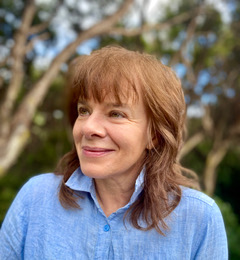
Carrie Tiffany by Eve Owen Jan 2025
Saturday 21 March | 11.00am – 2.00pm| Carrie Tiffany: Mateship with Birds Creative Writing Workshop
Carrie, a former park ranger, has twenty years’ experience as a researcher, writer, editor and teacher of creative writing. Her novel, Mateship with Birds, won the inaugural 2013 Stella Prize. Geoff Park will share an ‘in conversation’ with Carrie, before she leads a bird-themed Creative Writing Workshop. No writing experience is needed.
Workshop ticket: $100
Venue: Newstead Arts Hub
For more information and bookings – click here
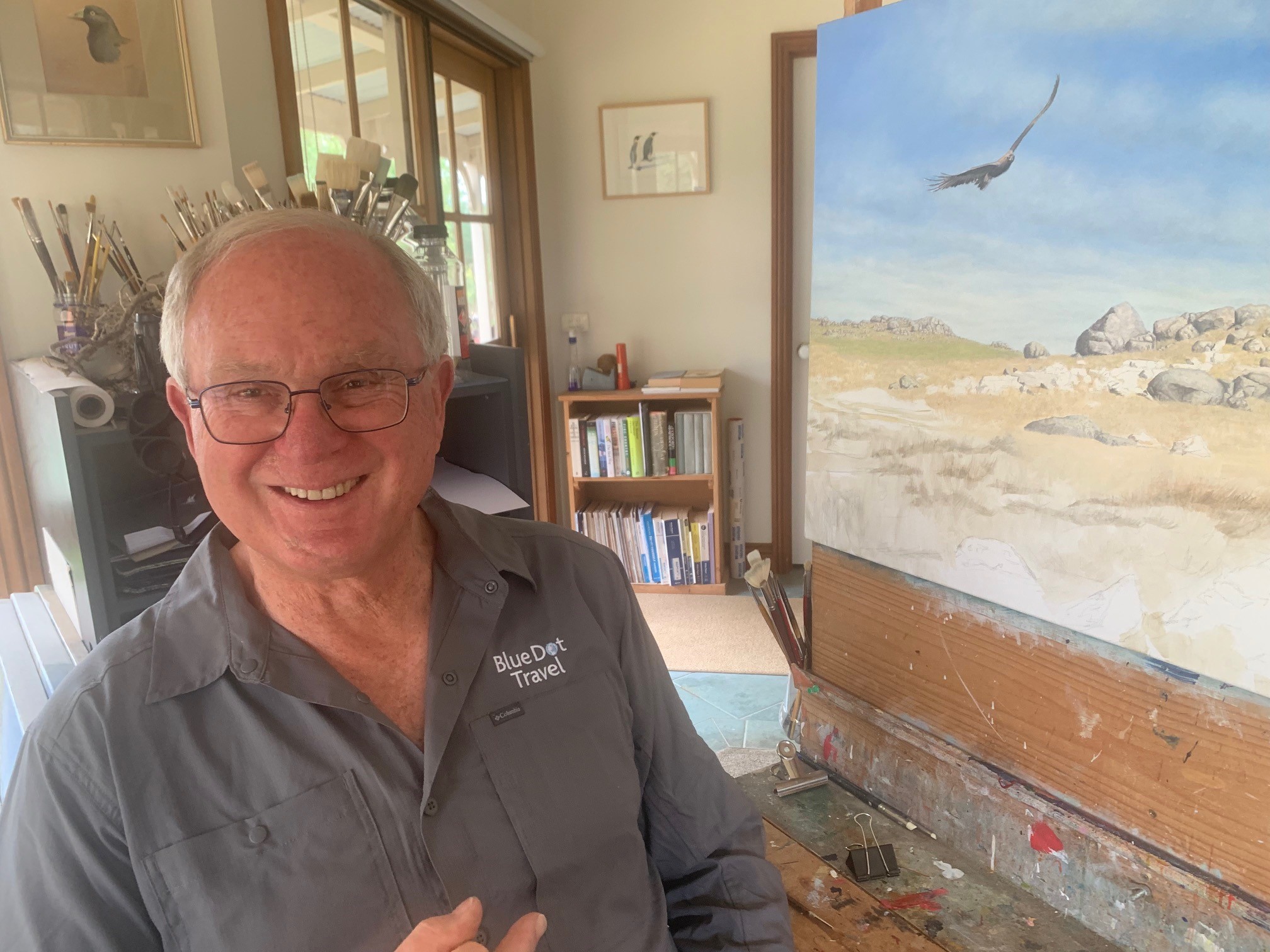 Sunday 22 March | 11.00am – 2.00pm | Richard Weatherly: A brush with woodland birds Woskshop
Richard is an iconic Australian artist, conservationist and innovative farmer. With over fifty-five years of professional experience, Richard will draw on his acclaimed illustrated works, such as The Fairy-Wrens and A Brush with Birds, as he leads this workshop. Materials provided, though participants are welcome to bring their own.
Workshop ticket: $100
Venue: Newstead Arts Hub
For more information and bookings – click here
 Monday 23 March | 7.30am- 12.30pm | Lawrie Conole: The ‘Difficult’ Bird Search
The Newstead district is an Important Bird and Biodiversity Area (IBA) with sites identified as being internationally significant for the conservation of birds and other biodiversity. It is home to a suite of ‘difficult’ birds, those that are cryptic, declining and often just plain hard to find species that call our local bush home.
Lawrie will introduce you to some of these characters and their habits, including their distinctive songs. It will then be your mission, should you choose to accept it, to venture to a selection of local sites where, armed with some new skills and information, you’ll hopefully encounter some of them such as Speckled Warbler, Chestnut-rumped Heathwren, Painted Button-quail, Hooded Robin, Spotted Quail-thrush, or even a Crested Bellbird.
Event ticket: $20
Venue: Newstead Arts Hub
For more information and bookings – click here
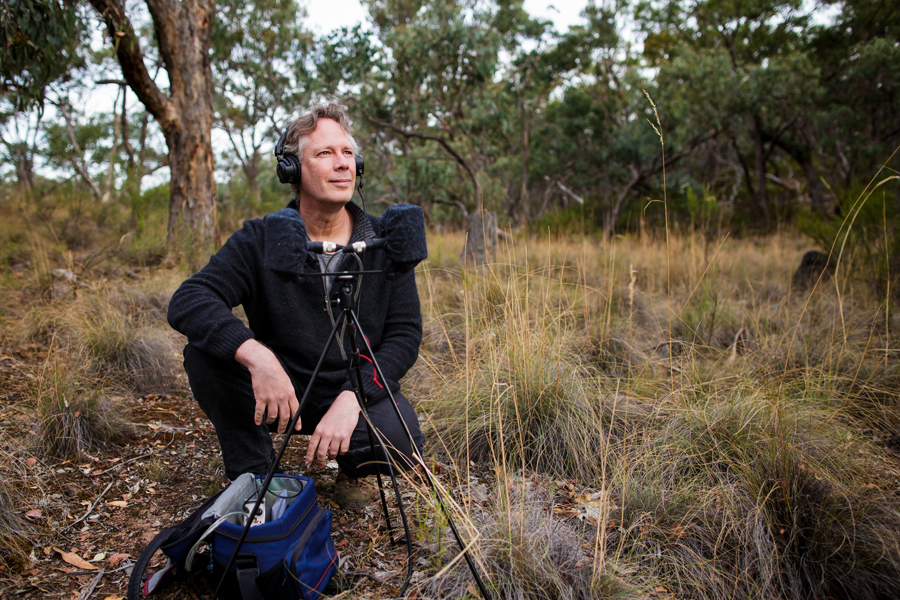 Wednesday 25th March | 7.00 – 9.00pm | Andrew Skeoch: The wild bird soundscapes of our woodlands
Learn the songs and calls of some of our rarer bird species! This immersive one-hour presentation will introduce the importance of sound for species ID, monitoring, and assessing the state of our local habitat. This will be followed by a session for those interested to share their observations of local birdlife/wildlife occurrences/movements, and to introduce a future project.
Andrew Skeoch is a professional wildlife sound recordist, acoustic ecologist and author of ‘Deep Listening to Nature’. He has given presentations to audiences ranging from festivals such as WOMADelaide’s Planet Talks to local communities, written for The Conversation, and presented radio features, keynote addresses and a TEDx talk.
Event ticket: Gold Coin Donation
Venue: Newstead Community Centre
For more information – click here
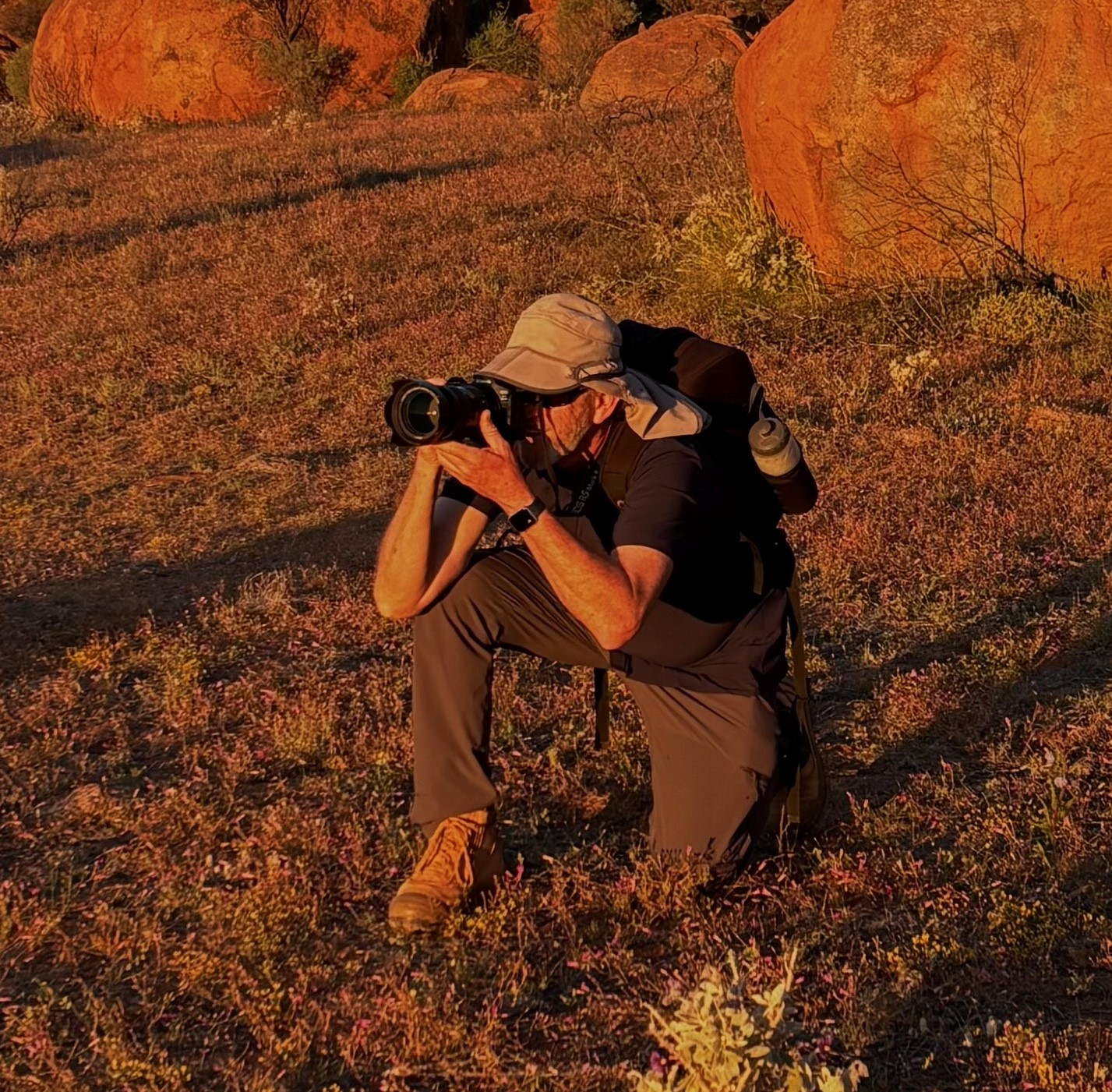 Thursday 26th March | 8am – 12.00pm | Patrick Kavanagh: The art and craft of bird photography
In this workshop, Patrick, an accomplished nature photographer with a special ‘focus’ on woodland birds of the Newstead district and their habitats, will offer personal tuition on photographic techniques and field craft. The workshop starts and ends at Newstead Art Hub and will involve gentle walking in an outdoor environment. BYO Camera.
Workshop Ticket: $100
Venue: Newstead Arts Hub
For more information and bookings – click here
Thursday 26th March | Exhibition opening John Wolseley and Geoff Park | 6.00pm
A joint exhibition of works to celebrate birds and the landscapes they inhabit. Open weekends from Saturday 14 March – Sunday 29 March or by appointment.
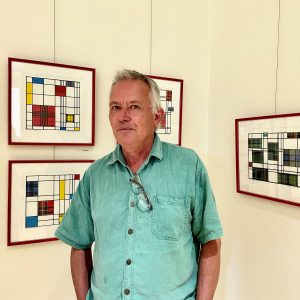
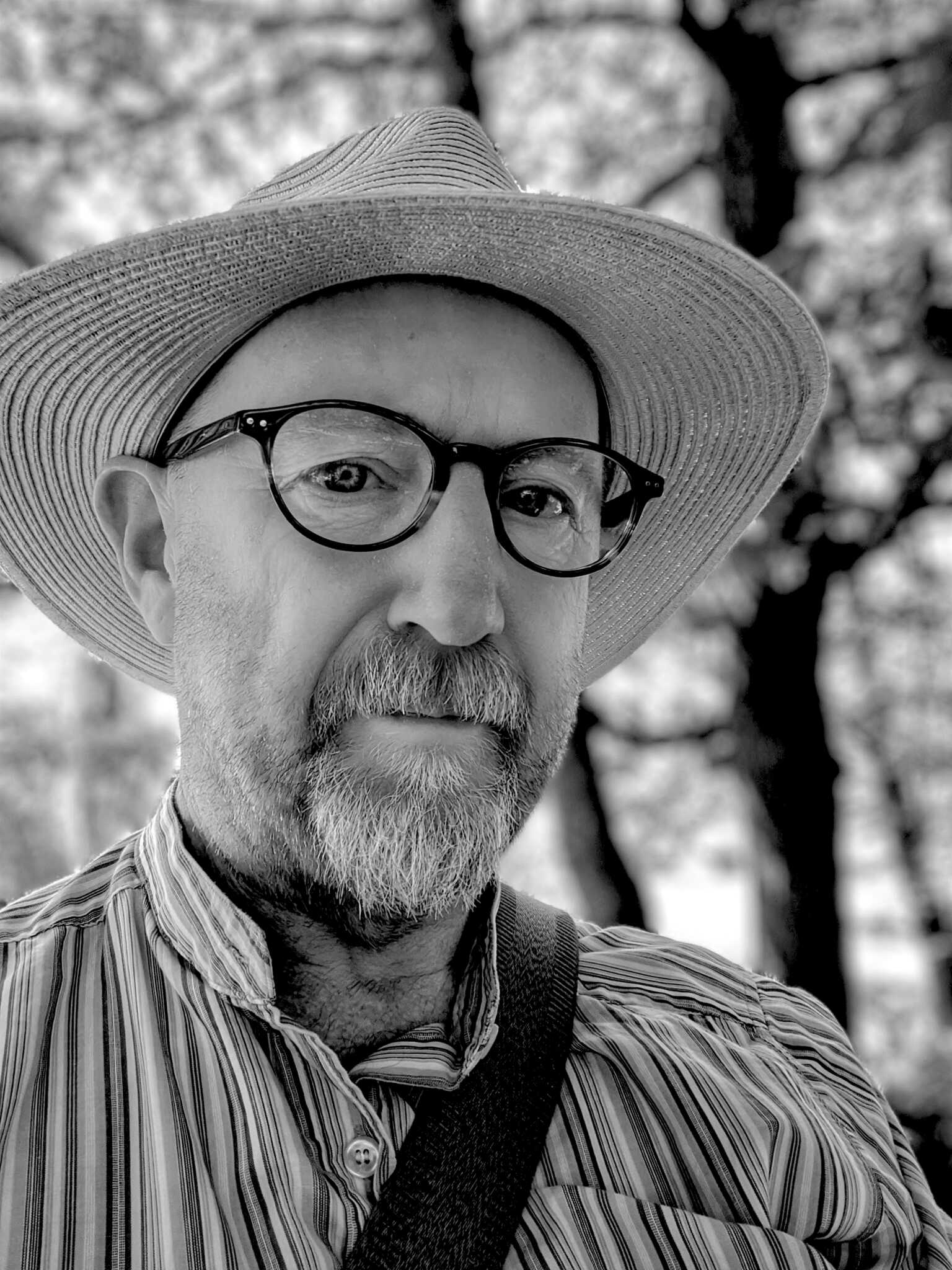
Geoff Park
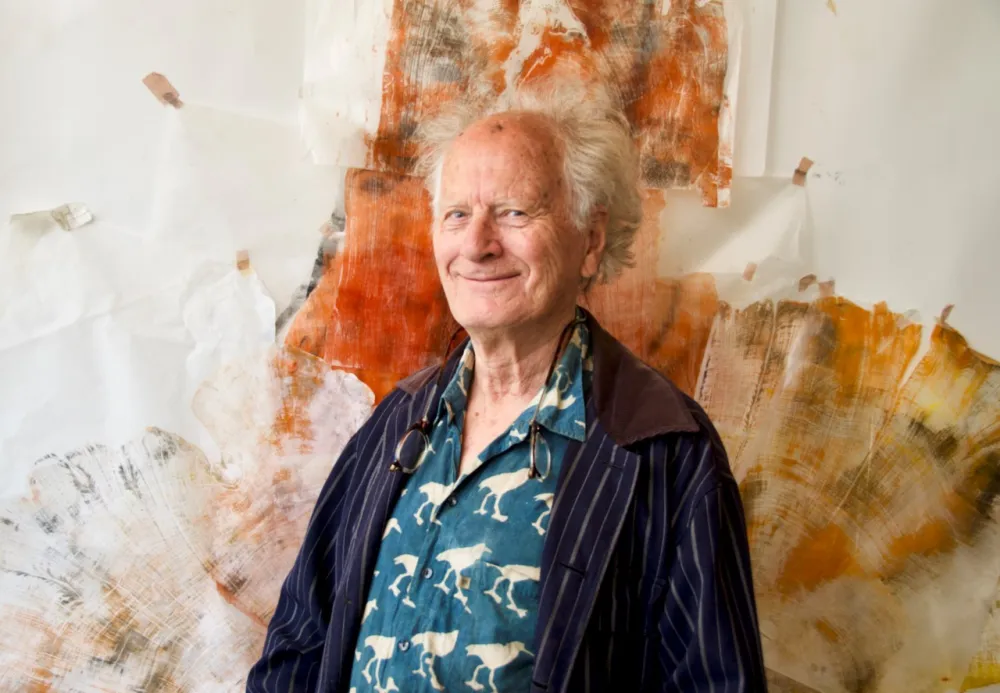
John Wolesley
Friday 27th March | 6.00pm – 7.00pm) | John Wolseley and Geoff Park in Conversation
Since moving to Australia in 1978, John Wolseley has immersed himself in the landscape, an approach which has given rise to a variety of different ways of collaborating with the land itself. His large scale works on paper, watercolours and installations are often based around scientific themes.
Geoff Park is an ecologist, wildlife photographer and field naturalist with a 60-year obsession with birds. Since 2008, with his Natural Newstead blog, Geoff has been documenting the nature of the Newstead district through writing and photography with a particular focus on birds.
Join them in conversation as they discuss their experiences of engaging with landscapes and the creatures that inhabit these places. An evening of sharing stories, ideas from their lives of observing, documenting and wondering about nature.
Event ticket: SOLD OUT (Join Waitlist)
Venue: Newstead Arts Hub
For more information and waitlist – click here
The proceeds from this diverse and rich program of events will be dedicated to a community designed, citizen science woodland bird conservation project in central Victoria, in partnership with the Wettenhall Environment Trust.
2025 End of Year Retrospective
Posted on 22 December, 2025 by Hadley Cole
As the year draws to a close we clear our desks, hang up our boots, wash down the big red Connecting Country ute, and take a moment to think about what we have achieved this year. Like many environmental orgnisations 2025 has brought times of financial hardship and sadly the scaling back of staff and projects. Despite this the Connecting Country team, staff and volunteer committee members have rallied together and delivered numerous educational events attracting many community members from across the region, we continue to coordinate and deliver biodiversity monitoring through the engagement of volunteers and we partner with many local and regional organisations to deliver our events and projects.
Throughout the 2024/25 financial year we delivered 6 educational and community engagement events attracting around 350 people, supported 26 Landcare Groups, coordinated 192 bird surveys carried out by our dedicated volunteers and partnered with over 26 non-government and government organisations. For a small community not-for-profit organisation operating with less than a handful of part time staff and a volunteer committee we are proud of our achievements and remain dedicated to the work we do.
Connecting Country staff will be taking a break over the festive season. The office will be closed from Monday 22 December until Thursday 15 January 2026. Any inquiries made during this time will be responded to when we return to the office in January 2026.
We are so grateful to our donors, volunteers, and supporters! We wish you all a happy end of year and relaxing festive season.
Take some time to learn more about our achievements for the 2024/25 financial year in our annual report: 2024-25 Annual Report
Farewell Marie Jones after 17 years!
Posted on 11 December, 2025 by Hadley Cole
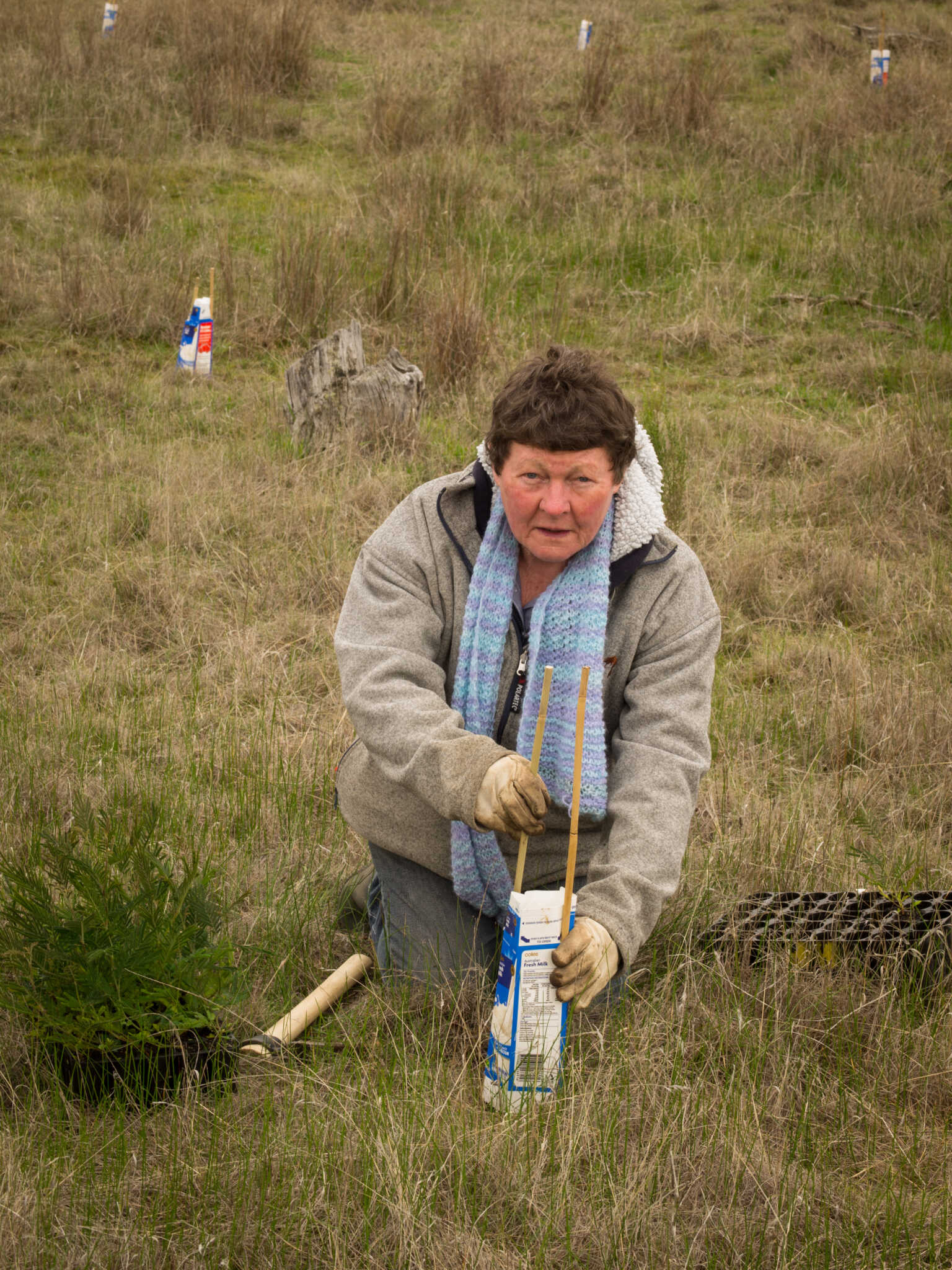 At Connecting Country’s 2025 AGM we wiped away a tear or two as we said farewell to Connecting Country stalwart and superstar Marie Jones. Marie has been involved with the organisation since its inception and has at one point or another held every single position on the executive committee, from Treasurer, to President, Secretary and all roles in between.
In 2007, Marie was instrumental in the creation of Connecting Country. Over the last 17 years she has worked tirelessly to ensure that Connecting Country is successful and sustainable. She has been involved in at least four sub-committees of the organisation including the Landcare Steering Group, where she provided hours of support and mentorship to the various staff that took up the role as the local Landcare Facilitator.
Marie began her volunteer career in the local community over thirty years ago! Throughout this time, she has guided many projects that will have a lasting impact on the local environment, heritage and people across the Chewton, Castlemaine and entire Mount Alexander region. She has been involved in many local community groups including, Golden Point Landcare, Post Office Hill Action Group, Friends of the Box Iron-bark Forests, just to name a few!
In 2024 Marie’s dedication to volunteering over the past three decades was recognised when she received the Joan Kirner Victorian Landcare Award. It was no surprise to the Connecting Country team when Marie’s name was called out. We all knew she was deserving of the award, we were thrilled that the rest of Victoria and the statewide Landcare community also recognised her contribution.
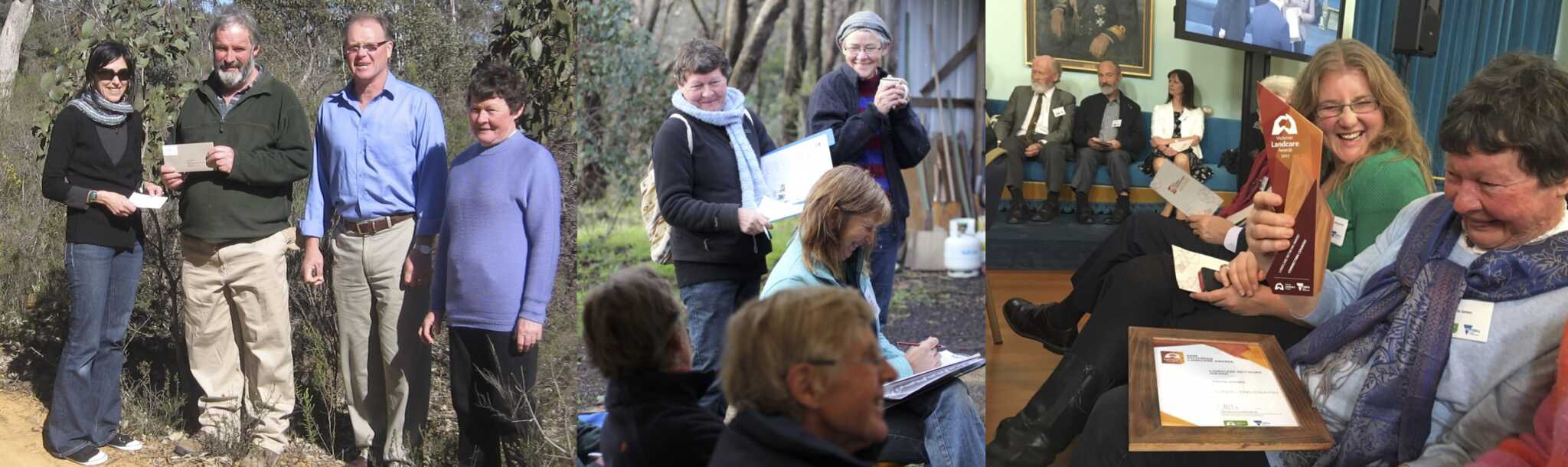
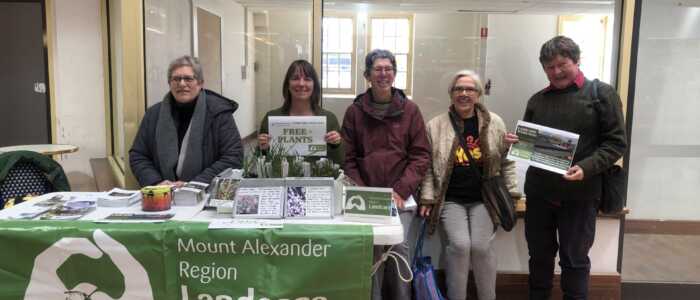
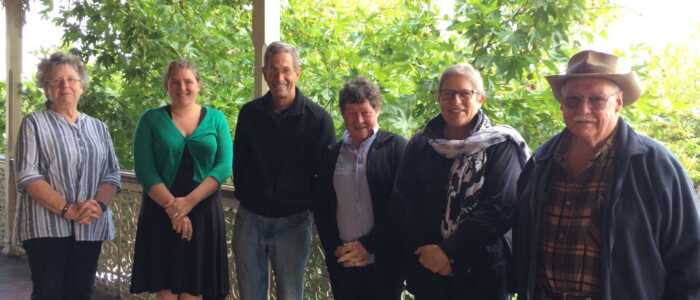
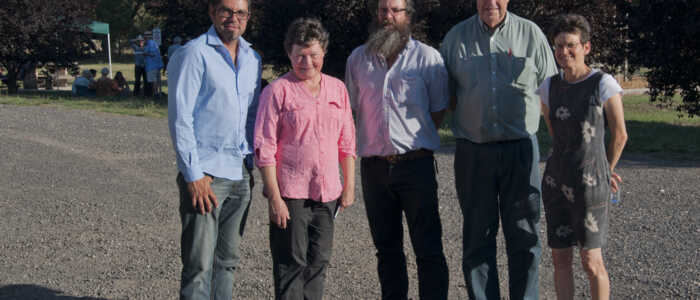
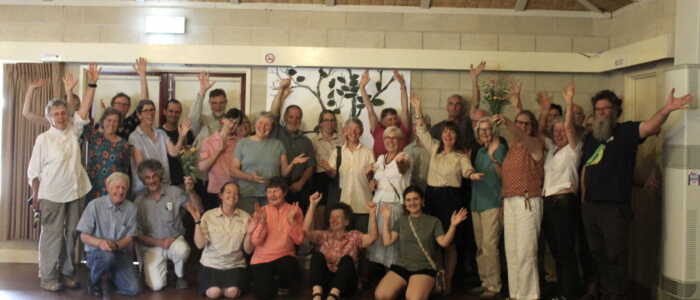
Photos above from left to right: The inception of Connecting Country. Fire & Biodiversity event (2014), Landcare Network Award (2017)
Marie is often the thread linking various community members and organisations within the Mount Alexander region together. She has a wonderful ability to bring people together and enable civil and respectful discussions around, what are at times, controversial topics. She is an exceptional grassroots environmental leader. She is the person people want to talk to about new ideas, about government funding, about issues groups may be having, about issues in the community, about working with other groups, about forming new committees or working on arising issues.
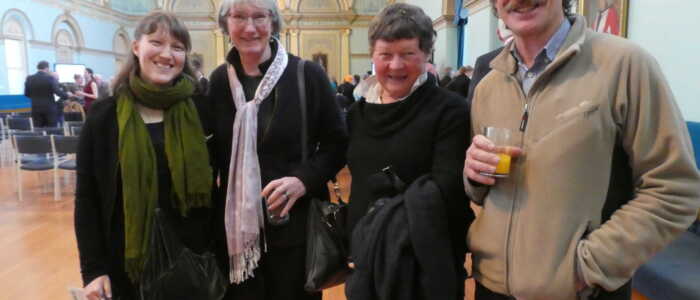 2017 Landcare Awards, Asha Bannon, Christine Brooke, Marie, Ian Higgins.
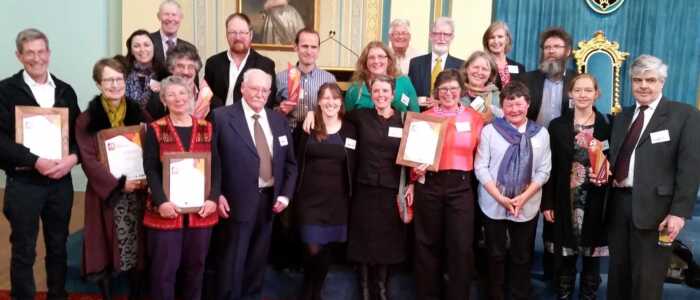
Perhaps one of Marie’s most outstanding achievements has been the work she put in behind the scenes to establish Connecting Country. Although its creation was a joint effort by many, everyone involved will attest that Marie was a driving force whose skills, knowledge and commitment were critical to its success. She was instrumental in engaging the widest range of stakeholders possible during the establishment process, particularly encouraging Landcare groups and their members to become involved, which they did. One of the defining things about Marie is that she takes a constructive and positive approach to any situation. She treats everyone as a person, with respect, no matter what disagreement or problem there is to work out.
Marie has a saying “think globally, act locally”, which articulates that the actions we take in our own patch can have a ripple effect across communities at the regional, state, national and even global level. Marie’s ability to keep all the parts of an issue in perspective is a strength that makes her relatable to many people within the community.
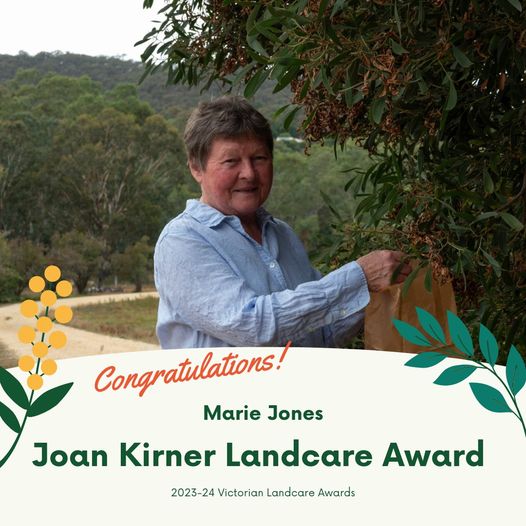
The entire Connecting Country community greatly appreciates Marie’s contribution, and whilst she has stepped down from the Committee, we know she will stay well-connected through Landcare and other local pursuits. We hope that stepping away from the Connecting Country responsibilities will create more time for her and her partner John to spend time with family and friends and enjoy some well-deserved down time.
Words from current Connecting Country staff and committee members about Marie:
I had known Marie for many years but it was after a FOBIF walk on my farm at Yapeen in 2016 that Marie approached me to join the Committee of Connecting Country. I have always been impressed by Marie’s energy, enthusiasm, excellent communication skills and her involvement in community and environmental matters. She has been an invaluable member of the Connecting Country Committee and a joy to work with. – Max Kay, Connecting Country Treasurer
It has always been a joy to come to work and see Marie. She is always helpful, supportive and knows just how to handle every situation. She has a knack of knowing exactly what is going on and what is needed at the right time. She will be greatly missed. Thankyou for everything Marie! – Bonnie Humphreys, Connecting Country Landscape Restoration Coordinator
I first met Marie when we were members of regional committees with the North Central CMA, almost 20 years ago, and she subsequently got me involved in Connecting Country when we moved to Faraday. Marie’s passion for environmental enhancement and protection, is well known, as is her great concern and support for the well-being of our communities. Her dedication to everything she takes on is awe inspiring. It has been a great pleasure working with Marie at Connecting Country – great conversations, many problems to solve, many laughs to be had and all in a very positive and cheerful way. I’m hoping there will be many more opportunities to work with her in the future. Can we call catching up for coffee “working”? – Chris Brooke, Connecting Country Committee Member
When I started at Connecting Country, Marie went out of her way to make me feel welcome with a coffee and a local field guide. She has always shown and appreciation and respect for staff, quickly responding to any queries and never shying away from the challenging issues. Her involvement across many aspects of the community means she always brought valuable community voice into project planning and decision making. I will miss Marie on the Committee but I know it won’t be the last we see of her. – Lori Arthur Connecting Country Director/ Landcare Facilitator
When I first started with Connecting Country as the Landcare Facilitator in 2021, Marie immediately made sure I knew she was their to support me in my new role. Her knowledge of the local community is incredible! She passed on so much information of previous projects, events and partnerships between local groups and community members. Whenever I had a new idea, Marie was the first person I went to, and still do! Despite the fact that she has witnessed all the various conservation trends over her years, she always endorsed my ideas with enthusiasm and support. Marie’s diplomacy and community spirit will be greatly missed by all at Connecting Country. Hopefully she and John can now take a well earned rest! – Hadley Cole former Landcare Facilitator.
Connecting Country AGM and new committee members
Posted on 25 November, 2025 by Hadley Cole
On Saturday 22 November we held our AGM at the Guildford Community Hall. It was a lovely day to get together and celebrate our achievements for the year. Connecting Country members and supporters enjoyed brief AGM formalities that were followed by a presentation from Dr. Barry Golding and a wonderful afternoon tea provided by the Guildford Store.
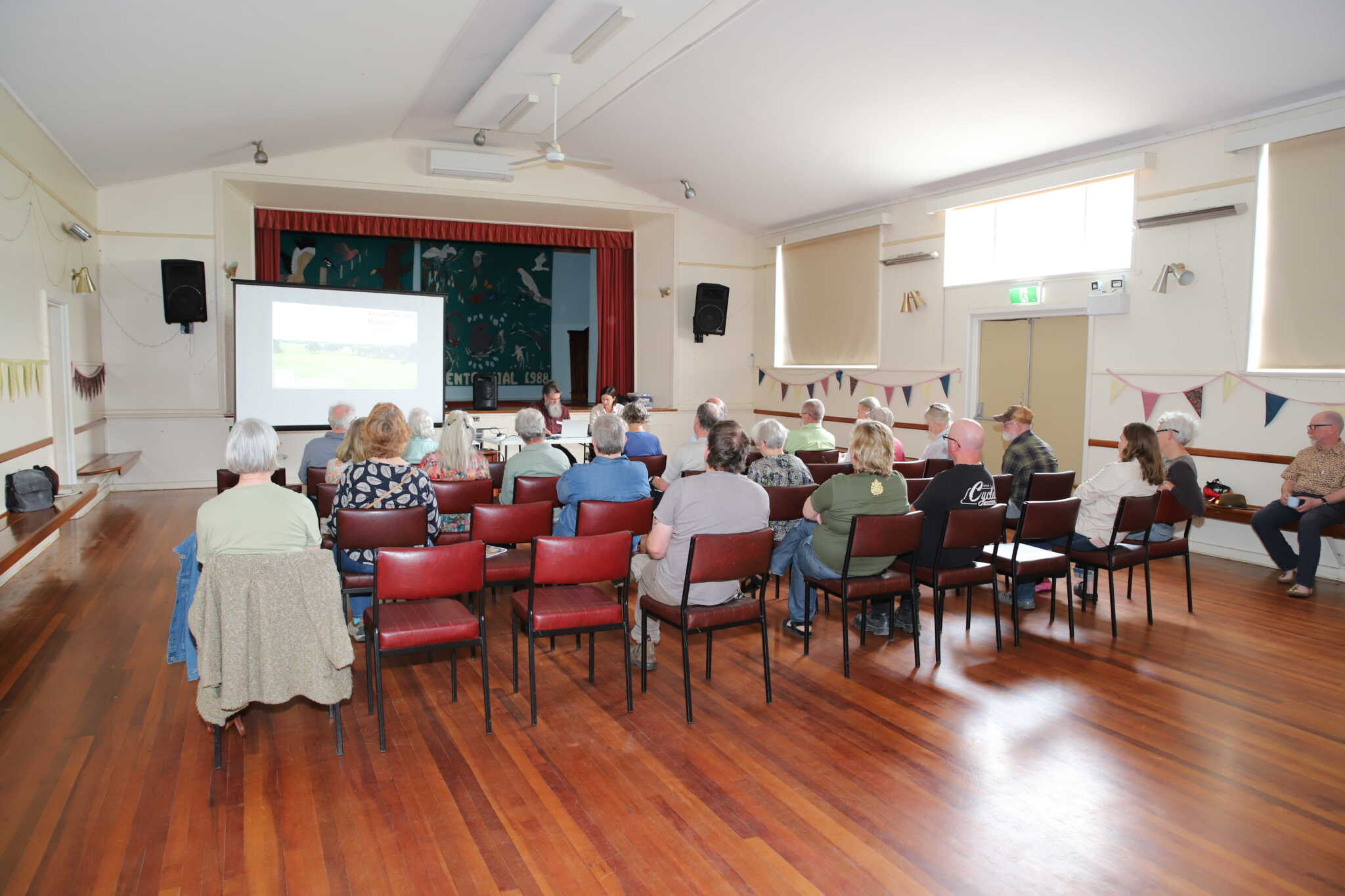
AGM attendees at the Guildford Community Hall. Photo by Lou Citroen.
Dr. Barry Golding took the opportunity to reflect on his book Six Peaks Speak, published in 2023. Dr. Golding spoke of the great amount of evidence that is recorded in Central Victoria demonstrating Dja Dja Wurrung occupation of this Country for millenia, and the importance of protecting artefacts and culture that still exist in the landscape. The ‘Six Peaks’ refers to Mounts Kooroocheang/Gurutjanga, Beckworth/Nyaninuk, Greenock/unknown, Tarrengower/Dharrang Gauwa, Alexander/Liyanganuk, and Franklin/Lalkambuk. In his book Golding shares the knowledge and history each mountain holds within their geology and writes of the importance of recognising and understanding the unsettling colonial history in the region.
This years’ AGM saw a changing of the guards as the committee farewelled long term committee member and one of the early advocates for Connecting Country Marie Jones. Outgoing president Brendan Sydes thanked and congratulated Marie for hear many years (almost two decades) of dedication to our grass roots community organisation. He noted her thorough understanding of how small, community organisations work and her diligence in knowing what needs to get done, and getting in there and getting it done. Marie’s natural approach to working with community and bringing people into the fold has been a foundation to the success of Connecting Country from the early beginnings. “You should be very proud of what you have achieved here” Brendan shared.
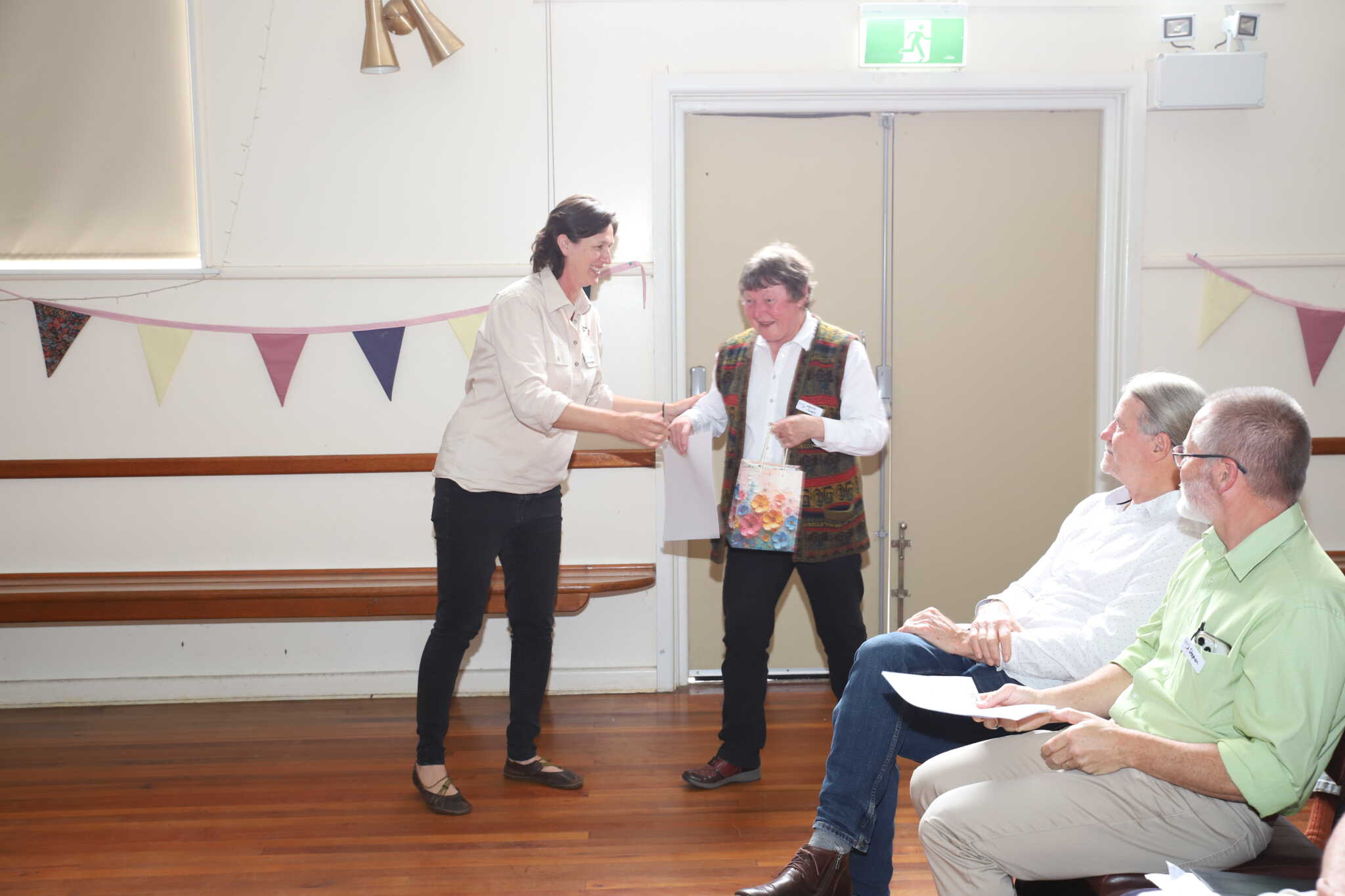
Marie Jones receiving Thank You gifts from Director Lori Arthur. Photo by Lou Citreon
The entire Connecting Country community will miss Marie dearly. She has been a stalwart in the organisation since inception and has always made herself available to staff and volunteers alike.
We also saw the changing of committee roles with Brendan Sydes stepping down as president after 12 years and handing the reigns over to Stephen Oxley who has been sitting on the committee as a general member for the last 3 years. Cate Sinclair has stepped into the role of Secretary taking over from Marie after sitting on the committee as a general member for the previous 12 months. As it stands the new committee is;
President: Stephen Oxley
Vice President: Brendan Sydes
Secretary: Cate Sinclair
Treasurer: Max Kay
General members: Christine Brooke, Darren Tinker, Deirdre Slattery, Ben Welsh
We would would like to acknowledge new members Darren and Ben and returning member Deirdre and thank them for their willingness and commitment to Connecting Country. We look forward to achieving many more great outcomes for the environment together!
Connecting Country’s 2025 AGM was made possible due to the generous donation of community donors.
Connecting Country AGM with Dr Barry Golding
Posted on 13 November, 2025 by Hadley Cole
Join us for the Connecting Country 2025 AGM with special guest presenter Dr. Barry Golding on Saturday 22 November at the Guildford Community Hall.
Following brief AGM formalities, Dr. Barry Golding will give a presentation on the downstream implications of his book Six Peaks Speak, focussing on some of the broader implications and outcomes of his research for dealing with unsettling legacies and working with First Peoples on public and private land.
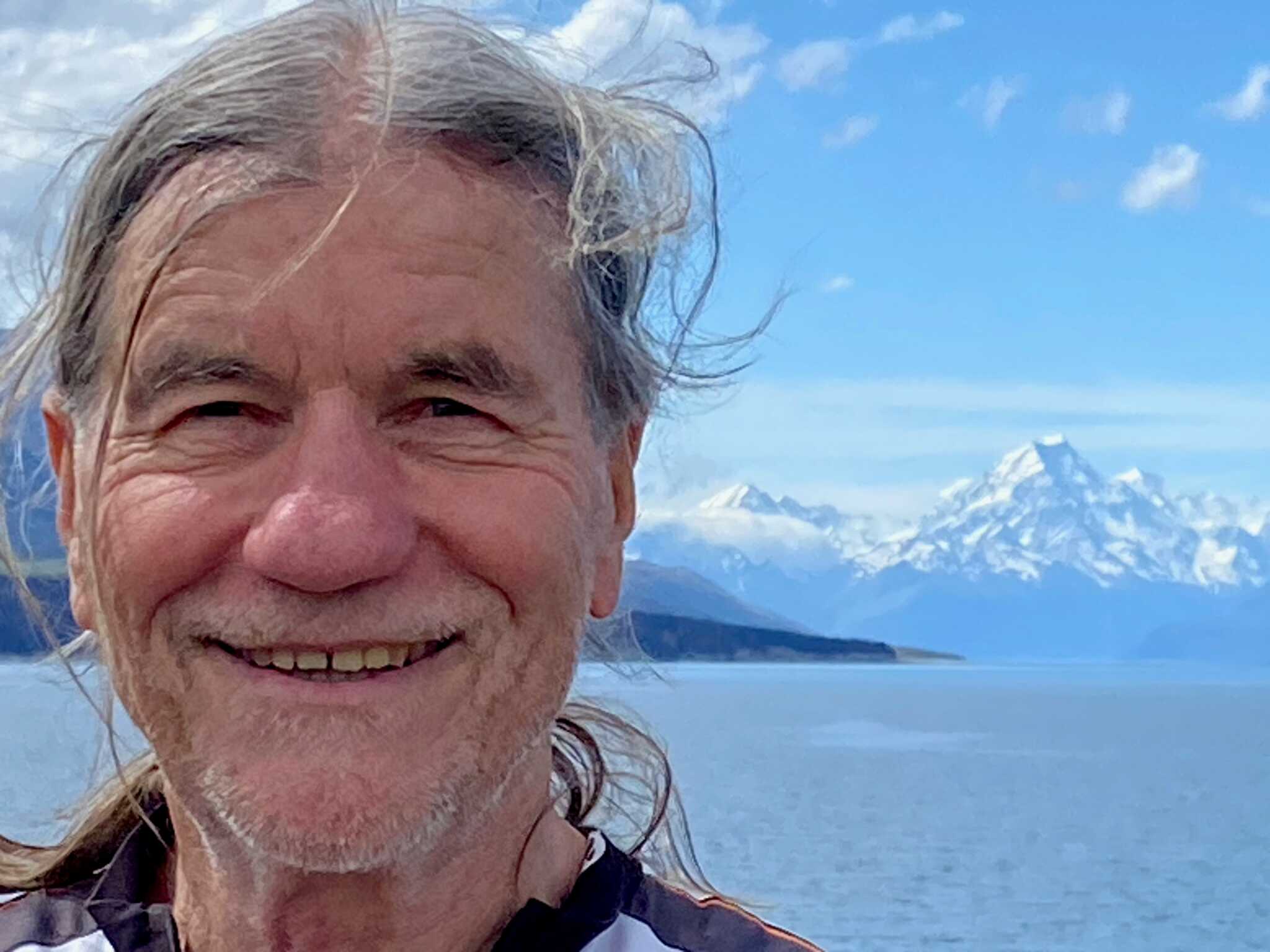
Dr Barry Golding AM is an Honorary Professor with Federation University in Ballarat. He self-describes as a ground-up, community-oriented, polymathic, place-based researcher and story teller. His degrees span four disciplines: geology, arts, environmental sciences and education. Barry has researched and published internationally about vocational, adult, community, First Nations and informal learning.
In 2023 Barry undertook a State Library Victoria Creative Fellowship, researching and writing a book, Six Peaks Speak: Unsettling legacies in southern Dja Dja Wurrung Country, published in 2024 with local geologist, Clive Willman and in close discussion with Dja Dja Wurrung people.His presentation on Saturday 22 November will focus on his learnings since the release of in 2024. It’s sure to be a fascinating discussion!
Presentations will be followed by a delicious afternoon tea.
When: Saturday 22 November 2025, 2.00 – 4.00pm
Where: Guildford Community Hall, 32 Fryers Street Guildford VIC
Cost: Free!
Please book for catering purposes – click here
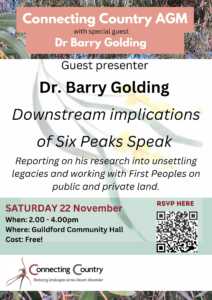
Connecting Country AGM 2025 with special guest speaker, Professor Barry Golding
Posted on 6 November, 2025 by Lori
Please join us for our AGM with special guest speaker Professor Barry Golding – author of Six Peaks Speak, on Saturday 22 November 2025 from 2.00pm to 4.00pm
Professor Barry Golding
Dr Barry Golding AM is an Honorary Professor with Federation University in Ballarat. He self-describes as a ground-up, community-oriented, polymathic, place-based researcher and story teller. His degrees span four disciplines: geology, arts, environmental sciences and education. Barry has researched and published internationally about vocational, adult, community, First Nations and informal learning. In 2023 Barry undertook a State Library Victoria Creative Fellowship, researching and writing a book, Six Peaks Speak: Unsettling legacies in southern Dja Dja Wurrung Country, published in 2024 with local geologist, Clive Willman and in close discussion with Dja Dja Wurrung people.
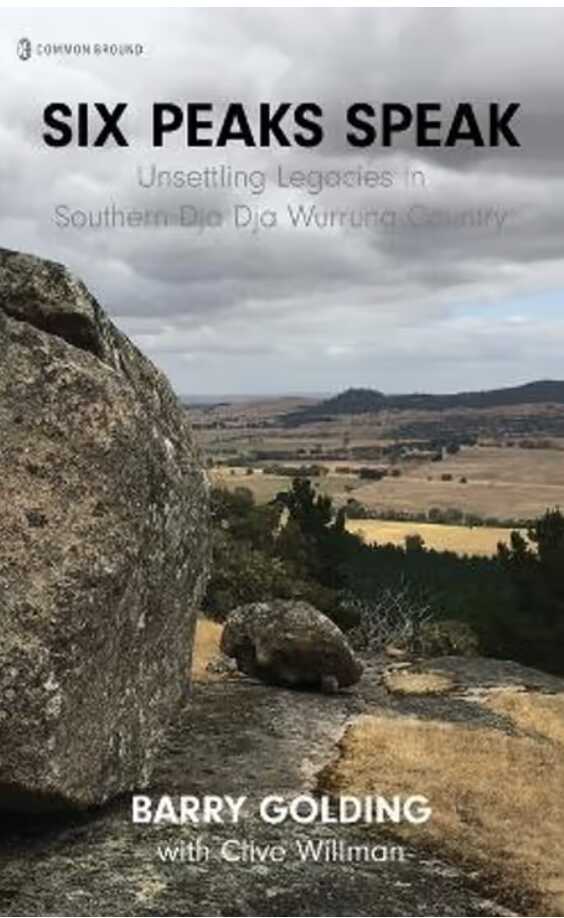 Six Peaks Speak tells the unique stories and continuing legacies of the ancient mountains in the Central Victorian region from a multidisciplinary perspective. The book bears witness to ‘unsettling’ changes over the past 200 years, as viewed from the perspective of the peaks (including Dharrang Gauwa – Mount Tarrengower and Liyanganyuk banyul – Mount Alexander) that stand sentinel over an ancient volcanic landscape and its immense natural and cultural significance.
When: Saturday 22 November 2025 at 2.00pm – 4.00pm
Where: Guildford Community Hall, 30 Fryers St Guildford VIC
Cost: Free!
Delicious afternoon tea provided.
Everyone is welcome! For catering and logistical purposes, please register your attendance – click here
Dr. Barry Golding will present after brief AGM formalities.
AGM formalities
The following Connecting Country AGM 2025 documents are available to download:
Please note only current Connecting Country members can vote in the AGM. To become a member – click here
For more information please email info@connectingcountry.org.au or phone 0493 362 394
Nominate for the Committee of Management
Want to be more involved with Connecting Country? Why not consider becoming a committee member. We are actively looking for new committee members to broaden the skills of our Committee. The positions require 2 hours per month to attend committee meeting plus small amounts of reading or work time as required to keep the organisation rolling. If this sounds like you, please complete a nomination form or contact our office to discuss via info@connectingcountry.org.au.
The 2025 AGM is kindly sponsored by local community donors.
If you would like to donate to Connecting Country’s cause in promoting local conservation action and restoring landscapes, head over to our Give Now donation page – click here
Seeding Our Future Project 2024/25
Posted on 30 October, 2025 by Hadley Cole
Back in November 2024, Connecting Country kicked of the Seeding Our Future project funded through the 2024 Victorian Landcare Grants. The scope of the project wass to help protect and conserve locally rare and threatened plant species through a series of educational workshops that build knowledge and skills within our local community.
Indigenous seed security is a concern for many in the natural resource management sector. With increased fragmentation of landscapes and the changes in weather patterns and climate due to global heating, the future of many plant species is under threat. Grand scale restoration works are needed and programs such as the Victoria Governments Bushbank program require huge quantities of seed to meet restoration targets. Seeding Victoria are working with project partners Cassinia Environmental and the Natural Resources Conservation Trust to raise awareness of seed security and provide training and resources to aspiring seed collectors to increase seed supply and availability.
The Seeding Our Future project compliments the work Seeding Victoria and partners are undertaking to raise the importance of seed conservation. Considering this, for the first workshop we hosted in November 2024 we partnered with Seeding Victoria in a Seed Collection Workshop at the Botanical Gardens in Castlemaine. The workshop was sold out with keen participants coming along from as far away as Reservoir!
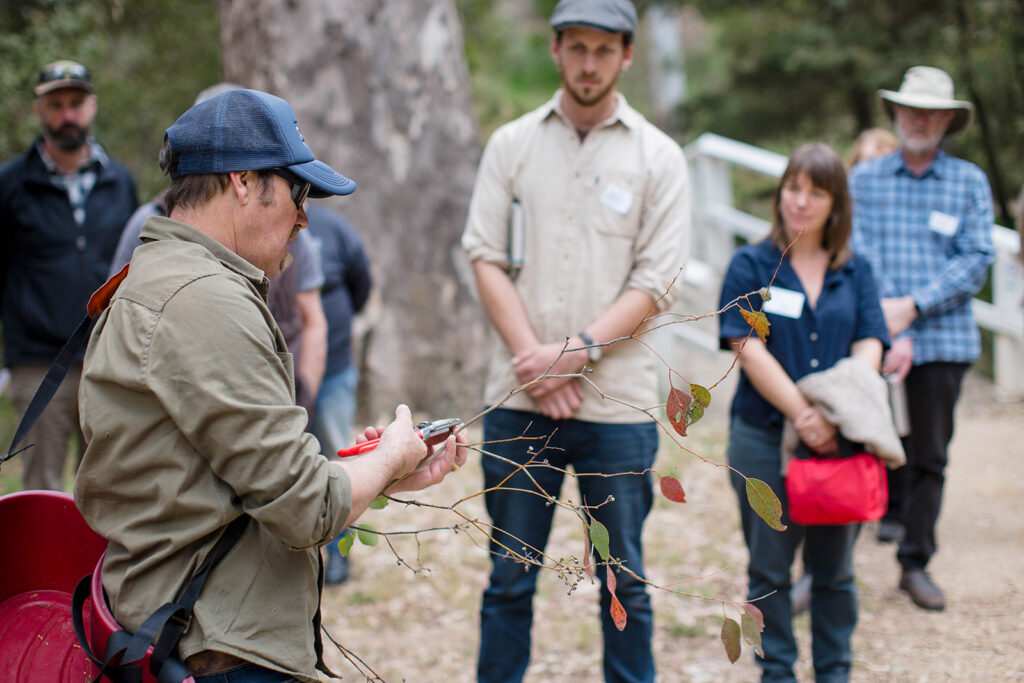
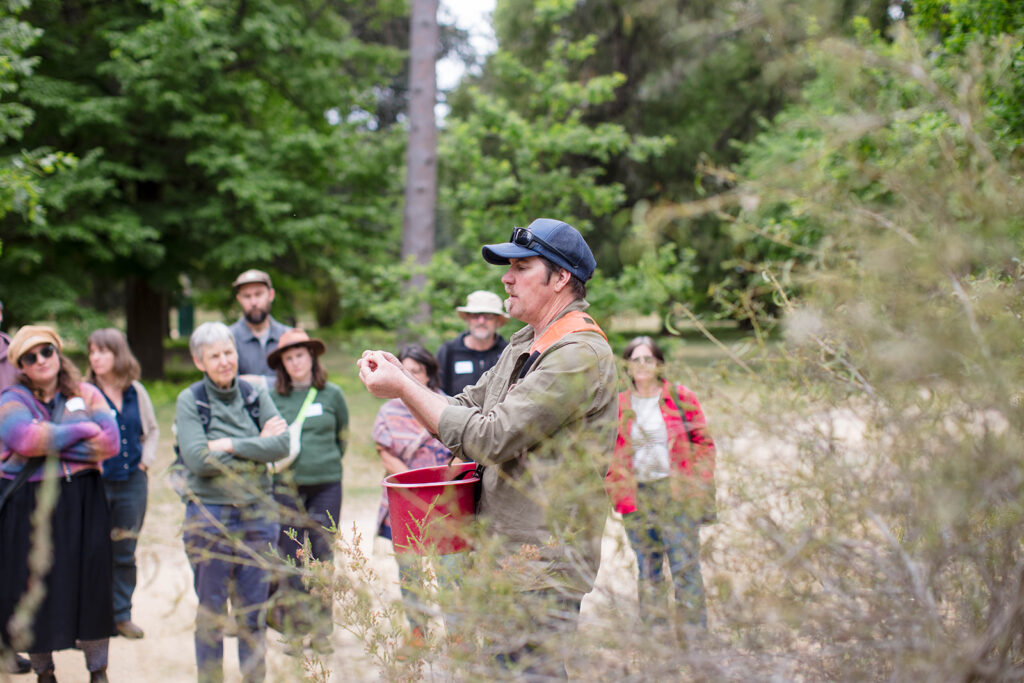
Dan Frost from Seeding Victoria talked us through the basics of seed collection including the equipment needed, permits required and the various collection processes for different indigenous plant species. After a morning in the classroom, we went for a walk through the Botanical gardens and up to the bush land reserve behind the gardens to explore which local plants are currently flowering, seeding or close to seeding and how you might approach collecting and storing their seed.
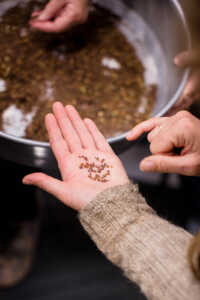


Dan talked us through the adapted seed collection techniques for various plant families including some grasses, daisies, acacias, eucalypts, bottle brushes, and cone producing plants.
November until late summer is some of the best times for seed collection in the local area, so for aspiring seed collectors this was the perfect time to build a knowledge base and learn about the permits required before getting out there to collect!
Participants reported that they thoroughly enjoyed the workshop. A big thank you to Dan and Robert from Seeding Victoria for sharing their deep knowledge of local seed. We hope to see the future of seed collecting secured and many of our local plant species conserved and protected.
Below photo shows Dan Frost from Seeding Victoria presenting on various collection techniques to a very engaged audience. All photos in this post by Carmen Bunting.



Nature Art Soundscapes presents The Feathered Five!
Posted on 30 October, 2025 by Lori
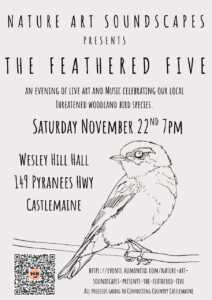
A truly special, immersive art and music event, celebrating some of our treasured local woodland birds.
Nature Art Soundscapes are musicians Hilary Blackshaw (violin, guitar and vocals), Joel Bloom (lap steel guitar), Clara Schutz (cello) and artist Jane Rusden. The quartet celebrates local woodland wildlife through weaving beautiful live art making with evocative musical soundscapes.
Audiences are invited to immerse themselves in the magic and wonder of local nature, through gentle relaxation (BYO cushions, blankets and/or PJs – we seriously don’t mind!), or you are welcome to bring your own art supplies and draw along with Jane.
When: Saturday 22 November 7-9pm
Where: Wesley Hill Hall, 149 Pyranees Highway, Castlemaine
Tickets: Adults $20, children (under 18) free. Book here or available at the door.
All proceeds generated from this performance will be donated to Connecting Country Castlemaine to assist their woodland bird monitoring project.
Great Southern Bioblitz – Castlemaine Region 24-27 October
Posted on 16 October, 2025 by Lori
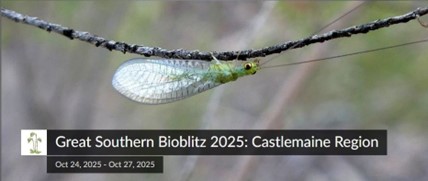
It’s the beginning of October and so wonderful to see the new growth and increasing activity in bushlands and gardens after so many months of challenging conditions. Trees, shrubs and other understorey plants are putting out new leaves and foliage, and canopies are becoming denser. Birds are calling and nesting. Frogs are croaking. Thankfully insects are about again, albeit not in good numbers yet, but Painted Ladies and some day moths are about. And we are already being treated with the bright colours of Myrnong, Waxlips, Leopard orchids and Caladenias, with scattered clusters of emerging leaves promising Helmet and Gnat orchids.
Hopefully while all of this is happening those of you who live in or visit the Mount Alexander Shire will be getting ready for the Great Southern Bioblitz 2025,which runs from midnight October 23 to midnight October 27. This is your opportunity to join other citizen scientists to help build the scientific databases that increase the knowledge and understanding of our bushlands and their biodiversity. These annual Bioblitz surveys collect vast amounts of data on species and distribution that would otherwise be unavailable.
The Castlemaine Field Naturalists Club are again hosting a count in this region and they’d love your contributions! If you can contribute, all you need is a camera or phone and enthusiasm!
You’ll find lots of information, including deadlines, tips on uploading your images to iNaturalist, the online global databank for observations of biodiversity and more on the Castlemaine Field Naturalists Club Great Southern Bioblitz webpage.
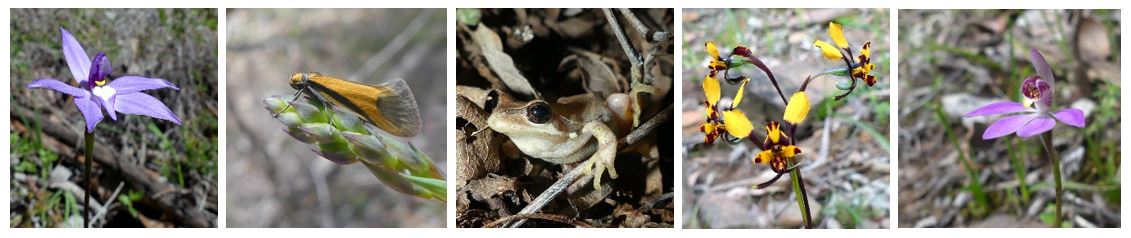
Images: Castlemaine Field Naturalists Club
North Harcourt Sedgwick Landcare Group AGM with Ira Barker
Posted on 16 October, 2025 by Lori
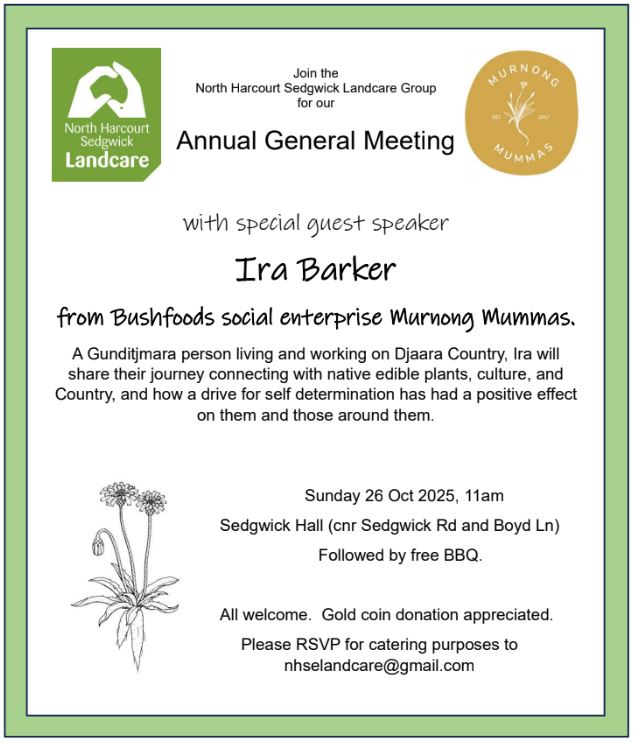
North Harcourt Sedgwick Landcare (NHSE) are pleased to welcome Ira Barker from bushfoods social enterprise, Murnong Mummas, as the special guest speaker at the Groups Annual General Meeting.
A Gunditjmara person living and working on Djaara Country, Ira will share their journey connecting with native edible plants, culture, and Country, and how a drive for self determination has had a positive effect on them and those around them.
AGM business will include the annual activity report, and the election of the committee for the next year. They welcome new nominations to the committee – contact nhselandcare@gmail.com for more information.
A free BBQ will follow the formal business.
When: Sunday 26 October 11am-12pm
Where: Sedgwick Hall, Sedgwick
Bookings: Free (gold coin donation will be appreciated) – click here to book.
Taradale Landcare AGM and nestbox installation demonstration
Posted on 8 October, 2025 by Lori
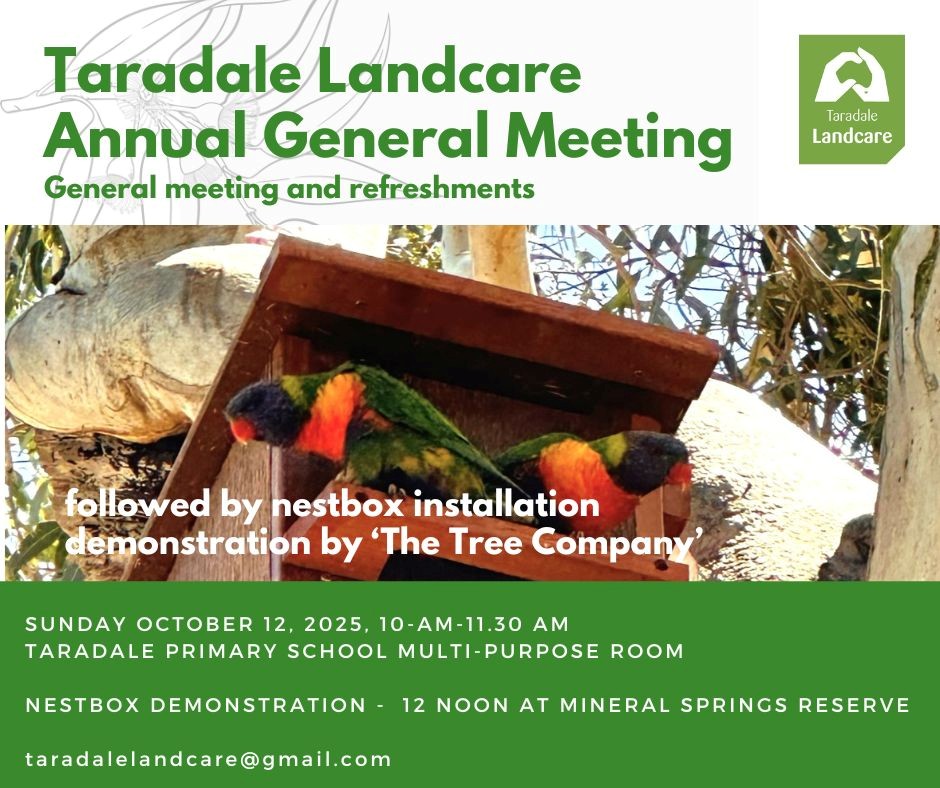
Taradale Landcare are hosting their Annual General Meeting on Sunday 12 October in Taradale, VIC and encourage new members and committee nominations. Following the usual AGM formalities and refreshments, Tom from The Tree Company will provide a nestbox presentation and installation demonstration at Taradale Mineral Springs Reserve.
When: Sunday 12 October, 10am – 11.30am
Time: AGM 10am – 11.30am – Taradale Primary School multi-purpose room
Nestbox installation 12noon – Taradale Mineral Springs Reserve
RSVP: taradalelandcare@gmail.com
Baynton Sidonia Landcare present Taungurung Cultural Heritage Workshop: Fri 17 October 2025
Posted on 6 October, 2025 by Hadley Cole
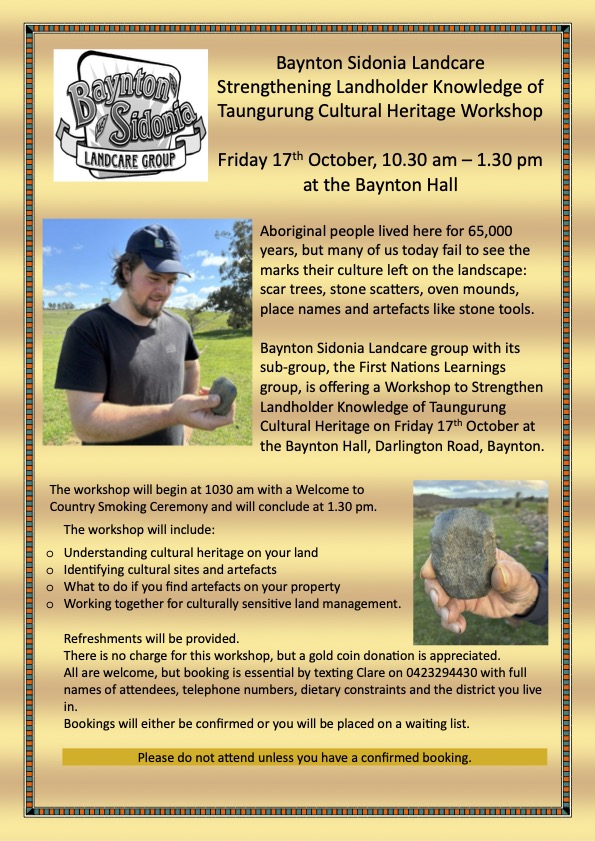
Our friends at Baynton Sidonia Landcare are hosting a Strengthening Landholder Knowledge of Taungurung Cultural Heritage Workshop on Friday 17 October from 10.30am to 1.30pm at the Baynton Hall.
The aim of the workshop is to build landholder knowledge and confidence to support the preservation of Taungurung Culture on Country and to create shared pride in it.
The workshop will include:
- Understanding cultural heritage on your land
- Identifying cultural sites and artefacts
- What to do if you find artefacts on your property
- Working together for culturally sensitive land management
Where: Baynton Hall, 51 Darlington Road, Baynton VIC
When: Friday 17 October, 10.30am – 1.30pm
Bookings essential: The workshop is free, but a gold coin donation is appreciated. All are welcome, but booking is essential by texting Clare on 0423294430 with full names of attendees, telephone numbers, dietary constraints and the district you live in. Bookings will be confirmed or you will be placed on a waiting list. Please do not attend unless you have a confirmed booking.
Seed Collection Workshop with Seeding Victoria
Posted on 2 October, 2025 by Hadley Cole

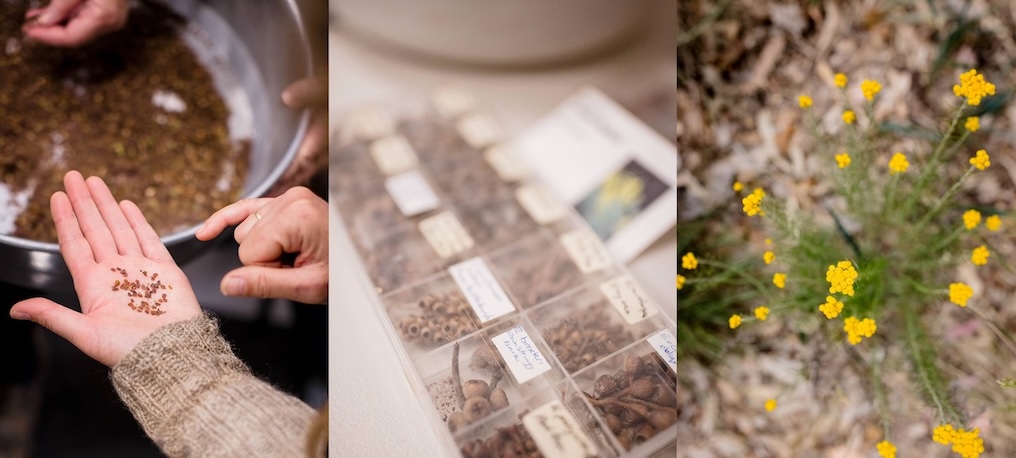
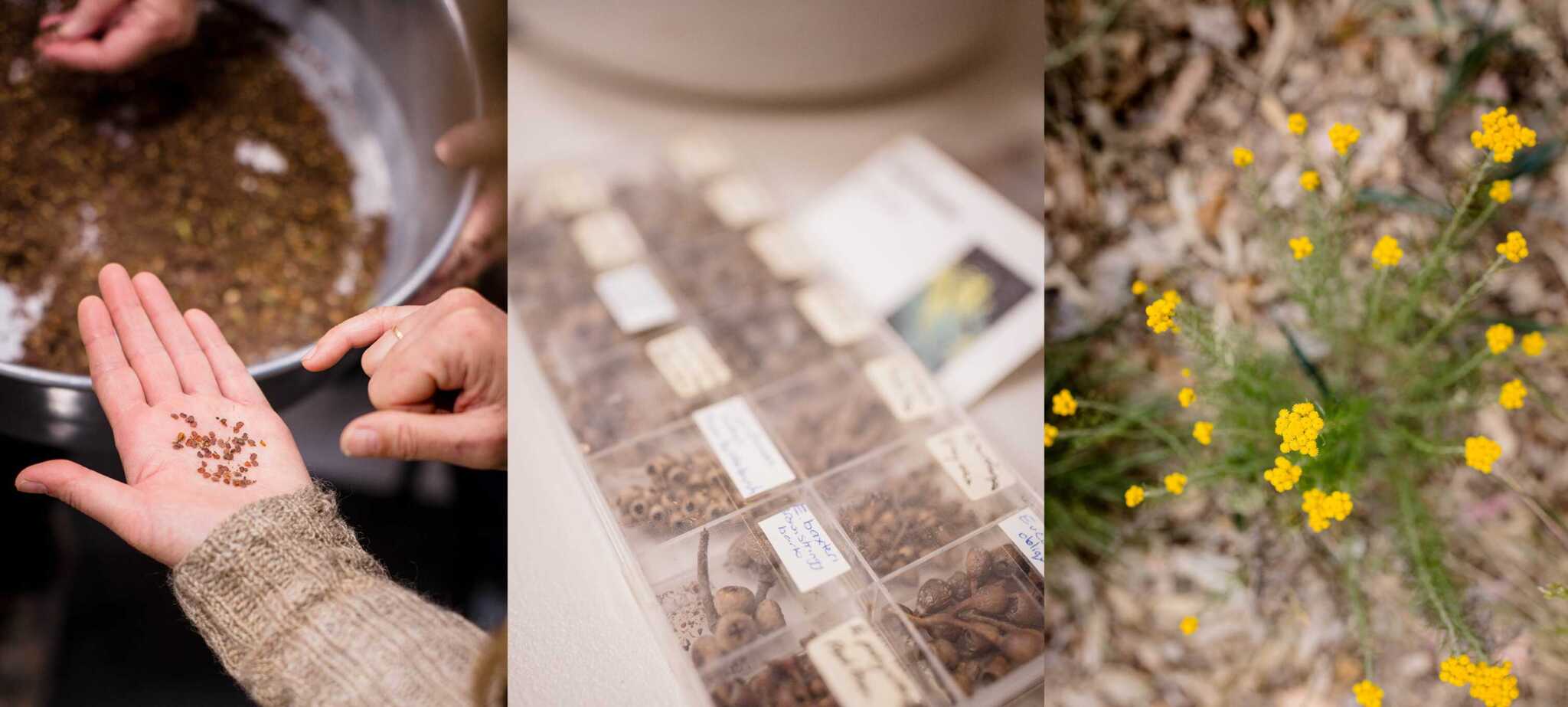
Seeding Victoria is a community not-for-profit working hard to provide provenance based seed supply for revegetation projects throughout Central, South West and North West Victoria. The work of Seeding Victoria is crucial to the implementation of successful restoration.
In partnership with Natural Resource Conservation Trust, Cassinia Environmental and Connecting Country, Seeding Vic. presents a Seed Collection Workshop on Saturday 18th October 2025 in Castlemaine.
This workshop offers local community members the opportunity to take direct action to increase flora populations across the region through the development of seed collection skills and local flora identification. Through the collection of seed and growing of indigenous plant species, particularly those that are rare, we can increase genetic diversity and population of local indigenous flora, creating resilient ecosystems and seed banks for our future.
The day will involve;
- The nuts and bolts to seed collecting: You will learn species identification, what permits you need to obtain for collecting seed, OH&S, collection techniques, extraction and storage.
- Field Trip: We will have a look at the OH&S components of seed collecting, observing what’s flowering and what will be ready to collect in the coming months.
- There will be an opportunity to order seed-collecting equipment on the day.
- Learn about how the Natural Resource Conservation Trust Seed Bank Revolving Fund works and how to obtain a discount for seed-collecting equipment.
- Introduction to the BushBank Program: How to get involved in collecting seed for the $30M Government program and access funding to undertake biodiversity planting on your property.
When: Saturday 18 October 2025, 9.30am – 3.30pm
Where: Castlemaine Botanical Gardens Tea Rooms, Downes Rd. Castlemaine
Cost: $30.
For more information and bookings – click here
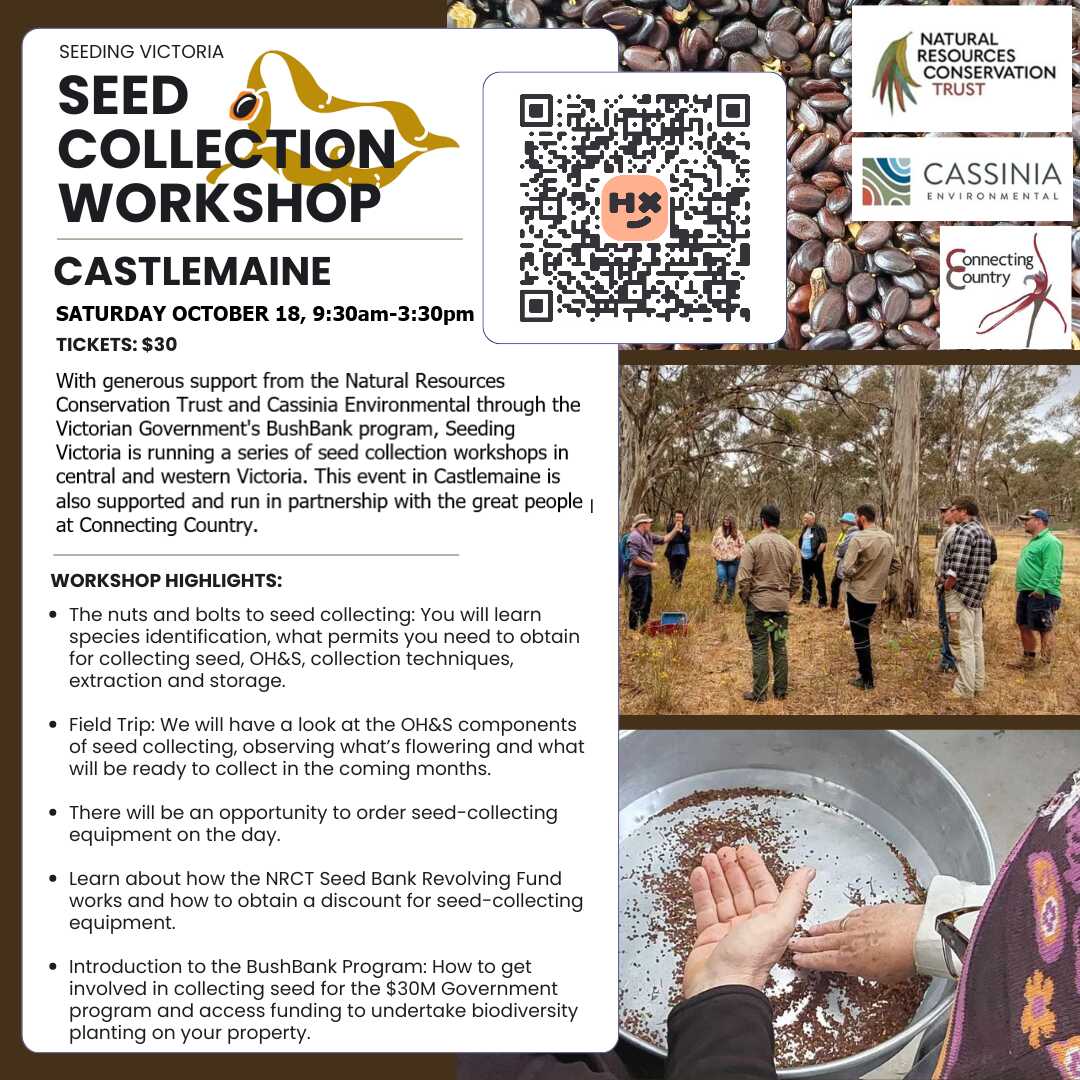
This workshop is funded by Cassinia Environmental, Natural Resources Conservation Trust and the Victorian Government BushBank program.
Community Fire Forum – Inglewood
Posted on 10 September, 2025 by Lori
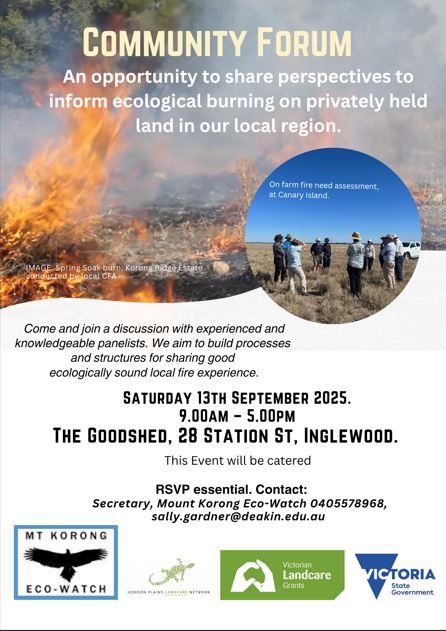 Just up the road in Inglewood, the Mt Korong Eco-Watch (MKEW) are being supported by Loddon Plains Landcare Network to host a Community Fire Forum this Saturday 13 September 2025. It is sure to be a great opportunity to contribute to this rarely discussed topic with many knowledgeable and experienced panelists.
Mt Korong Eco-Watch (MKEW) have been conducting a series of conversations among private landholders and others over a 10-month period about ecological practices of fire. This forum will bring these conversations to a focus and with a wider group of participants. The aim is to explore the potential for establishing a sustainable process for sharing fire experiences with each other, learning together and offering guidance to others.
Contributors to the forum include Paul Foreman (Blue Devil Consulting/Biolinks Alliance), Terri Williams (landholder and teacher Bendigo TAFE), Oli Moraes (DJAARA), Peter Morison (formerly Trust for Nature), Karen Tymms (Trust for Nature), Dale Tonkinson (Biodiversity Officer CFA) and others.
When: Saturday 13 September 9am-5pm
Where: The Goodshed, 28 Station Street, Inglewood
Bookings: Essential. Contact Mount Korong Eco-Watch Secretary, Sally Gardner. Phone 0405 578 968 or email sally.gardner@deakin.edu.au
Spring into BushBank: Cassinia Environmental showcases restoration projects across Victoria
Posted on 10 September, 2025 by Lori
All over Victoria, nature restoration projects are underway on private land as part of the State Government’s BushBank Program.
The Victorian Government’s $77 million BushBank program provides a unique opportunity for private landowners to play a meaningful role in addressing climate change and supporting wildlife, leaving a legacy for generations to come. Delivered by Cassinia Environmental, the BushBank Private Land Stream supports private landowners to undertake restoration projects. Restored sites are permanently protected by Trust for Nature with conservation covenants.
BushBank is the most ambitious restoration program in Victoria’s history and its delivery will continue until 2035. Expressions of interest are open to landowners with a minimum 20 hectares available for restoration.
To learn more about the program, key delivery partner, Cassinia Environmental, is inviting community members, conservationists and landowners to find out more by taking part in its spring BushBank events. Designed to showcase restoration success stories and inform curious landowners, these events offer the opportunity to see unique revegetation models in action.
Across 53 projects, the BushBank Private Land Stream has secured 8,699 hectares towards the ambitious 20,000 hectare goal. To date, 4,800 hectares have already been restored. The program is creating long-term conservation outcomes and offers new opportunities for landowners through revegetation, covenants and access to carbon markets.
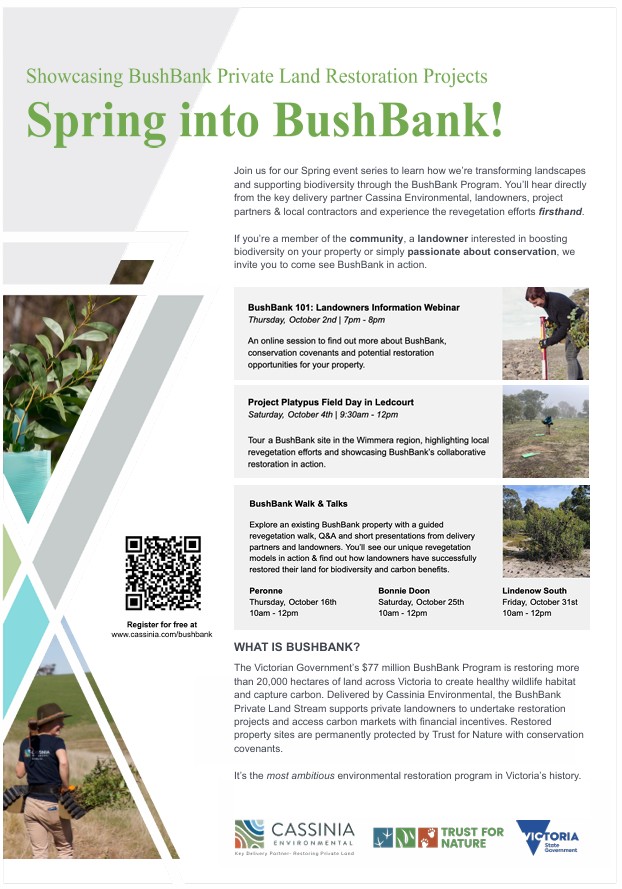 Spring BushBank events include:
BushBank 101: Landowners Discovery Webinar
Thursday, October 2nd, 7pm – 8pm
An online session hosted by Cassinia Environmental to introduce BushBank, conservation covenants and potential restoration opportunities, ideal for landowners curious about what the program involves and how to get started.
Project Platypus Field Day in Ledcourt
Saturday, October 4th, 10am – 12pm
Hosted by Project Platypus, this event offers a BushBank site tour and discussion of local revegetation efforts in the Wimmera region, showcasing BushBank’s collaborative restoration in action.
Walk & Talk: BushBank Restoration in Action
These on-site events provide a unique opportunity to visit a BushBank site and participate in a guided revegetation walk, Q&A and short presentations from delivery partners and landowners. Each property offers a unique landscape, backstory and revegetation process, giving attendees a firsthand look at successful restoration creating biodiversity and carbon benefits.
Walk & Talk Peronne
Thursday October 16th, 10am – 12pm
Explore this unique conservation site where large-scale restoration is underway with support from Land Life and Greening Australia. Attendees will see revegetation tailored to support the Red-tailed Black Cockatoo and other native fauna, and hear from contractors and seed collectors about the site’s transformation.
Walk & Talk Bonnie Doon
Saturday October 25th, 10am – 12pm
Meet landowner Lachlan Cook, whose 37 hectare property is a model for carbon and biodiversity restoration. Hear about his experience registering a carbon project and walk through steep, formerly grazed hills now regenerating with native species like Yellow Box and White Box. Plantings have been tailored across three ecological vegetation classes with a mix of direct seeding and seedlings.
Walk & Talk Lindenow South
Friday October 31st, 10am – 12pm
Tour a self-managed BushBank site restored by a bold landowner who has overcome challenging soil conditions and degraded pasture to establish thriving revegetation. Visitors will explore interesting direct seeding and planting techniques and hear practical insights into soil management, local flora and long term site care.
To learn more or to participate in the free “Spring into BushBank” events, visit www.cassinia.com/bushbank.
Taking Root and Branching Out
Posted on 3 September, 2025 by Lori
To celebrate Landcare Week in August, Connecting Country teamed up with Barkers Creek Landcare and Wildlife Group (BCLWG) to host a special event titled Taking Root and Branching Out on Wednesday 6 August at Phee Broadway, Castlemaine. The event centred on the launch of a beautiful audio documentary developed by local, award-winning podcast creator (and member of BCLWG), Kyla Brettle. It tells the story about the long tail of environmental damage wrought by the colonial gold rush in Central Victoria and the almost 30 year history of a tiny community group (Barkers Creek Landcare and Wildlife Group) striving to make a difference alongside a broader account of social change and the value of land-caring.
Over 150 people came to hear and learn in what has been described by some attendees as a more unusual, but extremely engaging and centering, experience where the focus was to ‘listen in’ without the overstimulation of heavy visuals. The podcast artfully articulates the journey of both landscape transformation and community learnings alongside music and local voices and you can’t help but be captivated.
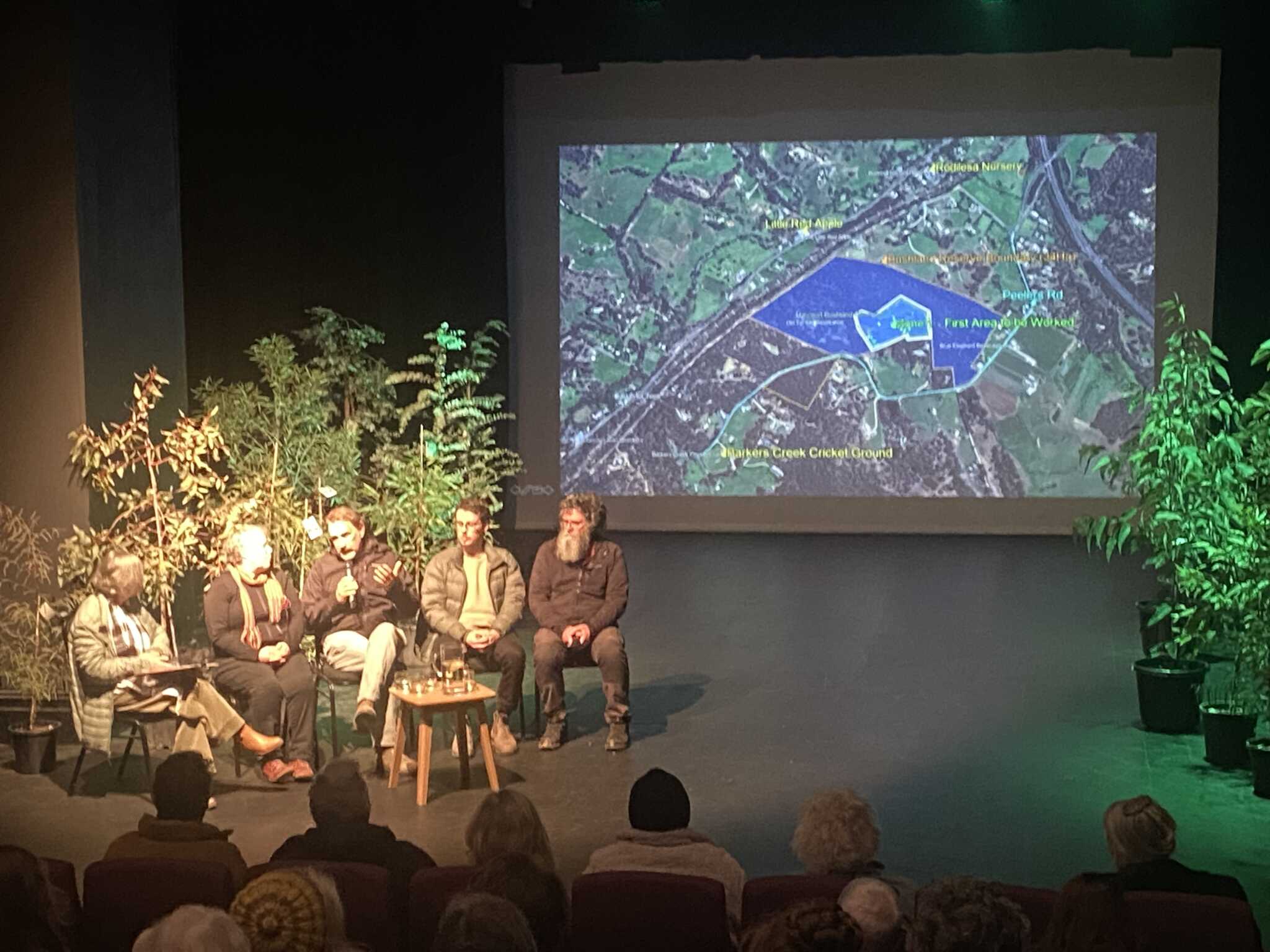
Photo: Sharon Fraser and members of the panel (L-R) Cath Jolly, Paul Foreman, Oli Moraes and Brendan Sydes discussing the Reserve.
After the podcast BCLWG provided a delicious sticky supper, a taste of the style of morning teas many Landcare groups strive after the heavy lifting of on-ground working bees. Sharon Fraser, MC for the evening then led a discussion panel about future plans for the Barkers Creek Reserve in Harcourt. Panel members Cath Jolly (BCLWG Secretary), Paul Foreman, ecologist with Biolinks Alliance, Oli Moraes, Galk-galk Dhelkunya Project Manager with DJAARA and Connecting Country President, Brendan Sydes emphasised the importance of engaging with partners and ‘experts’ to make a significant impact to our damaged countryside and the ongoing need for significant funding to achieve this ambition.
It was a heart-warming event and a big thanks go out to the Barkers Creek crew for creating this special evening in the center of Landcare Week as a celebration of what Landcare can achieve, but also what we can aspire to. If you missed it, a link to the podcast is available here and Kyla has written a reflection on the event on her Endgame Substack page.
This special event was hosted by Barkers Creek Landcare and Wildlife Group and Connecting Country with funding and support from The Victorian Landcare Program, North Central Catchment Management Authority, Ian and Shirley Norman Foundation, Mount Alexander Shire Council, The Little Red Apple, Biolinks Alliance and The Good Opp Shop.