

Bird of the Month Article: Scent & Pheromones in Birds
Posted on 17 September, 2026 by Hadley Cole
Bird of the Month is a partnership between Connecting Country and BirdLife Castlemaine District. Each month we take a closer look at a special local bird species . Thanks always to the brilliant Jane Rusden and Damian Kelly for these wonderful articles and fabulous photos.
Words written by Damian Kelly, Photo by Jane Rusden.
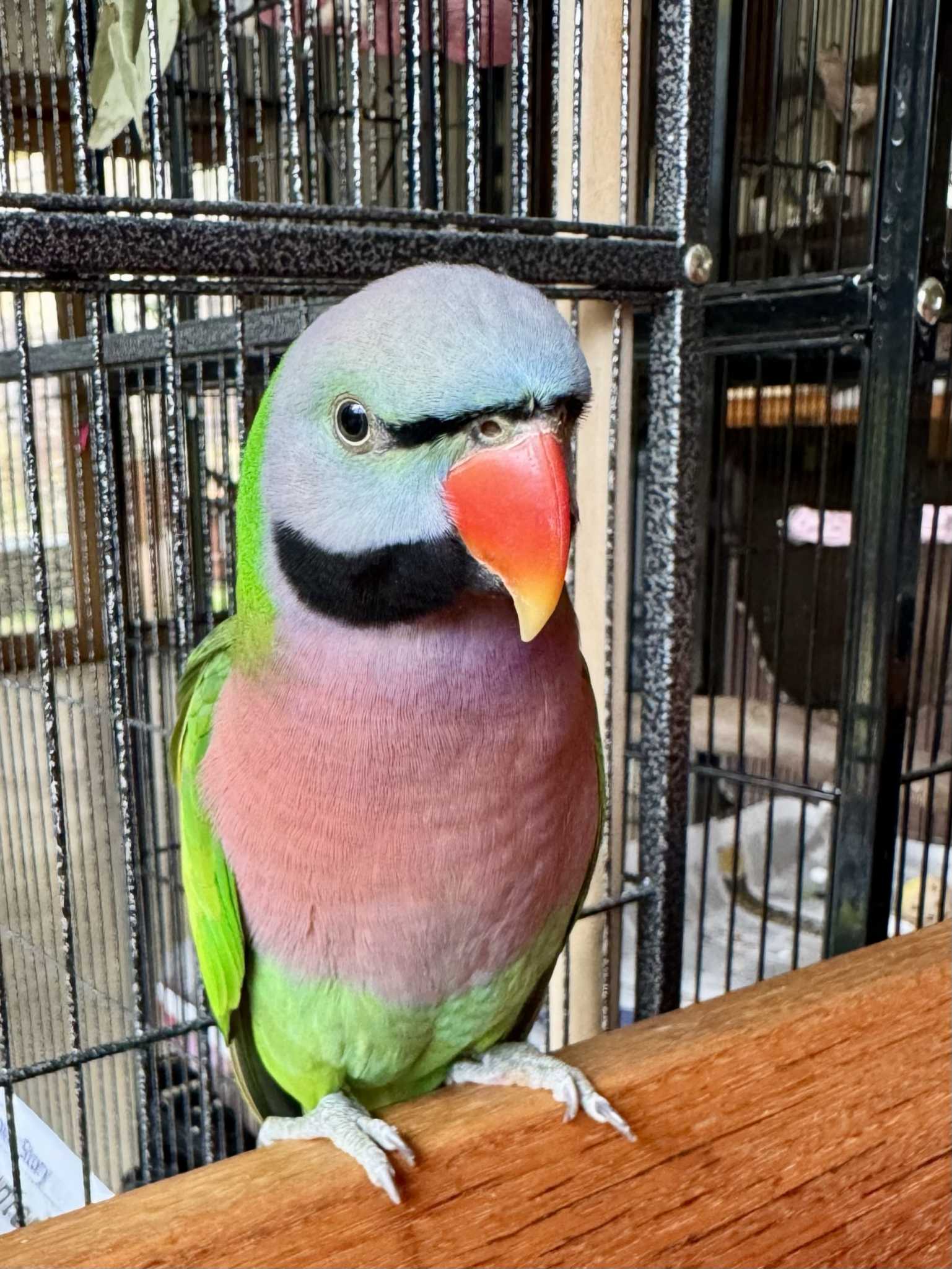
Red-breasted Parakeet having a chat and wafting his perfume, leading to questions about birds and pheromones. Photo by Jane Rusden.
When my rescue male Red-breasted Parakeet is happy and we are having quality one on one time, he’s eating a favourite food or going to bed (he loves bedtime), I’ve noticed he gives off a divine earthy scent of flowers, lavender and musk. Which has lead us to ask ‘Are pheromones a thing with birds?’ In this article we do an exploration into the world of bird noses, scents and smells.
Many animals use pheromones, a scented chemical secretion, to communicate with other animals which are often of their own species. If you see a moth with huge feathery antenna, you’re looking at a male and it’s apparatus for sniffing out females often over quite large distances, as she emits pheromones to attract a mate. Some mammals have scent glands just inside their anus, such as cats which spray territorial markers. Our local Long-neck Turtle are known to wee on you when moving them to safely off a road, a highly effective alarm system which stinks horribly.
What about birds? Various avian studies have demonstrated the complexity of avian olfactory structures, or noses, and indicated the relative importance of scent in species as diverse as kiwis, vultures and petrels, but also in species with much smaller olfactory features including various songbirds, pigeons, quail and chickens. Recent studies on pelagic birds (birds such as albatross and petrels that live on the open ocean) have found that these species use their sense of smell to create an olfactory map of the ocean, which they can then use to navigate when visual clues are not available, which is not unusual when you are living on the open ocean. Anyone who has been on a pelagic birding trip will be familiar with birds being attracted to fish waste. Sea birds are strongly attracted to fishing burley (chum) slicks because the scent of ground fish, oil, and small particles signals an easy meal. More examples of birds using smell in behavioural studies in particular, have now demonstrated that many species of birds use scent for a variety of things. From orientation in homing pigeons, food location in kiwis, vultures and petrels and the recognition of various odours in domestic chicks.
Interestingly, use of aromas can be cross species. Studies in Europe show that Blue Tits avoid entering their nests when there is an aroma of known predators around and it is likely that ground nesting birds such as waders use scent to confuse predators that rely on smell to detect nests and chicks. Which makes sense as wader nests are usually a rudimentary scrape on the ground and very exposed, relying of camouflage to hide them from predators that predominantly use vision to locate a meal.
Perhaps the clue to the scent given off by my Red-breasted Parakeet is a common local species, the Musk Lorikeet, also a popular aviary bred species which is well known for its distinctive scent. Its name is a giveaway and its aroma is often described as a combination of honeyed florals and a sweet earthy musk. It’s most likely the source of their earthy floral and musky scent is the birds preening oil, secreted from a gland on their rump. Scientific situations such as mist netting and bird banding, suggests these species don’t have a scent. However if the birds only waft pheromones when they are with their favourite person, it makes sense bird banders don’t get the olfactory pleasure of a nose full of parrot perfume.


Leave a Reply