

Clean up Australia Day: Sunday 3 March 2024
Posted on 27 February, 2024 by Ivan
Clean Up Australia Day is an annual nationwide event focused on empowering local communities to clean up, fix up and conserve the natural environment. This year Clean Up Australia Day will be held on Sunday 3 March 2024.

Local Landcare and Friends groups of the Mount Alexander/ Leanganook region often host a Clean Up Australia Day event. Please see below for a list of local events happening across our region or to find events happening near you – click here .
You can also get in touch with your local Landcare group to see if they are hosting a 2024 event by finding your local group on the Connecting Country website – click here
Friends of Campbells Creek 16th annual clean-up event:
Help to clean up rubbish along the creeks and trails, followed by a social morning tea.
Meet: We’ll meet here at the bus shelter next to Winters Flat Footbridge, Johnstone Street (Midland Highway), Castlemaine, and then spread out to various locations to gather rubbish and return to Winters Flat.
Early Start: We’ll start early (8:00 am) to avoid the heat of the day and finish work at 10:00 am.
We’ll provide: collection bags, rubbish skip (courtesy of the Council), tea/coffee and biscuits.
Wear: hats, gloves, sturdy clothing, enclosed boots/shoes
Bring sun protection, a rake if you have one, your own water (and a friend)
Hope to see you there!
For more details – click here
Sutton Grange Landcare Group
Where: Meet at the Sutton Grange Hall, Faraday – Sutton Grange Rd. Sutton Grange VIC
When: Sunday 3 March 2024, 9.00 am – 10.30 am
What to bring: Hats, sunscreen, sturdy footwear, water bottle, gloves and a friend!
It is anticipated that they will finish at 10.30 a.m. with refreshments and the opportunity to exchange thoughts on what you would like our group to concentrate on in 2024.
Golden Point Landcare Group
Where: Meet at Expedition Pass Reservoir (The Res), Golden Point Rd. Golden Point VIC
When: Sunday 3 March 2024, 10.00 am – 12.00 pm
What to bring: Hats, sunscreen, sturdy footwear, water bottle, gloves and a friend!
You can also register your own local clean-up event on the Clean Up Australia Day website – click here
Save the date: Natural Capital Forum 13 June 2024
Posted on 27 February, 2024 by Ivan
Our friends and project partners at the North Central Catchment Management Authority (NCCMA) are hosting an interesting forum in June 2024 on Natural Capital and how it might assist landowners balance biodiversity and potential income. Save the date for now, 13 June 2024, and if interested, please see the details below, including how to request an invite. We are excited to see how the Natural Capital space can assist landowners in our region manage their land with further incentive to restore the landscapes for ecological benefits.
Natural Capital Forum: Balancing the books between nature, productivity, and people
Join representatives from NCCMA on June 13, 2024, in Bendigo for the Natural Capital Forum and discover how you can harness the power of natural capital to drive success.
Learn about the wealth of natural assets like soil, air, and biodiversity that provide essential benefits to humans and see how you can make natural capital work for you.
Tailored for land managers, primary producers, farmers, and supporting organisations.
Stay tuned for more details or request an invite at info@nccma.vic.gov.au.
Don’t miss this opportunity to unlock the potential of natural capital for your success at the North Central Natural Capital Forum.

Bird of the Month: Great Cormorant
Posted on 22 February, 2024 by Anna
Welcome to Bird of the month, a partnership between Connecting Country and BirdLife Castlemaine District. Each month we’re taking a close look at one special local bird species. We’re excited to join forces to deliver you a different bird each month, seasonally adjusted, and welcome suggestions from the community. We are blessed to have the brilliant Jane Rusden and Damian Kelly from BirdLife Castlemaine District writing about our next bird of the month, accompanied by Janes’s stunning photos.
Great Cormorant (Phalacrocorax carbo)
While sitting in the deep shade of Castlemaine Botanical Gardens, nature journaling with BirdLife Castlemaine District, we witnessed a Great Cormorant diving underwater fishing. Somehow it managed to swallow, with considerable effort, a huge silver fish which glistened in the morning sun. After the swollen bulge in its neck deflated as the massive fish went down its gullet, the Great Cormorant had a swish of its face and a bit of a bath, before perching on the much-loved tree that hangs well over the water from the island in Lake Johanna. After a bit of a preen, it set about drying its wings and digesting its huge meal.

Great Cormorant drying its wings in a typical pose for the species. Bird feathers are structured to be waterproof and trap air, but diving birds have a more open structure because trapped air would be like trying to dive with floaties on … very difficult. As a consequence, the Great Cormorant gets soaking wet and needs to dry out after a fishing session. Photo by Jane Rusden.
The Great Cormorant is a true cosmopolitan species. You can find it in the Botanic Gardens in Castlemaine as well as across the world. It is the most widespread cormorant and can be found over much of Europe as well as China, Japan, Africa, India, America, New Zealand and parts of South-east Asia. Up to 6 subspecies are recognised. Overseas birds tend to have more white on the face than Australian birds.
As a very adaptable species, it can be seen both along the coast as well as inland wherever there are rivers or large water bodies. Banding studies in Australia show that some birds are sedentary, but more than half were later recorded a long way from their original location. Birds have been recorded travelling from NSW to Western Australia and even as far as Macquarie Island and Lord Howe Island.
Interestingly, overseas in Europe and America it is largely associated with coastal regions and estuaries. However, in Australia it is primarily a freshwater bird. Diet consists mainly of fish, crustaceans, frogs and large insects. Fish are usually caught by diving, with mainly shallow dives of 1-3 metres and mostly less than 1 minute under water. The deepest dive recorded has been 9.5 metres.

A Little Pied Cormorant (left) and a Great Cormorant (right) perched, at Lake Johanna. Notice the beautiful teal colour of the Great Cormorant’s eye. Photo by Jane Rusden.
Great Cormorants are sociable birds that breed and travel in groups. Breeding is usually in large colonies up to 2000 birds, although one colony at Lake Menindee in NSW numbered around 20,000 birds. Breeding tends to be erratic, especially inland where it depends on water levels. Nests are open, flat platforms made of sticks, twigs, plant material and debris. Usually 3-5 eggs are laid and both parents incubate and feed the young.
Their range overlaps with other Australian cormorants but usually it is easy to separate them as only the Little Black Cormorant is similar, although it lacks any yellow on the face area.
Focus on trees: Tree photography workshop opportunity
Posted on 19 February, 2024 by Ivan
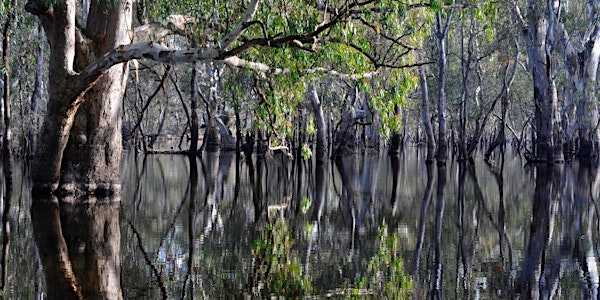
Our friends and project partners at Biolinks Alliance are hosting a large old trees photography workshop with the wonderful Alison Pouliot. Alison is a leading expert and holder of knowledge regarding nature photography, conservation, fungi and deep ecosystem understanding.
Connecting Country are requesting our community and supporters to map significant old trees in our region, through our project here. Well captured photography can contribute greatly to recording and telling their story.
Please see details about the event below, including how to book tickets.
Focus on Trees – Tree Photography Workshop with Alison Pouliot
Large old trees are vital keystone structures in rural and urban landscapes. However, the value of these trees is often overlooked in planning such as road and fire management. Documenting these trees visually is important both as a scientific record and in drawing attention to their significance and conservation.
This workshop specifically focuses on assisting participants to improve both their technical and creative skills in photographing trees. Tree photography provides many challenges and each of these will be discussed and techniques for overcoming them demonstrated throughout the workshop. This is a very hands-on, interactive workshop combining theoretical, critique and practical sessions. It begins with a discussion of participants’ interest in photographing trees as well as any challenges or issues they may have experienced. This is followed by a session where participants’ pre-submitted images will be constructively critiqued by the group (during which participants are free to remain anonymous), followed by a field trip to put techniques into practice. Participants will be provided with supplementary printed notes to reinforce principles covered in the workshop.
Participant Requirements
Participants are asked to wear appropriate clothing and sturdy footwear for the field trip, which will go ahead regardless of weather. They are reminded to bring their cameras/phones including additional batteries, battery charger and instruction manual. Participants are encouraged to submit two images (as per guidelines that will be provided to participants) prior to the workshop for constructive critique during the workshop.
Book here
This event is being held as part of Biolinks Alliance’s Large Old Trees project and is made possible through the generous support of the TAP fund, Lindy Shelmerdine, David Moffatt and Lady Marigold Southey. You can find out more about this project here: https://biolinksalliance.org.au/hero-tree