

Mapping large old trees: let’s celebrate and protect these beauties!
Posted on 28 September, 2023 by Ivan
It has been a little over a year since we announced the arrival of our new mapping portal, aimed at helping community citizen scientists map the old, and often large, trees of Central Victoria.
We have been excited to see the database entries feed in over the past 12 months and we have now reached 25 large old trees entered into the portal. The majority of the entries have been around the Maldon, Welshmans Reef, Chewton, Castlemaine and Guildford areas, with a variety of citizen scientists taking some excellent photos and providing data about the tree species, age, height and habitat values. A special mention must go to Bev Phillips from Maldon Urban Landcare Group (MULGA), who entered a whopping 15 trees into the database. Well done, and a massive thank you, Bev, for your persistence and love for our landscape.
We thought it would be timely to publish the photos entered into the mapping portal so far, to highlight the diverse range of large old trees across our landscape. Interestingly, all of the 25 entries are Eucalyptus species, which are usually the tallest trees in the local landscape. We would love to see some other species mapped and entered, such as the Casuarinas, Acacias, Banksias, Bursarias and other local midstory species.
Please enjoy the images below, captured by our keen citizen scientists over the past 12 months.


The interactive mapping portal is part of Connecting Country’s larger project, ‘Regenerate before it’s too late‘ , engaging the community in the importance of old trees and how to protect them. Over the next two years (2024-2025), we will continue to host community workshops and develop engagement resources. We will also help local landholders with practical on-ground actions to protect their large old trees and ensure the next generation of large old trees across the landscape.
How to map and enter old trees in our mapping portal
We are asking the community, including landholders, Landcarers and land managers, to map their favourite old trees across our region. Anyone can access Connecting Country’s new online mapping portal. The portal uses BioCollect, an advanced but simple-to-use data collection tool developed by the Atlas of Living Australia (ALA) and its collaborators. BioCollect helps users collect field biodiversity data for their own projects, while allowing the data to be easily copied into the ALA, where it can be publicly available for others to use in research, policy and management. This allows individual projects to collectively contribute to science across Australia.

The mapping portal is now open for any community member to record the old trees in your area. You will need to register with the Atlas of Living Australia (its easy and free), then upload a photo and enter the field details needed for the survey. The portal will ask you simple questions about the tree location, size, species, age (if known), health status and habitat value.
To record your large old tree, or view the field survey questions and required measurements – click here
By recording large old trees, you will help build our understanding of the large old trees in our region and contribute to the largest biodiversity database in our country. As the database grows, you can also access the portal to learn about other wonderful large old trees in our area and view the photos.
We are most grateful to the generous project support from the Ian & Shirley Norman Foundation. The foundation aims ‘To encourage and support organisations that are capable of responding to social and ecological opportunities and challenges.’ To learn more about Ian & Shirley Norman Foundation – click here

Bird of the Month: Brown Treecreeper
Posted on 19 September, 2023 by Jess
Welcome to Bird of the month, a partnership between Connecting Country and BirdLife Castlemaine District. Each month we’re taking a close look at one special local bird species. We’re excited to join forces to deliver you a different bird each month, seasonally adjusted, and welcome suggestions from the community. We are blessed to have the brilliant Jane Rusden and Damian Kelly from BirdLife Castlemaine District writing about our next bird of the month, accompanied by Damian’s stunning photos.
Brown Treecreeper (Climacteris picumnus victoriae)

Pizza stealing Brown Treecreeper at Warburton’s Bridge Campground. Damian Kelly took this stunning portrait, despite losing some pizza to this cheeky thief.
Even homemade pizza is not a healthy addition to the Brown Treecreeper’s diet, but Damian Kelly was taken unaware as this little bird crept in and stole a bite with the skill and confidence of a seasoned food thief. Usually more wary, Brown Treecreepers are often seen disappearing around the back of a tree trunk or even hanging upside down on the underside of a branch as they forage for insects and spiders, their usual food source.
In spite of its name, the Brown Treecreeper can also be seen on the ground foraging for insects. Due to its very large tree-climbing feet, when on the ground this bird hops in a distinctive way, rather than walking. The anatomy of their unusual feet mean that when getting a drink from a birdbath, they reverse into the water. These feet are built for roosting on vertical surfaces as they sleep, quite hard to fathom how this is restful, but it works for this incredible bird!
The Brown Treecreeper usually feeds in pairs or small groups of 3-8 birds, foraging equally between the ground and trees. In human frequented places like picnic grounds and camp sites individuals will often come close to people. Like Damian with the pizza, I have had experiences locally with birds that have approached me and pinched bits of my food quite boldly!
The Brown Treecreeper is Australia’s largest treecreeper and its range extends all the way down the east coast from Cape York in Queensland and inland around to South Australia, generally preferring drier open woodlands.
As one of Connecting Country’s “Feathered Five” the Brown Treecreeper is a key indicator of the health of woodland fauna in our area and can often be seen and heard in our local woodland areas. Unfortunately in recent times populations of this species have been declining in various parts of its range due to land clearing, as well as changing fire regimes that reduce ground cover.
Generally this species is quite sedentary and banding studies have shown that almost 100% of re-captures have been less than 10km away from the original banding site. It is quite a long-lived species with some birds known to be at least 11 years old.
Nesting occurs in tree hollows, usually beneath the leaf canopy with a clutch size of 3 eggs. Sometimes a second clutch is raised in a season. Co-operative breeding has been recorded with additional helpers, usually males from the previous clutches, feeding the young.

Brown Treecreeper calling from the side of a tree trunk, Rise and Shine Reserve. Photo by Damian Kelly.
Spring is the perfect time to wander in our local reserves, parks and woodland areas looking for birds. Keep and ear and an eye out for the engaging Brown Treecreeper.
Find more information on Brown Treecreepers, including their calls, here.
Large old tree walk: with Uncle Rick Nelson
Posted on 13 September, 2023 by Ivan
Connecting Country is thrilled to announce we are teaming up with Nalderun Education Aboriginal Corporation to deliver a cultural walk through the majestic large old trees at Castlemaine Diggings National Heritage Park in Golden Point, VIC. Come along and learn about these centuries-old trees, their cultural importance to the Dja Dja Wurrung people and the important role they play for biodiversity.
Our very special guest speaker is Dja Dja Wurrung Elder, Uncle Rick Nelson. He is a cultural advisor for the community on various matters for the Dja Dja Wurrung. Uncle Rick will take us on a guided walk, showing us some of the large old trees that sit quietly in our landscape and sharing their cultural significance. We are super excited to have his knowledge for this experience.
This is a free event for limited numbers, with lunch provided, so please book early to avoid disappointment.
For catering and logistical purposes, please register your attendance – click here
- When: Saturday 14 October 2023 10:00 AM – 12:00 PM
- Where: Castlemaine Diggings National Heritage Park, Golden Point 3451 (exact location will be revealed once you book)
The cultural walk is part of Connecting Country’s larger project, ‘Regenerate before it’s too late‘ aimed at engaging with the community about the importance of old trees and how to protect them. Over the next two years, we will develop engagement resources such as the old tree mapping portal, community events and an educational video. We will also help local landholders with practical on-ground actions to protect their large old trees and ensure the next generation of large old trees across the landscape.
- Click here to book, tickets are limited, so get in quick.

We are most grateful for our generous project support from the Ian & Shirley Norman Foundation. The foundation aims ‘To encourage and support organisations that are capable of responding to social and ecological opportunities and challenges.’ To learn more about Ian & Shirley Norman Foundation – click here
Learn more about Nalderun: Click here
Calling all nature lovers: iNaturalist workshop Friday 6 October
Posted on 13 September, 2023 by Ivan
It’s here! We are excited to present our much-anticipated workshop on how to use and benefit from the iNaturalist biodiversity platform. As part of ‘The Buzz project: promoting pollinators of Central Victoria’, Connecting Country is hosting an iNaturalist workshop on Friday 6 October 2023 in Castlemaine, VIC. Local naturalist and Castlemaine Field Naturalist Club member Euan Moore will hold the workshop and will cover a range of skills including;
- How to set up an iNaturalist account and profile
- How to upload photos to iNaturalist
- How to reach out to naturalists and scientists on iNaturalist to confirm, verify or identify your sightings
iNaturalist is a wonderful online platform that allows all curious citizen scientists to record sightings and identify all kinds of species including, insects, birds, mammals, reptiles, plants, sea life, coral, and fungi. Species that are identified and verified are added to a sweep of data that is collected and recorded not only on iNaturalist but also to the Atlas of Living Australia. Recording data is vital in conservation management. If we know what is out there then we can make the best decisions on how to restore and protect biodiversity across the country!

iNaturalist is a nonprofit social network of naturalists, citizen scientists, and biologists built on the concept of mapping and sharing observations of biodiversity.
This is a free event for limited numbers, with lunch provided, so please book early to avoid disappointment.
To register your attendance – click here
- When: Friday 6 October 2023 10:00 AM – 2:00 PM
- Where: Castlemaine Senior Citizens Centre
This is a wonderful opportunity for keen Landcarers to learn the most efficient and useful ways we can use iNaturalist to record data across Landcare sites in the region.

The Buzz Project is funded by the 2022 Victorian Landcare Grants through the North Central Catchment Management Authority. We would like to thank the NCCMA for making this event possible.
Walking Together – Cultural Literacy
Posted on 11 September, 2023 by Ivan
Please enjoy this wonderful article from our friends and project partners at Nalderun. The article was written by Floria Maschek, an ally and member of Friends of Nalderun (FoN). Nalderun is a Dja Dja Wurrung word meaning “all together”.
Walking together – cultural literacy
I gaze across the historic Monster Meeting site by Forest Creek in Chewton, the view to the creek unbroken. Now a bumpy, grassy landscape, I imagine what was once likely a forest, once likely sheep trodden paddocks, and once a tortured ‘honeycombed’ ‘moonscape’. New plantings are growing along the water’s edge where it curves away. Many know this area as ‘upside down country’, a reference to the gold diggings. A digger’s flag flaps noisily in rainy gusts, marking a place and time, an important rebellion that shaped Australian democracy, a triumph …but this place speaks about more…
Here is a merging of histories, futures, the present; those of the First Peoples, the squatters, the digger’s, those after, here now and to come. Standing between the mountains I know as Liyanganuk Banyul, Dharrang Gauwa, Lalkambuk, Gurutjang, I’m conscious of a teaching as ancient as local volcanic rumblings. Country is always connected to all points of time. I wander and wonder in Djaara Country – Djandak.
A sign drew me here – wood, metal, laminate. ‘Womin-dji-ka’ is written in large, friendly lettering. Commonly interpreted as ‘welcome’, a more literal translation is ‘to come – (an instruction of) I am asking you to come – purpose’. Included are further words in Dja Dja Wurrung (‘Wurrung’ – speaking/language/ tongue). The new sign, with its old pictures and ancient words, is a sign of living culture and change. A QR code links me to a video of a traditional Welcome to Country.
This continent is home to more than 250 Traditional First Nations languages and about 800 dialects. Indigenous languages were banned, lost through many violent and systemic acts of colonisation. Increasingly traditional languages, knowledge and culture are embraced. First People are rediscovering and sharing their heritage. There are nuances to the term ‘literacy’. Cultural literacy means that we better understand beautiful and complex traditional systems, empowered by orality.
From story, song, local seasons, life cycles, soil, fire practices, to kinship, art, the reading of the stars and the spaces between…Everything can be read with diverse ways of knowing.
Ngunnawal, Wiradjuri and Kamilaroi artist and activist Lynnice Church says
‘Language is part of our songlines, stories, spirituality, law, culture, identity and connection. Language transfers important knowledge passed down from our Ancestors and Elders that guides us.’
Indigenous Literacy Day is on September 6th. When I first considered literacy as a topic, I felt uncomfortable for reasons not yet entirely clear to me. Discomfort had something to tell me. As I listened, it slowly dissolved.
I once heard Aunty Julie McHale give a teaching. Not just a story – as was made very clear by this much respected Elder. It had survived since little Lalkambuk was a fiery active volcano. Importantly, I learnt that teachings are told in a way that is relational to the listener. Everything I’ve learned about First Nations cultures shows they are deeply adaptive and relational. It is not without reason that they are the oldest continuous cultures on earth.
The QR code is a modern portal for sharing cultural traditions. New technologies are often embraced with ingenuity by First Peoples as they share in their cultural ways. I am learning about the complexities of language sharing at an interesting time.
First Nations communities can more freely explore and restore language and culture now, but this process of restoration is a sensitive, gradual one. Respect means we honour these processes by embracing First Peoples agency, listening carefully, particularly to local Elders. As respect grows, so too will our cultural literacy. As we better read and look after Country, it is better able to sustain all who walk here.
I am learning from First Nations educators, importantly Djaara. Special mention to Harley Dunnoly-Lee, Djaara Elders and non First Nations people living locally – Lynne Kelly and Vic Say.
To learn more:
Djaara – learn more about Dja Dja Wurrung, the Djaara and Djandak: Click Here
Boorp Boorp Boondyil
A permanent, award winning, interactive exhibition produced by Djaara Elder Uncle Rick Nelson continuing the legacy of his late father Elder Uncle Brien Nelson. Mount Alexander Shire Council, and SharingStories Foundation, Nalderun Education Aboriginal Corporation and St. Peters Primary School were essential partners. Castlemaine Visitor Centre.
Floria Maschek is an ally and member of Friends of Nalderun (FoN). FoN members are guided by Nalderun Education Aboriginal Corporation and are diverse individuals and representatives of many local community networks, supporting Nalderuns visions and work. Nalderun Education Aboriginal Corporation supports the Aboriginal Community and is led by Aboriginal people while providing many learning and cultural opportunities to the broader community. Nalderun is a Dja Dja Wurrung word meaning “all together”.
More information can be found at www.nalderun.net.au
Caring for old paddock trees: best practice
Posted on 11 September, 2023 by Ivan
Why protect paddock trees?
Paddock trees are often the oldest and most valuable habitat elements in agricultural landscapes. When paddock trees are cleared, it takes generations to replace the habitat they provided, including the insects and abundant nectar for birds and mammals, thick bark with cracks and crevices for microbats and small reptiles, and hollows for many significant species.

Paddock trees provide great habitat for travelling birds and wildlife between larger tracts of habitat. Photo: CC
Even standing dead trees, fallen branches and leaf litter offer valuable resources and should be retained wherever possible. Many paddock trees across our region are suffering die-back caused by old age, pests and disease, nutrient loading, soil compaction and lack of protection from intensive agricultural practices. These valuable giants are disappearing from our farming landscapes, often with no younger trees to replace them. However, we can take action to protect paddock trees to extend their life, and establish future generations.
How do we protect paddock trees?
- Fence off paddock trees from stock and machinery where possible, including space around them to promote natural regeneration.
- Incorporate existing paddock trees into revegetation plantings to improve the health of paddock trees and habitat value of revegetation.
- Leave dead paddock trees standing if possible – they contain cracks, crevices and hollows for wildlife such as microbats, and perching sites for birds of prey, parrots and water birds.
- Install stock-proof guards around young trees within paddocks if fencing is not feasible.
- Reduce grazing pressure: When native vegetation is browsed heavily, plants struggle to flower or set seed, and they have less habitat value. Grazing pressure also creates soil compaction and increased nutrient loads from manure.

A magnificent large Yellow Box (Eucalyptus melliodora) with young, successional trees growing in a fenced off area. Photo: CC
The importance of remnant vegetation
As most of our region was cleared for mining, timber and agriculture, any remaining native vegetation is extremely valuable for wildlife habitat and provides many on-farm benefits. Remnant vegetation is essentially indigenous plants growing in their natural environment. Protecting bush with lots of plant species and a complex structure is the highest priority. However, even a single large old tree, or a patch of native grasses or shrubs is worth protecting.
Revegetation is a valuable tool to increase species diversity, and expand or reconnect existing patches of bush to provide habitat for wildlife. However, the process of reestablishing high quality habitat in cleared areas is very labour-intensive and slow.
Large trees can take hundreds of years to grow and develop the tree hollows and create the fallen timber essential for many local wildlife species. Leaf litter can take decades to rebuild. Soil conditions in disturbed areas often favour weedy grass growth or inhibit growth of native plants, and some plant species are difficult to source or are unavailable.

Revegetation of degraded woodlands with understory plants. Photo: Gen Kay
Protecting what native vegetation is already there, and providing the conditions for it to regenerate naturally, is much cheaper and easier than re-establishing it from scratch. Eucalypts and other plants often self-seed, and if protected from grazing animals and weed competition, can start to establish. It is far easier to protect areas of seedlings with plant guards or fencing than investing in the planning, site preparation, planting, and ongoing maintenance of revegetation.
And finally……leave rocks, logs, branches and leaf litter
Leave logs on the ground to provide important resources for fungi, insects, reptiles, frogs, birds and small mammals. Clearing up rocks, logs, branches and leaves will exclude many woodland animals by removing the habitat elements they depend on. It will create a simple habitat and favour animals that are already common in our towns and farms, like magpies, cockatoos, rabbits, foxes and hares.
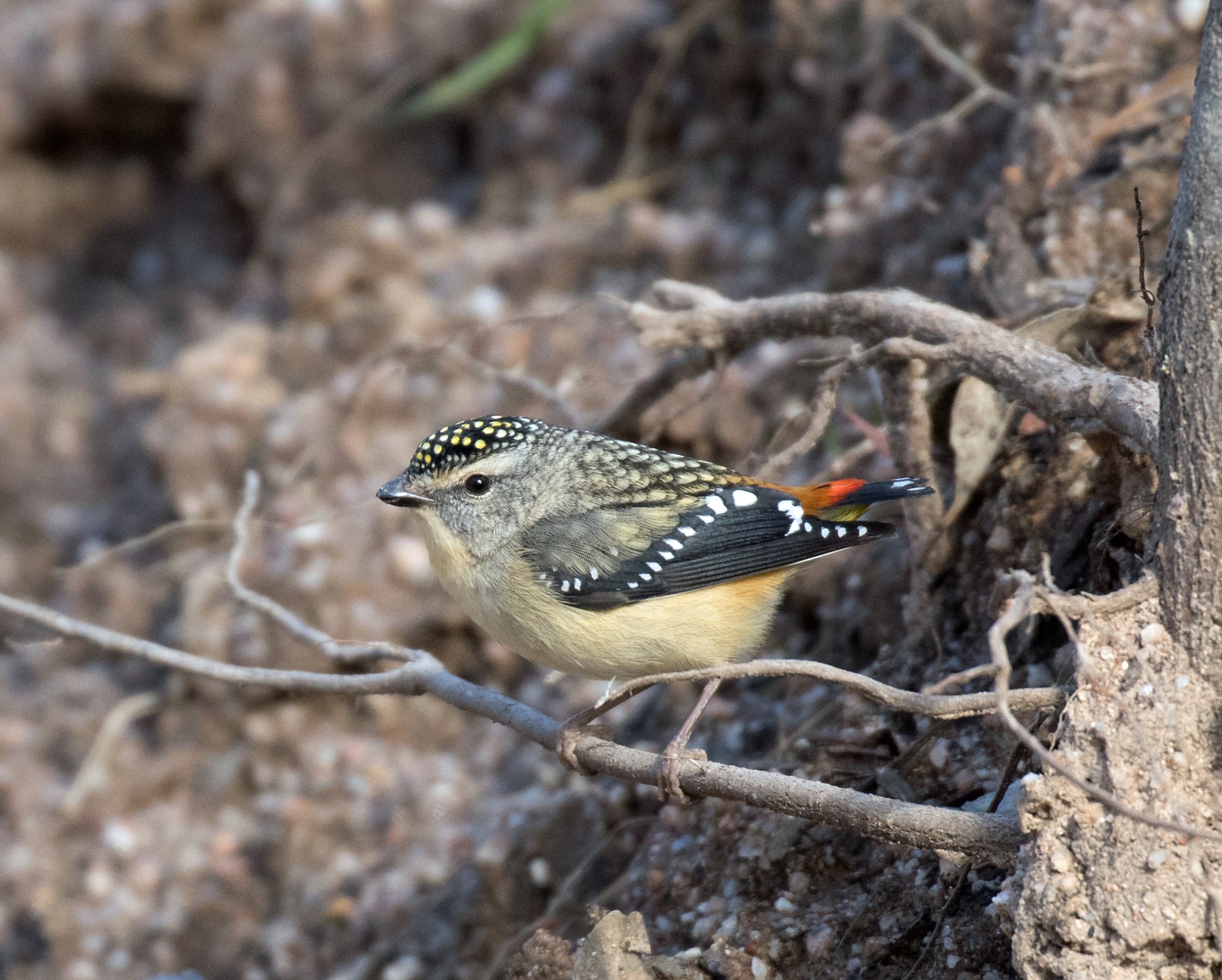
The gorgeous Spotted pardalote (Pardalotus punctatus) searching for insects in the leaf litter and dead branches. Photo: Geoff Park
We all want to protect our properties from bushfire. However, make sure you check the latest research and guidelines on fire hazard reduction. Some historical practices are now considered ineffective for fire control but highly damaging for the environment. For example, removing leaf litter creates bare ground which often encourages weed growth, creating its own fire hazard. If you do need to remove logs and branches for safety or access, consider moving them to another location where they can continue to provide habitat.
This factsheet is part of a larger project called ‘Regenerate before it’s too late‘ that engages the community about the importance of old trees and how to protect them. We are most grateful for the generous project support from the Ian & Shirley Norman Foundation . The foundation aims ‘To encourage and support organisations that are capable of responding to social and ecological opportunities and challenges.’ To learn more about Ian & Shirley Norman Foundation – click here
National Threatened Species Day 2023: Central Victoria’s Ballantinia
Posted on 7 September, 2023 by Hadley Cole
National Threatened Species Day on 7 September each year aims to raise awareness of plants and animals vulnerable to extinction across Australia. According to Nature Conservancy Australia, we have 100 endemic Australian species that have been declared extinct as of March 2021.
Threatened Species Day offers a moment to pause and reflect on how we can conserve and protect Australia’s vulnerable and often unique species from becoming extinct. Many of Australia’s threatened species have become so due to human activity such as land clearing, the introduction of non-native pest and weed species and climate change which has lead to the fragmentation of native species populations. Often the solution to protecting threatened species is through human intervention in the conservation, restoration and enhancement of habitat and biodiversity.

Ballantinia antipoda is a tiny annual plant growing among moss. Photo by Aaron Grinter.
Sadly, in Central Victoria we have numerous threatened species including flora and fauna. A lesser known but precious endemic threatened species in the region is Ballantinia antipoda or Southern Shephard’s Purse. Ballantinia is a tiny annual brassica, less than 5cm tall, with striking delicate white flowers. It has a very limited habitat range across the highest points of Leanganook (Mount Alexander).
Ballantinia was endemic to south-eastern Australia, being found through parts of Victoria and Tasmania. Around the 1800s, it started disappearing and was presumed extinct for most of the 20th century until it was rediscovered at Leanganook (Mount Alexander) in 1983. With much of the wider environment heavily modified for development and agriculture and invaded by weeds, the plant found refuge by growing in delicate moss mats on granite outcrops on the mountain. Surveys across the species’ historic range have failed to locate Ballantinia at other sites, and so it is believed that the only surviving population of the species is on Leanganook (Mount Alexander). Accordingly, its status is extinct in Tasmania, and critically endangered in Victoria.
In order to continue to preserve the species, annual surveys are undertaken to locate these refuges and note their condition, including current threats. In late August 2023 volunteers from across the Mount Alexander region joined Department of Energy, Environment and Climate Action’s Natural Environment Programs Officer, Aaron Grinter, to survey for Ballantinia across Leanganook (Mount Alexander).
Aaron reported that” the survey was attended by 15+ volunteers including Harcourt Valley Landcare and Metcalfe and Sutton Grange Landcare groups, as well as Parks Victoria field staff, Threatened Species Conservancy, Bendigo TAFE, Royal Botanic Gardens Victoria, and Connecting Country. All recently recorded population patches were surveyed except 1 due to time constraints. The plant was absent in 3 of the 8 remaining areas, and, where it was found, it was in significantly reduced numbers. One of the most important sites in particular that has previously recorded more than 1000 plants, only recorded 65. While climatic variation between warmer and cooler seasons is expected, a warming climate poses a significant threat to the species.

Volunteers survey for Ballantinia antipoda at Leanganook (Mount Alexander). Photo by Aaron Grinter.
As Ballantinia is a cool climate annual, it germinates at 14 degrees Celsius, so we speculate that because of this warm, short winter, it hasn’t has the opportunity to fully sprout, which means the seed bank is not being sufficiently replenished. Royal Botanic Gardens Victoria have collected seed from the Ballantinia population in the past and have successful grown plants in a controlled environment. They will be returning next month to collect seed to bolster diversity in the population they have grown at the Royal Botanic Gardens.”
Thank you to Aaron Grinter, Natural Environment Program Officer at DEECA for the information and photos for this article.
Revegetation in a changing climate captures audience
Posted on 4 September, 2023 by Ivan
On Tuesday 1 August 2023, over 60 people gathered at the Castlemaine Anglican Church Community Hall to hear excellent presentations from a variety of guest speakers addressing how we can plan revegetation in a changing climate for best success. The strong mid-week, mid-winter audience heard from Sasha Jellinek (University of Melbourne), Oli Moraes from DJAARA and Tess Grieves from the North Central Catchment Management Authority (NCCMA). The evening was completed with a Q&A panel session to answer the audience’s questions and give reason for hope in the future.
The overall learning and topics revolved around how we can use climate prediction modelling to consider future vegetation growth conditions and adapt current practices to future-proof our landscapes.

Lead guest speaker, Sasha Jellinek, covered where to find information on climate projections and future scenarios, as well as sourcing seeds from a mix of local and different bioregions, and how to make up this mix. Sasha is an experienced ecologist with a Doctor of Philosophy (PhD) focused on Ecology from the University of Melbourne and has worked across many fields. He was involved in the production of Greening Australia’s ‘Establishing Victorias Ecological Infrastructure; A Guide to creating Climate Future Plots‘ which is a great resource for those embarking on this road.
Oli presented DJAARAs recently released Climate Change Strategy and talked about how we can approach revegetation projects using cultural knowledge and wisdom. Tess provided a great overview of the NCCMAs climate resistance projects and how they have been incorporating climate change modelling into their project planning and implementation.
A highlight of the presentations was the passion, dedication and knowledge of all three guest speakers, and we thank them for sharing so that we can all start planning for future success.
The event was recorded by the wonderful Ally from Saltgrass Podcasts and is available here.

This event was part of a larger project called Future Proof our Forests, where Connecting Country has established Climate Future Plots to monitor the success (or otherwise) of revegetation sourced from a variety of climates.
We would like to thank the Ross Trust for their generous funding for this important project. The Ross Trust is a perpetual charitable trust with a vision to create positive social and environmental change so Victorians can thrive.
Learn more:
For more information on climate future plots, see:
https://www.greeningaustralia.org.au/climate-future-plots/
https://connectingcountry.org.au/what-is-a-climate-future-plot/
