

Phascogale talk on Thursday 3 May 2018 in Maldon
Posted on 30 April, 2018 by Tanya Loos
 Did you know that Duans wag their tails when excited and purr when they sleep?
Duan is the Dja Dja Wurrung name for the Brush-tailed Phascogale.
Come along to a free public talk to learn about the secrets of the Brush-tailed Phascogale. Hear about a new project using chainsaws to create artificial nesting sites for the threatened Brush-tailed Phascogale in central Victoria.
William Terry from Southern Cross University will present his local research into this fascinating species – Managing the impacts from development and urbanisation on the Brush-tailed Phascogale in the modified landscape of central Victoria.
When: Thursday 3 May from 7 to 8 pm
Where: Maldon Neighbourhood Centre, Corner Church and Edwards Streets, Maldon.
Bookings are not required.
Makarrata Garden Tarrangower is a community engaged sculpture project to research habitat of Powerful Owl and Duan, and to educate ourselves about the history of Dja Dja Wurrung people and celebrate their living culture. Makarrata is a complex Yolngu word describing a process of conflict resolution, peacemaking and justice. For more information on this project, see www.forestkeegel.com
Details for rescheduled Camp Out on the Mount 2018
Posted on 26 April, 2018 by Asha
New details for the rescheduled Camp Out on the Mount are now available. Please follow this link to the Camp Out web page to stay updated: https://connectingcountry.org.au/landcare/camp-out-on-the-mount-2018/

Cooking damper at the 2017 Camp Out on the Mount
When: Friday 11 to Saturday 12 May 2018
Where: Leanganook Camping Ground, Joseph Young Drive, Mount Alexander Regional Park, Faraday
What to bring: Camping gear, food (Lions Club BBQ will be available on Friday night for a gold coin donation), weather appropriate clothes and sun protection.
CLICK HERE to visit the booking website – registering your interest is the best way to stay updated about any schedule changes.
Below is a run-down of the 2018 Camp Out weekend. You are more than welcome to attend some or all of the activities. If you have any questions, please call Asha on (03) 5472 1594 or email asha@connectingcountry.org.au

PLEASE NOTE: In the event of severe weather warnings (e.g., storms or extreme heat), the Camp Out on the Mount will be cancelled.
Homes for birds and mammals: nest box workshop Sunday 6 May 2018
Posted on 26 April, 2018 by Tanya Loos
Are you considering enhancing your property by adding a few homes for wildlife? Rosellas, pardalotes, kookaburras and owlet-nightjars will readily use nest boxes. Many mammals will use them too, including possums, bats, sugar gliders and brush-tailed phascogales!
Autumn is an ideal time of year to install nest boxes, according to Miles Geldard, who has designed and constructed thousands of nest boxes. Animals are seeking warm and secure homes before winter.
If you already own nest boxes, or want to set some up on your property, come along to an afternoon workshop with Miles and Connecting Country in McKenzie Hill, near Castlemaine.
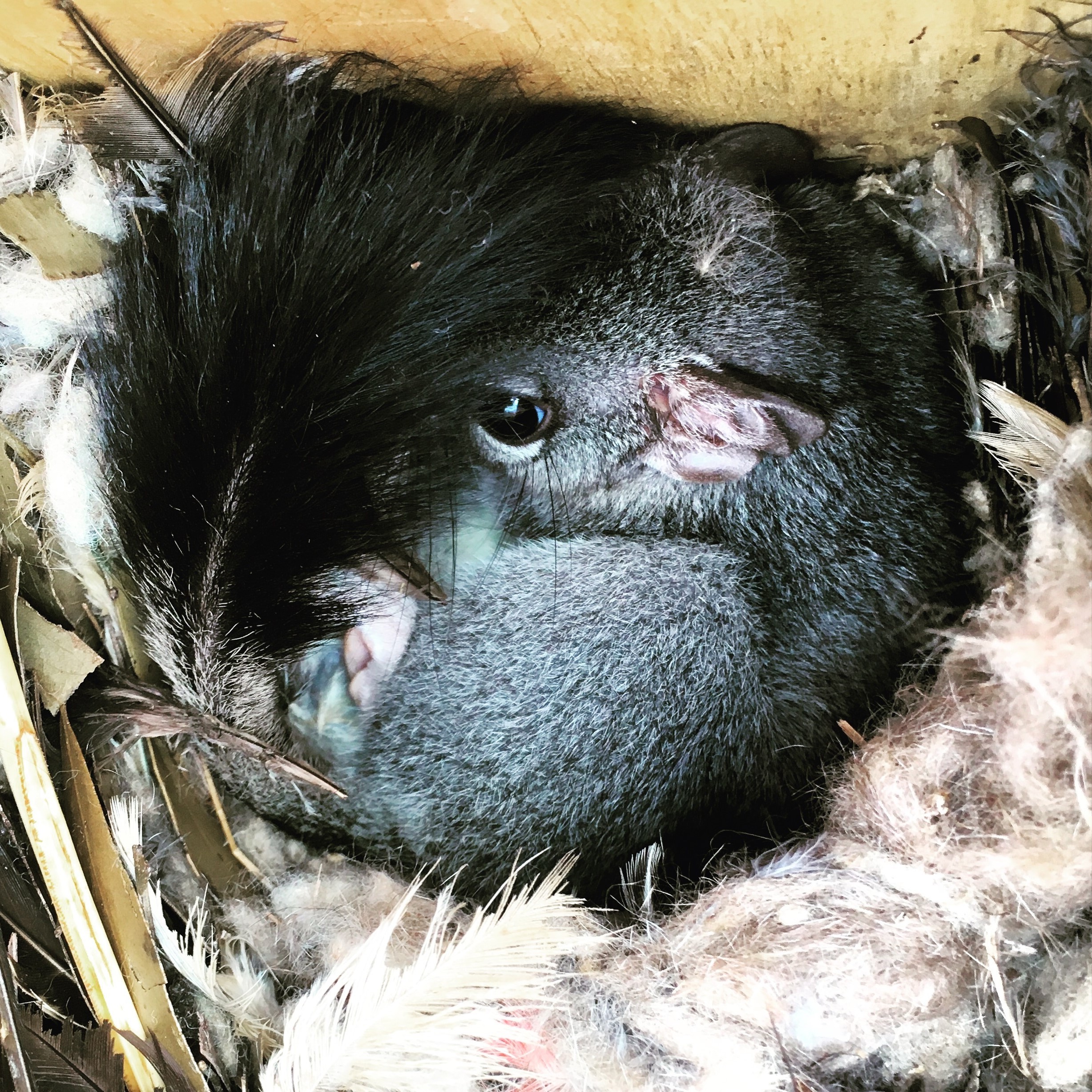
A Tuan in a nest box, by Jess Lawton
Sunday 6 May 2018 from 12:00 midday to 3:30 pm
Miles Geldard shares his extensive knowledge on the design, construction, installation and monitoring of nest boxes for wildlife
Includes light lunch, indoor presentation and nestbox check using a special camera
We will also have a very special door prize for a lucky attendee!
Connecting Country has an extensive nest box monitoring program. We encourage any landholders who are hosting some of the 400 nest boxes in the region to attend! For more on our nest box program click here.
Please RSVP including any dietary requirements by 2 May 2018 by email (tanya@connectingcountry.org.au) or phone (5472 1594).
Wattle book launch – Saturday 28 April 2018
Posted on 23 April, 2018 by Frances
Acacia, known in Australia as wattle, is the largest genus of plants in the country — nearly 1,000 species! Its brilliant flowers transform winter and spring landscapes. But how many wattle species can the average citizen name and recognise?
A new 112 page wattle guide helps the beginner to make a start. In plain language, and generously illustrated, it presents 21 species which flourish in the Mount Alexander region of central Victoria. A general introduction explains different features of wattles, helping identification and appreciation of these tenacious and beautiful plants.
The book is published by Friends of the Box-Ironbark Forests (FOBIF) in association with Castlemaine Field Naturalists Club and Connecting Country. The authors are Bernard Slattery, Ern Perkins and Bronwyn Silver.
George Broadway (President, Castlemaine Field Naturalists Club) will launch the book on Saturday 28 April 2018 from 11 am in the Phee Broadway Theatre Foyer, Mechanics Lane, Castlemaine.
Everyone is welcome, refreshments will be served and copies of the book will be available. For further information, please contact FOBIF. If you can’t make the launch, the book will be available from Stoneman’s Bookroom from 28 April, and online from the FOBIF website. Cost is $10.
Here are images of the cover and some sample example pages on one of our favourite prickly plants, Spreading Wattle (clikc arrow to scroll through):


Birdata app and portal – an exciting new step
Posted on 19 April, 2018 by Tanya Loos
Recording bird surveys has just become much easier for a lot of keen bird people in our local area! Last Friday (13 April), over 20 bird survey volunteers gathered at the Castlemaine Botanical Gardens Tea Rooms to hear about BirdLife Australia’s smartphone app and bird data website.
Andrew Silcocks from BirdLife Australia manages the Bird Atlas – a comprehensive map of the distribution and numbers of Australian birds. Over the course of three very enjoyable hours, we learned how our data collection helps in bird conservation, how to use the very user-friendly app, and how to examine bird information on the portal known at Birdata.
And we were all very happy to hear Chris Timewell, BirdLife Australia’s Woodland Bird Project Coordinator (formerly Director of Connecting Country), present on the Birds on Farms research project. A separate blog post about the Birds on Farms project will follow soon.

Andrew Silcocks and Chris Timewell from BirdLife Australia
Connecting Country has been an affiliate organisation of BirdLife Australia since 2015. The two organisations are both bird mad (of course!), and collect and share bird data with one another. Connecting Country’s long term monitoring program has sent BirdLife over 20,000 individual records for their Birdata bird mapping project, and we have also extracted data from BirdLife to help with our reporting.
The Birdata app
The feedback from participants was wonderful! The app is surprisingly easy to use – the phone finds your location, then you give it a site name, add the survey information such as the type of survey, and then simply start counting birds! So for those of you who were unable to attend the workshop, the following comments may encourage you to visit the Birdata website, download the app and have a go!
‘Really clearly explained, and I found the app easy to use’
‘I used Birdata extensively up until about 2 years ago so this provided a valuable update’
‘I had never previously used this app but I now feel very confident to conduct and submit surveys’
‘Opened my eyes to the power of the app AND the portal’.
To download the app click here. In the help section of the Birdata website here, there are short instructional YouTube videos and printed information on the portal and the app. These also might be useful for those of you who attended the workshop and would like a refresher.
The Birdata portal
The Birdata website is referred to as a portal. Once you are logged in, you can see your surveys and all your data. You can edit and change surveys you have done, such as correct a misidentified bird or refine the location.
You can also share your surveys with other people, such as on social media or by email. Any person doing bird surveys for one of our ‘official’ monitoring programs (such as the KBA monitoring, the Perkins surveys, or the Connecting Country sites) can send their data directly to BirdLife using the app if they wish. This saves on time and double handling. However, also emailing a copy of your surveys to us here at Connecting Country will help with keeping track of our bird survey program. Of course, those people who wish to stay with the old pen and paper method are most welcome to do so!
A fantastic feature of the portal is the ability to generate an up-to-the-minute bird list of any area of any size simply by drawing a polygon on the Birdata map. I used this function today to supply a bird list to Sutton Grange Landcare group. See the ‘Explore’ button on the portal for this feature.
Many many thanks to Andrew Silcocks for such an enjoyable and informative workshop! We would also like to thanks the Wettenhall Environment Trust for funding the workshop.

Say ‘swift parrot’! Workshop attendees were all smiles on a beautiful autumn day.
Save the date – Camp Out on the Mount 2.0
Posted on 19 April, 2018 by Asha
Due to the severe weather warnings last weekend, we have rescheduled the 2018 Camp Out on the Mount!
The new date is Friday 11th May (starting late afternoon after school) to Saturday 12th May (finishing late afternoon). A new schedule for all of the activities and more details will be coming out next week, but please save this date in your diaries if you’d like to come.

Pine Assassins from Castlemaine Secondary College from the 2017 Campout
Workshop: the ecology and care of large old eucalypts – 28 April 2018
Posted on 17 April, 2018 by Tanya Loos
Large old trees, their ecology and care – a two hour workshop in Guildford on Saturday 28 April. This short workshop will be presented by Tanya Loos from Connecting Country in partnership with the Mount Alexander Shire Council. It includes a walk through the Guildford Recreation reserve.
Our old eucalypts are incredibly valuable to local fauna. Studies show koalas prefer large old trees as their branches are broad and comfortable. Old trees are superior nectar producers to their young cousins, with masses of blossom providing abundant nectar to honeyeaters, bees and flying foxes. Their seed production is better too, with old trees producing more and better quality seed.
And then there are the hollows! Hundreds of animal species cannot survive without the hollows that large old trees provide. Possums, sugar gliders, bats, rosellas, owls, geckos and many more critters need hollows to shelter and to raise young.

A magnificent candlebark on Yapenya ( Mount Barker)
So come along and find out how we can care for these living treasures! We’ll discuss the mistletoe question (answer: leave it!), what large old trees really can’t stand, and what to plant beneath large old trees to keep them healthy and happy.
Saturday 28 April 2018 at 10:30 am – 12:30 pm
Please book or make inquiries through Mount Alexander Shire Council: call 54711700, or info@mountalexander.vic.gov.au
Volunteers needed for nest box checks
Posted on 12 April, 2018 by Asha
Connecting Country is once again monitoring our nest boxes. These boxes were installed across the shire in 2010-11 to provide habitat for Brush-tailed Phascogales.
The boxes have all been monitored at least once during autumn in the survey periods of 2011, 2012, 2014 and 2016. A summary of the results to date across the whole of the survey periods, and other information about the monitoring program, are available on the Connecting Country website – click here.
Please contact us if you are interested in assisting as a volunteer with the nest box checks by emailing asha@connectingcountry.org.au. You won’t be climbing trees or ladders, or handling animals, rather helping with carrying equipment and recording data. It is a great opportunity to see some interesting and special places in our local landscape, and learn more about phascogales and other species.
Updates on the nest box monitoring program will be provided after the autumn monitoring. For further info on our nest box program, see our monitoring page of our website – click here.

Connecting Country nest box
Historic gum trees of Maldon – Nature News April 2018
Posted on 12 April, 2018 by Tanya Loos
April’s Nature News was written by Sarah Edwards, who completed her internship at Connecting Country, and Bev Phillips from Maldon Urban Landcare Group. This story featured in the Midland Express on 10 April 2018.
If you want to explore some of the ‘living treasures’ featured in this month’s Nature News, Bev Phillips is leading a walk for a Maldon Focus Quarterly Conversation on Saturday 5 May 2018 at 1.30 pm. See here for more information.

Red Box at St Brigid’s Catholic Church Maldon.
This story began in 2010, when the late Wendy French from Maldon Urban Landcare Group (MULGA) noticed some large pre-European settlement indigenous eucalypt trees located within Maldon, and was very interested in discovering how old they were. Wendy studied approximately 20 trees in town and estimated their age.
Six years later, MULGA continued the work Wendy had started. Firstly, there was an original Red Box tree, estimated at 295 years of age, at an intersection that was being re-designed. Then there was a planning proposal for a retirement village to be developed on the site of a Maldon church, where there were four eucalypts estimated as between 185-430 years old. MULGA wanted protection of the trees during construction, and for an existing Petanque piste to not be moved close to the area the four trees. These issues re-ignited the notion of protecting old indigenous trees, as MULGA discovered the trees were not listed or protected under the heritage overlay.
In 2017, MULGA members organised a field day to search for all indigenous eucalypts in Maldon that could be classified as being over 165 years old, hence existing before European settlement in 1852. With the help of Frances Cincotta, from Newstead Natives, MULGA members identified, photographed and recorded GPS coordinates for the trees, and used standardised measurements and published growth rates to estimate their age.
They identified 61 likely pre-1852 eucalypts, including Grey, Yellow, Red and Long-leaved Box species on private and public land in Maldon. The oldest tree was estimated at 530 years old, and 80% were estimated at over 200 years old. In addition, 36 pre-1852 trees were surveyed on parts of the Maldon Historic Reserve. These trees were estimated to be between 190 and 645 years old.
Somehow, the 97 eucalypts managed to survive throughout the gold rush and population boom of the area. They are historically significant as well as being important to the ecosystem in Maldon. If only trees could talk, imagine the stories they could tell!
This is an ongoing project. Although the eucalypts surveyed on the Maldon Historic Reserve are under the protection of Parks Victoria, there is currently no protection overlay for the 61 eucalypts surveyed in other areas of Maldon. The protection of these trees is essential to preserve the natural environment and the heritage of Maldon. MULGA will continue to work with Mount Alexander Shire Council to achieve this.
Volunteer with a flair for graphic design needed for bird project
Posted on 10 April, 2018 by Tanya Loos
Calling all graphic designers! We are looking for a volunteer to design two very special bird signs, which will be displayed permanently at Rise and Shine Bushland Reserve in Sandon, and at the Muckleford Nature Conservation Reserve. The signs will illustrate the values of the Muckleford and Strangways Key Biodiversity Areas (KBAs), and are a key component of our Caring for Key Biodiversity Areas project.

The Critically Endangered Swift Parrot. Pic by Chris Tzaros
The trigger species for these areas are the Diamond Firetail, Swift Parrot and Flame Robin. KBAs are designated by BirdLife International and BirdLife Australia.
The Caring for Key Biodiversity Areas project involves an on-ground works component, bird surveys and the two interpretive signs.
Design of the signs would be an excellent project for a university student who is studying the visual arts, or a graphic designer who wishes to do some pro-bono work to contribute to the community while raising the profile of their business. Purchase of the signs will be covered by the grant, but we need help with the graphic design component as a volunteer contribution.
We will be able to supply the written content and quality photos of the target species to use on the signs. But the magic of their presentation is up to you!
The signs will be launched in September 2018, so ideally we would have the signs designed by the end of July.
If you are interested, please send a copy of your resume, business website or an example of your graphic design work to Tanya at Connecting Country: tanya@connectingcountry.org.au
We will make a decision and let people know on Monday April 16, so get your applications in quick!
And of course, feel free to call on 5472 1594 if you have any enquiries!
The Caring for Key Biodiversity Areas projects is funded by the Victorian Government – Community and Volunteer Action Grants.
‘Bush Play’ and ‘Cranes, Herons and Storks’ – two April 2018 events
Posted on 5 April, 2018 by Tanya Loos
Autumn is a busy time in Central Victoria. We would like to share two events that our readers may enjoy. ‘Bush Play’ is an activity especially for children, as part of Nature Play week. ‘Cranes, Herons and Storks’ is a presentation proudly hosted by Castlemaine Field Naturalists Club.
Bush Play: the colours of the bush in Kalimna Park
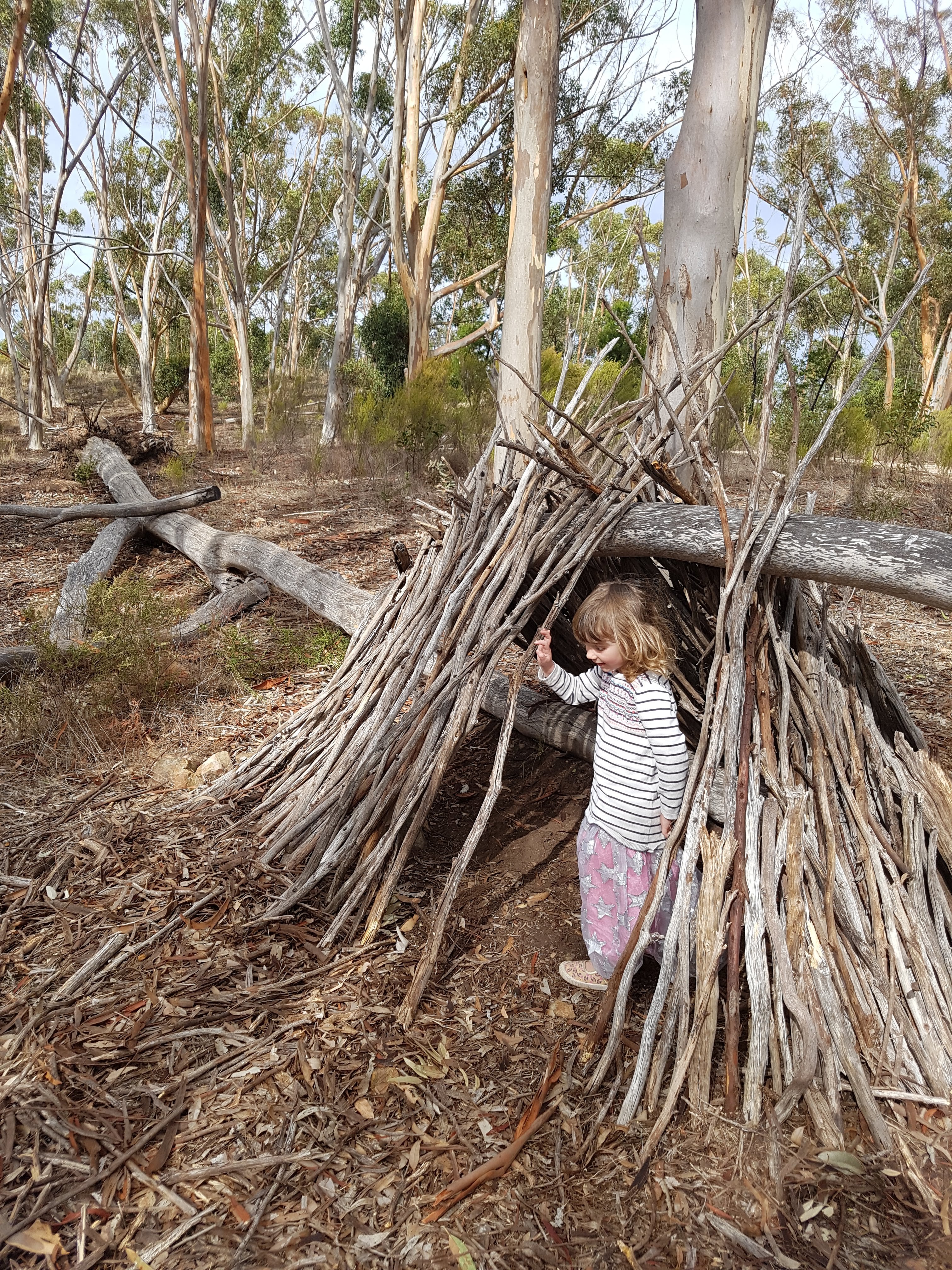 What: Come and join in a hunt for the colours of the bush. Help to discover how many different colours the bush has to offer. This is a free event for Nature Play Week and will be followed by a story about the bush. For details see the Facebook event page here.
When: Thursday 12 April from 2:00 to 3:30 pm
Where: Kalimna Park near the cubby houses
Who: For children aged 4 to 6 years old and an accompanying adult
Bookings: Please book as numbers are limited. Please email tiffany.inglis@gmail.com
Cranes, Herons and Storks: a talk at the Castlemaine Field Naturalists Club Monthly meeting
Renowned photographer and author David Hollands wrote the classic book ‘Eagles Hawks and Falcons of Australia’ in the 1980s. He has written and provided photographs for many books on Australian birds, including kingfishers, owls and waders. David will be sharing his amazing photos and speaking about his latest book: Cranes, Herons and Storks of Australia.
The evening commences at 7.30 pm on Friday 13 April in the Fellowship Room, located behind the Uniting Church on Lyttleton St, Castlemaine (next door to the Castlemaine Art Museum). Members and visitors are all welcome to come along, and to stay for a light supper after the talk. This is a free event.

Black-necked Stork at Yellow Waters, Kakadu National Park. Photo by David Hollands.
Tiny feathered visitor receives first aid
Posted on 5 April, 2018 by Tanya Loos
Many of our landholders and readers of this blog send us photographs of birds to identify, or animals that they are pleased to see on their properties and in their gardens. Last week, Robyn Patton, who lives south of Bendigo sent us photos of a bird that is ‘tiny and finch-like in size’.
The little creature had collided with a glass window and passed out from concussion. Robyn put the tiny bird in her dressing gown pocket.

Cradled in gentle, loving hands.
The bird started to revive after a few hours, so she carefully placed the bird in a covered cat carrier. When the bird could perch well and seemed to be revived, Robyn set the little one free into the garden.
Have you guessed the species? It is a Striated Pardalote! We featured these stunning birds on a blog last year with Peter Turner’s wonderful photos ( see here). This rescued bird is very young, as it lacks the dark head and bold markings of adult pardalotes. My guess is that the little one had just left the nesting hollow, and unfortunately encountered a window on its first day!
Robyn’s quick thinking saved the pardalote from being eaten by an animal while unconscious. We suggest that a concussed bird be placed in a covered box such as a shoebox, with a tea towel or something soft in the bottom, and then left in a quiet room for a few hours to recover. The dressing gown pocket is very comfy, but a shoebox is an even quieter, safer spot for the bird to recover. The bird will not need water or food, just warmth, darkness and quiet. If it is still very ill, you may need to contact your local vet or wildlife shelter.
Robyn clearly loves her birds. Here she talks about the birds in her backyard:
‘They follow me around the veggie garden, checking out my every move. They make my heart smile and they’re great company. Yes, I actually talk to them on occasion. I keep telling them to eat only bad bugs, and make sure they have plenty of fresh water to drink and bathe in.’
Thanks for sending in the photos, Robyn – and we are thrilled this little bird recovered!
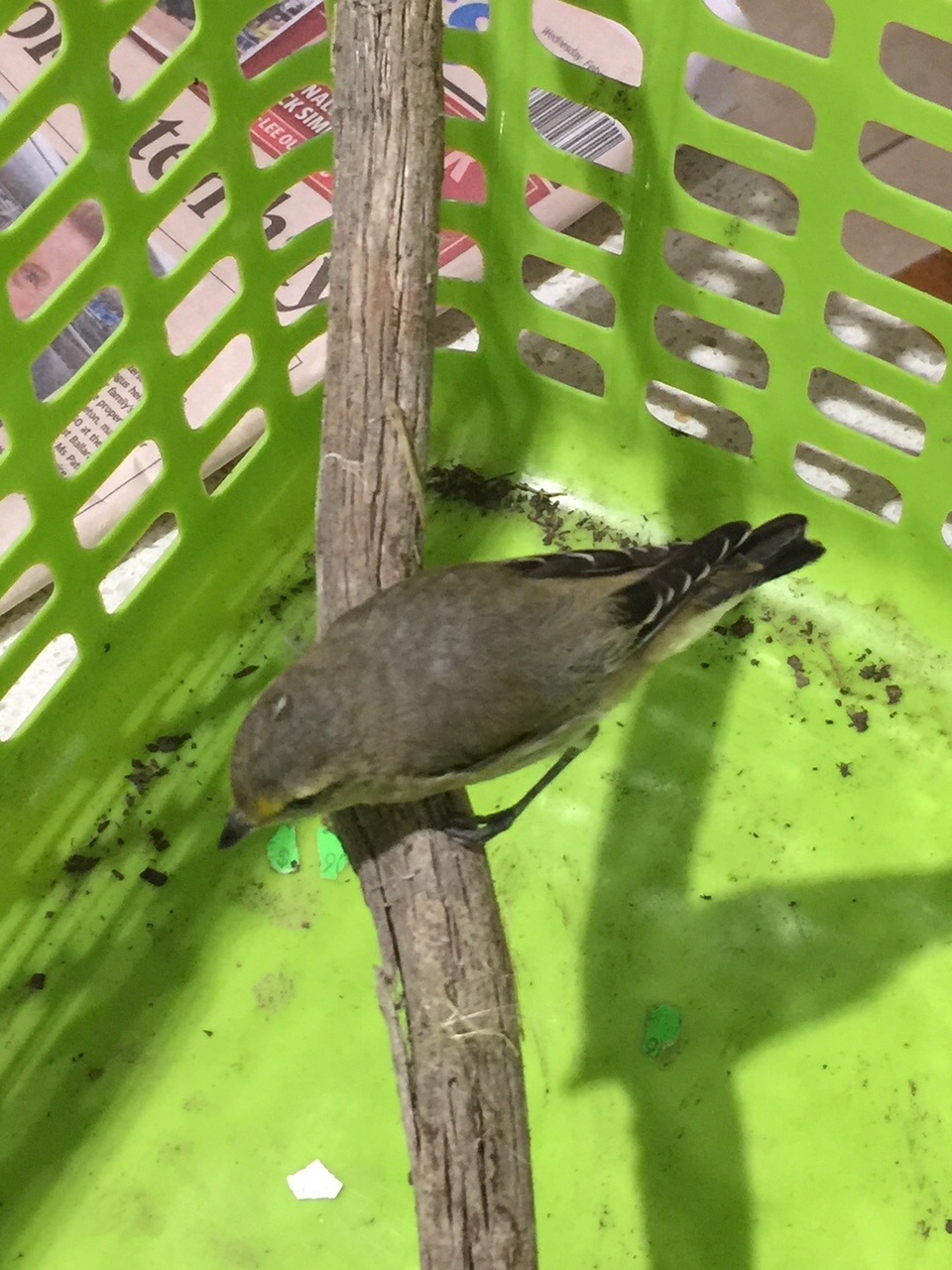
The perch in the cat carrier was an excellent idea
For information on how to prevent birds colliding with windows, please see the excellent link below.
https://www.allaboutbirds.org/why-birds-hit-windows-and-how-you-can-help-prevent-it/
Reminder – please book in for next week’s Camp Out
Posted on 5 April, 2018 by Asha
 The 2018 Camp Out on the Mount is coming up no sooner than next week! If you haven’t booked in yet, please visit our booking website to register your interest. You can select which activities you’d like to come along to, and this will help us plan ahead to make the weekend as enjoyable as possible for everyone. There’s no need to bring along your ticket, just yourself and gear for camping.
CLICK HERE to go straight to the booking website, or CLICK HERE to visit our page with more info about the 2018 Camp Out.
Thanks, and hope to see you there!