

Sticky Beak Tour 2016
Posted on 8 July, 2016 by Connecting Country
On Sunday 26th June 2016, 30 enthusiastic participants joined our ‘Sticky Beak Tour’ of restoration projects on four local private properties. Connecting Country had assisted all four landholders to undertake on-ground works projects on these properties over recent years. All 30 participants on the tour have also been undertaking on-ground works projects with Connecting Country’s support. As such, it was a chance for everyone to gather and share their experiences in landscape restoration. Despite it being a chilly day, we were warmed by the stories from these four landholders, and by the very tasty soup served up at the Guildford Winery. To quote one participant;
The tour has really helped us to crystallize our plans for future plantings on (our) property. Discussion during the tour really helped us to weigh up the pros and cons of different approaches and being able to see things “in the flesh” really assists with the visualisation process. We now have a clear idea of what we want to do next and more confidence that the work can deliver the results we are looking for.

Brandie Strickland, who is undertaking a student placement at Connecting Country, has recorded the stories of the four landholder’s we visited.
 Site 1- Cullen Gunn, Walmer

Cullen is an engaging gentleman from Hamilton. He and his family enjoy their delightful 280ha property in Walmer as often as they can (though not as often as Cullen would like). The property was originally grazed heavily; a practice Cullen hasn’t continued unless you count the 600 or so kangaroos. It is Cullen’s dream to make the property carbon neutral and very biodiverse. He has established several areas dedicated to farm forestry. And, in 2008, decided to try direct seeding to add some diversity around his forestry operation. Four rounds of direct seeding later – including the help of Connecting Country – what looked like a potential failure is now as “thick as hair” in parts. As a result, Cullen and his family has watched over 100 species of birds return to the property and sugar gliders inhabit his nest boxes.
 Site 2- Chris Johnston, Green Gully

Chris’s property used to be grazed by cattle and was heavily cleared for firewood and other uses. Originally Chris worried that maybe there were more problems on the land than she could manage. However, given the history of the property over the past 10 years it “wasn’t really that bad”. With the help of Connecting Country, Chris is trialing an exclusion plot to see what grows naturally without grazing by kangaroos, rabbits and other animals. She is also revegetating the cleared gully areas, however has found kangaroos and cockatoos to be an issue as they shred the tree guards. She has been lucky enough to replace most tree guards second hand and is trialing protecting seedlings with smaller fenced areas using other gathered resources, like star pickets, at little to no cost. Chris is passionate about restoring the land and hopes to one day see it returned to the traditional owners, the Dja Dja Wurrung, for better land management.
 Site 3- Mark and Helen Wakeham, Yapeen

Mark and Helen moved to their property 14 years ago. Despite Helen’s sometimes lengthy commute to Melbourne for work, both Helen and Mark are extremely happy with their little slice of the country. Like many of the surrounding properties, their property is currently grazed by cattle. However, over the years, the number of cattle has lessened as management costs have increased and the property has become more recreational: ‘not a farm, just fun’. The use of cattle on the property is now more of a management tool. Both Mark and Helen are very open to increasing biodiversity on their property and over the years have allowed a lot of conservation and revegetation work to be done. The North Central Catchment Management Authority fenced and direct seeded at the rear of the property to protect remnant Box Ironbark Woodland. More recently, Connecting Country has created a buffer zone along the roadside and gully with direct seeding which will provide a excellent link across the landscape.
 Site 4- Mandy Jean, Guildford

Mandy and Brian own the Guildford vineyard. They acquired the property in 2004 and today, along with wonderful chef Zack Grumont, run a very successful business. If you walk around the vineyard you can see all the hard work that has gone into creating such a productive site. Mandy sees increasing biodiversity as critical to the vineyard’s success. The vineyard hosts up to 80 kangaroos over a year, hundreds of birds, bats and microbats and more insects than you can count. Kangaroos and birds, in particular, are very welcome as each benefits the vineyard in their own natural way. The birds reduce bug, disease and pest populations on the vines while the kangaroos provide a manure rich with nitrogen. With the help of Connecting Country, the vineyard is becoming more biodiverse with tubestock planted on the surrounding hills to enhance both beauty and environmental benefit. Mandy’s next project is a indigenous ‘insectarium’ to increase natural pest control.

Revegetation at the Guildford Vineyard

Bonnie with landholders

Lunch in cellar

Revegetation in Green Gully

Exclusion plot at Chris Johnson’s property.

Bonnie explains how direct seeding works
Acknowledgements
Our Sticky Beak Tour highlighted just a fraction of the work that landholders and community groups from across the Mount Alexander region have completed with Connecting Country over the past 8 years. We would like to thank all of them for their involvement – each project is a inspiring story of landscape restoration in this area. We would also like to thank:
- Cullen, Chris, Mandy and Mark and Helen for being such excellent and inspiring hosts,
- Geoff Park for his expert facilitation and photos,
- Bonnie Humphries for sharing her project and botanical knowledge,
- Zack Grumont and the Guildford Winery for a delicious lunch,
- Brandie Strickland for the photos and write-up, and
- the Australian Government for the funding as part of our Connecting Landscapes program.
Nature News – June 2016: Is there anybody home?
Posted on 5 July, 2016 by Connecting Country
On page 26 in this week’s Midland Express (5 July 2016) there is a great Nature News article by Paul Foreman about his property in Walmer.
In case you missed out on last month’s Nature News, Max Schlachter reported that the trick to monitoring nest boxes is having an eye for the décor. You can find the article on page 17 of the 7 June 2016 edition, or read it here:

A Connecting Country nest box in the field
Have you ever been out in the bush and noticed a mysterious green box hanging from the side of a tree? It might have had a cryptic code on the bottom like ‘CC10-206’?
If so, what you stumbled across is not a modern art installation or a military experiment, it’s a nesting box for one of Central Victoria’s lesser known marsupials – the Tuan (also known as the Brush-tailed Phascogale). Sometimes described as a cross between a possum and a rat, Tuans are carnivorous marsupials that live in trees.
In 2010/11 Connecting Country installed more than 400 specially designed Tuan nest boxes on properties across the Mount Alexander Shire. The boxes are monitored every two years and the 2016 surveys are just about complete.

Phascogale in nest
We’re all familiar with bird nests, but did you know that native marsupials also build a nest? Unlike most birds that only build a nest during the breeding season, marsupials such as Sugar Gliders, Ringtail Possums and Tuans live in a nest all the time, usually placed in the hollows of old trees.
The trick to monitoring nest boxes is to know which nest belongs to which animal, even when nobody’s at home.
Tuan’s are not the neat and tidy type – their nest is generally a complete mess. But they are prolific decorators and will use a variety of material to fill up their box. Bark is a favourite, as are feathers. Sheep’s wool and baling twine are also popular. In one box, a snake skin was even part of the décor – a bit gaudy for my taste.

Sugar gliders in nest
Sugar Gliders also make use of the boxes and display a complete lack of imagination when it comes to nesting material. Leaves are the only thing they’ll consider, and almost always from Eucalypts. But can they make a nest! The leaves are arranged in a spirally woven bowl, and sometime they’ll even create a complete sphere, with themselves inside it. How do they do it?
The results of this year’s survey will be collated soon and made available on the Connecting Country website http://connectingcountry.org.au/monitoring/nestboxes/. The site also has information on building and installing your own nest boxes.
Connecting Country would like to say a huge thank you to the 117 landholders whose properties we visited to survey their Tuan nest boxes this autumn. And also to the 20 volunteers who gave up their time to help take notes and carry a ladder through the bush. We couldn’t have got it done without you!
Local Climate Change Action: 1 new webpage and 2 upcoming events
Posted on 3 June, 2016 by Connecting Country
If you are interested in learning more about the impact of climate change in central Victoria then it you should head to Bendigo on Wednesday June the 15th. There are two events of interest – in the morning, the North Central Catchment Management Authority’s Climate Change Forum, and in the evening, a public forum on the future of Bendigo in a warming environment. More information on the these forums is below. Or, if you are enjoying the comfort of home, you can check out Connecting Country’s new Biodiversity and Climate Change resource pages.

Climate change will put pressure on the biodiversity of the Mount Alexander region. Photo: Shane Carey
Climate change and biodiversity in the Mount Alexander Shire
By working with people in our community to address the direct and indirect impacts of climate change, we hope to create a robust and healthy local landscape that remains livable for future generations of humans and other species.
Connecting Country’s activities – such as remnant protection, construction of wildlife corridors, control of pest plants and animals, and biodiversity monitoring – all contribute to climate change adaptation, mitigation and a better understanding of its effects. However, there is always more that can be done locally and at larger scales.
Our new climate change and biodiversity resource pages contains links to local information looking at climate patterns, the impact on biodiversity and what you can do to help. As with all of our resource pages, these references are continually evolving and your suggestions for new information is always welcome (email krista@connectingcountry.org.au).
CLICK HERE to view the pages.
North Central 2016 Climate Change Forum
This forum offers you an opportunity to share the latest knowledge of climate change science and agency activity with the North Central CMA. CLICK HERE to view the flyer.
When: 9 am – 1pm Wednesday 15 June 2016
Where: Bendigo Jockey Club, Heinz St, White Hills VIC 3550
RSVP: Attendance is limited. RSVP to the North Central CMA by Friday 10 June
Telephone: (03) 5448 7124
Email: info@nccma.vic.gov.au
Public Forum: The Future of Bendigo in a Warming Climate

Feathered Five Inspire Art, Song and Research
Posted on 10 March, 2016 by Connecting Country

Hooded Robins by Hannah Vellacott
The Feathered Five inspire many people – and our Feathered Five Festival showcases some of the resulting work ranging from artists, singing groups and scientists.
For local artist Hannah Vellacott, they have inspired a series of paintings titled ‘Diamond In The Woods”. These paintings will be on show during the Feathered Five Festival at the Corner Store Merchants (220 Barker St Castlemaine) from the 12 March until 9 April 2016.
Hannah describes her work: “In these paintings I aim to capture the beauty and fragility of the feathered five, through detail and the gentle wash of colour that is unique to watercolour painting. The use of white space is inspired by traditional Japanese ink paintings. I like the way the objects appear to float on the paper and your eye is drawn to the details in the bird or flowers.”
For local singing group, the Chat Warblers, they have inspired a new song! Written by Judith Tregear and mixed by Jane Thompson, the song will debut at our evening forum on Saturday the 19th of March. We cannot wait to hear it!
For world renowned ecologist, Andrew Bennett, woodland birds have inspired his long-standing research interests in landscape ecology and conservation biology, with a particular focus on understanding how human land-use and landscape change affect native wildlife and ecological processes. At the evening forum, Andrew will share the results from his recent research into woodland birds in Central Victoria and lead a topical discussion about “Drought then flooding rains: how do woodland birds respond to climatic change?”
Spots are still available for the evening forum, but are filling fast. CLICK HERE for more information and to make a booking. Bookings close on the 17th of March 2016.
Nature News: Dry times for the Diamond Firetail
Posted on 25 February, 2016 by Connecting Country
Connecting Country, in partnership with the Midland Express, has launched its new monthly ‘Nature News’ feature. Look out for these these articles by local naturalists appearing in the Midland Express on the first Tuesday of the month (or thereabouts). For the February edition, Tanya Loos shared her experiences about one of our local feathered friends; the Diamond Firetail. This article is reprinted below. Keep an eye out in the next one or two editions of the Midland Express for an article on local snakes by Bernard Slattery.
Of relevance to the article below, at the Saturday evening forum of our feathered five festival (19-20 March 2016), Andrew Bennett will be discussing his research on how woodland birds are responding to climatic change and Phil Ingamells will share some tips from the experts on how we all can help. Click here for more information on the festival and to secure your spot for the talks.

A Diamond Firetail in the bird bath. Photo by Geoff Park
Dry Times for the Diamond Firetail. By Tanya Loos.
As our gardens and paddocks wilt in the ongoing dry, access to water for fauna becomes ever more important. One visitor to the bird bath that is sure to delight the senses is the Diamond Firetail.
A small bird of great beauty, the Diamond Firetail sports a neat black and grey suit with white spots, set off by a dashing crimson rump and a coral-coloured bill and eye ring. Here in the Mount Alexander region we are fortunate to have small numbers of this rare bird in the local bushlands.
Diamond Firetails feed on seeds of both grasses and native trees such as she-oak. One day at the Rise and Shine Bushland Reserve south of Newstead, I chanced upon a lone Diamond Firetail foraging with a distinctive series of moves. He trundled along the ground, then leapt up to a grass seed head, grabbed it firmly in his bill, then stood on the grass head to eat the seeds. The process was repeated at the next grass tussock.
Living on seeds alone is thirsty work, and Diamond Firetails need a safe source of water in their bushland or woodland habitat. In dry times, one way to help firetails and other birds is through the provision of a bird bath or two. Bird baths are a wonderful way to enjoy your local birds, but do bear in mind they require daily maintenance to ensure the water is clean, and always topped up.
It is too hot and dry for breeding at the moment, but after the rains return and seeding grasses are available, nesting will occur anytime from August. To attract the female, the male Diamond Firetail selects a long piece of grass with a seed head, and holds it tightly in his bill. He then fluffs his spotted flank feathers and sings as he bobs up and down on the perch.
If the female approves, they will mate in the privacy of the nest. The nest is a domed affair, of grasses, seed heads and roots, and may be found in a mistletoe clump or a thick shrub such as Hedge Wattle. A few years ago, I observed a Diamond Firetail nest built amongst the large sticks of the base of a Wedge-tailed Eagle nest!
The Diamond Firetail is less common than it once was, largely due to the removal of suitable habitat. Happily small populations are still being reported in areas such as Muckleford, Guildford, Fryerstown and Sedgwick. If you have Diamond Firetails visiting your garden, or you see some out in the bush, we would love to hear from you!
For more information about the Diamond Firetail and other woodland birds, visit Connecting Country’s website: www.connectingcountry.org.au or contact Tanya on tanya@connectingcountry.org.au.
Feathered Five Festival March 2016: Diamonds in the hills
Posted on 15 February, 2016 by Tanya Loos
There’s diamonds in those hills – Diamond Firetails, that is. This jewel of a bird is one of the ‘feathered five’, our very special woodland bird species that are a focus for Connecting Country. Over the years, we have supported a number of on-ground projects that strive to ensure these five species and other woodland birds are flourishing in the Mount Alexander region of central Victoria now and in the future.
Our inaugural Feathered Five Festival is a celebration of woodland birds and their habitat with two days of birdwatching, activities and talks over the weekend of 19-20 March 2016. However, you don’t need to be a budding birdwatcher to attend the free Saturday Evening Forum on the 19th of March in Campbells Creek.
From 5pm until 6pm, Connecting Country staff members will be on hand to answer your land management concerns; Bonnie Humphreys can help you identify any plant, Jarrod Coote will consider whole farm planning and funding opportunities, Tanya Loos knows lots about birds and other fauna, Alex Schipperen is great with practical things such as fencing and the control of weeds and rabbits, and Asha Bannon will help you link-up with your local Landcare Group. You can bring along any plant samples you’d like identified and you can contact us beforehand if you’d like a detailed aerial photo of your property to discuss. Meanwhile, Judy Laycock will be running some exciting nature art activities with the kids.
Following a tasty dinner from Growing Abundance and music by Castlemaine’s Chat Warblers, we are thrilled to have Professor Andrew Bennett, from Latrobe University and the Arthur Rylah Institute, and Phil Ingamells, from the VNPA, share their thoughts on the future of biodiversity in the area. Andrew has been a scientific advisor to Connecting Country since 2010 and will discuss “Drought then flooding rains; how do woodland birds respond to climatic change?”. Phil Ingamells is sure to inspire us with his talk “Collaborating on ten things we can all do to help nature adapt to a new climate”. A short panel discussion will take place after the talks.

This Diamond Firetail is damp and covered in dew from the recent much needed rainfalls that have graced the Castlemaine region in recent weeks. Photo by Geoff Park (Natural Newstead)
On both mornings of the Feathered Five Festival, bird walks in search of the feathered five will occur in various locations around the Mount Alexander region. Connecting Country’s Woodland Bird Coordinator, Tanya Loos, explains; “in the last year or two, through walks and workshops, we have been encouraging a cohort of budding birdwatchers to get out there and improve their birdwatching skills. This weekend is their time to shine as a number of community led walks will be carried out simultaneously on the Saturday morning – the feathered five drive!”
On the Sunday morning, we’re pleased take part in a guided nature walk with a special focus on woodland birds and their habitat. The walk will take place at a private property in Strangways which is a woodland wonderland, with a lovely grassy understory and grand old eucalypts. This joint Connecting Country and the Friends of Box Ironbark Forest (FOBIF) event will be led by Tanya Loos (Connecting Country) and Andrew Skeoch from Listening Earth.
You can come to one event –or all three! Bookings are essential – by the 17th March 2016. Click here for more information and to book, or call Connecting Country on 5472 1594.
This festival has been made possible with funding from the Helen Macpherson Smith Trust and the Australian Government.

Bush birds with Chris Tzaros – a memorable morning monitoring!
Posted on 11 December, 2015 by Tanya Loos
Last Saturday, 5 December 2015, over 25 of us were treated to a morning workshop with author and photographer, Chris Tzaros. Chris is a wonderful presenter and ecologist, and his talk was a fantastic overview of the bush birds of the ‘Connecting Country landscape’. Chris likes to call them bush birds rather than woodland birds, because as he rightly pointed out, many of our so-called woodland birds are found in the area’s extensive Box Ironbark Forests.
I was also really amazed by Chris’s ability to mimic bird calls – no need to play the smartphone bird call app at all!
In a comprehensive presentation, Chris pointed out that we have a particularly rich bird fauna in this area on account of being at the intersection of many different landscapes. There is the Loddon River and the surrounding plains, Cairn Curran and the open country, the dry forests of Sandon and Muckleford, Mount Alexander and the River Red gum plains of Sutton Grange and surrounds. We also have quite good patches of bush left, which means that our declining woodland birds are faring a bit better here than in other more degraded areas. Chris gave us a great overview of the birds of this area, including a special focus on the feathered five – the five species selected as ambassadors for woodland birds in the region.
Chris has provided training for many bird monitoring programs around Victoria across a diverse range of landscapes and communities. The bird monitoring method is kept consistent by training each area across the state to use the standard 2 hectare 20 minute bird survey. This is the methodology recommended by BirdLife Australia, and also the method we use to monitor birds for our seasonal surveys.
As Connecting Country’s woodland bird coordinator, I also introduced everyone to the eleven zones identified as priority habitat areas in the region for declining woodland birds, and directed participants to the Group Sites which are the starting point for our community monitoring program. The link below takes you to the bird monitoring page which has both the Group Site maps and a birdwatchers kit (in PDF format) – with instructions on how to survey, how to submit data and so on: all of which are available for download (click here).
After the presentations, we visited the Rise and Shine Reserve and carried out a 2 hectare 20 minute survey at the Rise and Shine Group survey site. We were delighted to see one of the feathered five – a Jacky Winter – nesting at the entrance to the reserve!
Chris was very impressed with everyone’s enthusiasm and the willingness to start counting birds, both on their properties and in the surrounding areas. We will be building on this energy in 2016, with monthly bird outings, a Feathered Five Festival (19-20 March) and a new program called Stewards for Woodland Birds. Watch this space!
For more information or to get involved, please telephone me (Tanya Loos) at the Connecting Country office on 5472 1594, or email tanya@connectingcountry.org.au

It was well over thirty degrees Celsius at the Rise and Shine Bushland Reserve – but we did see a few birds on our two hectare twenty minute survey. Pic by Kerrie Jennings.

Here a Jacky Winter stands above the nest, with feathers sleeked down and wings outstretched in an effort to stay cool. Thanks for the pic Kerrie!
Missed the 2015 Landcare Forum? See It Here
Posted on 24 November, 2015 by Connecting Country
 The Mount Alexander Landcare Forum took place back in June this year, but it’s not too late to benefit from hearing what the presenters had to say (and sing) on the day.
Local videographer Jim Coad (Starfish Video) filmed each presenter at the forum and these have now been made available online via ‘Vimeo’. There are four videos from the Forum, covering the topics:
- Agroforestry & Landcare – Adapting farms for the future with…forestry – Ben Boxshall
- Applying Traditional Fire Knowledge to Pasture Management – Paul Foreman
- Saving the Silver Banksias of Baynton Sidonia – Clare Claydon
- The Lake Bolac Eel Festival & Healing Walk – Una Allendar & Brett Clarke
Each video goes for 30 – 40 minutes so you might not want to sit and watch them through. I would suggest turning up the volume and having a listen while you do the ironing – or something like that!
Click on the titles of the videos in the text above to view them on Vimeo.
A big thank you to Jim for his filming and editing, and to the North Central CMA for making the Forum possible.
Woodland Bird Monitoring Workshop with Chris Tzaros – 9 Dec 2015
Posted on 18 November, 2015 by Tanya Loos
On the first Saturday of December, join a small group of bird observers for a morning with ecologist and photographer Chris Tzaros. Chris shall take us through the ins and outs of monitoring woodland birds – with a special focus on the collection of data for Connecting Country and BirdLife Australia.
We are currently looking for volunteers to carry out regular bird surveys on both private and public land across the Mount Alexander region. In particular we are searching for the feathered five: the Jacky Winter, Painted Button-quail, Hooded Robin, Brown Treecreeper and Diamond Firetail. Attending this workshop would be a great first step in getting involved.
The workshop will cover:
- A background to bird identification and bird fauna of the Mount Alexander region.
- Bird monitoring methods of the monitoring project (including a practical component).
- The role of community volunteers in ecological monitoring projects.
Some experience in bird watching is desired, however we are open to any enthusiastic attendees! Be quick though – we have just a few places left.
When: Saturday 5th December 2015 , 9am-12pm (followed by lunch until 1pm).
Where: Newstead Community Centre, Newstead.
RSVP: Essential! Contact Tanya Loos on 03 5472 1594 or by email tanya@connectingcountry.org.au. Please detail any dietary requirements.

A male Red-capped Robin, by Chris Tzaros
About Chris Tzaros: Chris is a wildlife ecologist and nature photographer for his company; Birds, Bush and Beyond. In 1997 he was awarded Young Australian of the Year in the Victorian environment category in recognition of his commitment to box-ironbark conservation and his dedicated work on threatened birds such as the Grey-Crowned Babbler and Swift Parrot. In 2005, Chris authored a comprehensive book on the Wildlife of Australia’s Box-Ironbark Country. Chris is also an accomplished bird photographer and has contributed many beautiful images to Connecting Country’s Woodland Birds Brochure.
How to Create Frog Friendly Habitats
Posted on 16 November, 2015 by Connecting Country
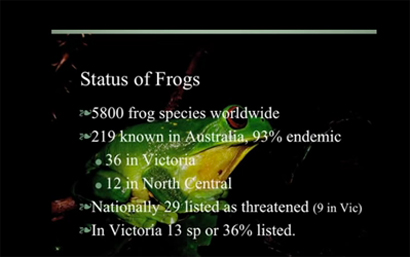
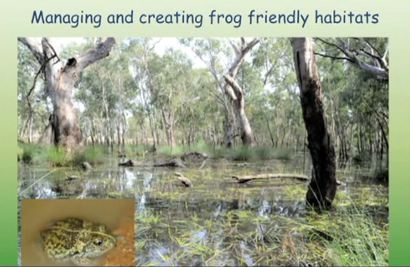
Renowned local ecologists, Elaine Bayes and Damien Cook have produced two terrific youtube videos:’Frogs and their Calls’ and ‘Frogs and their Habitats’. The information is well presented and relevant to our local area. Each goes for about 30 minutes. Click on each image below to view:
Know your weeds and what to do with them!
Posted on 2 November, 2015 by Connecting Country

David Cameron stresses that proper identification of weeds is essential
Did you know that there are at least 3 distinct species of Blackberry found in our area? Each of these have a different physiology and hence may require a different type of control. The importance of proper identification of weeds when deciding on appropriate management actions was stressed by DELWP Senior Botanist, David Cameron, at our “Back from the Brink” weeds workshop on Sunday 25 October 2015.
Alongside David, local contractor Matt McEachran, and Landcarers Frances Cincotta and Maurie Dynon shared their considerable wisdom and practical experience to help participants learn to identify weeds and the most appropriate techniques to managing them, from herbicide use to re-vegetation with native plants.
To find out more about the workshop session or to access some of the useful resources that were provided, please click here.
This workshop concludes our 2015 education program. If you missed out, summaries and resources from all sessions are provided in our education pages. Planning for the 2016 program is now underway – feel free to contact Krista on 5472 1594 or krista@connectingcountry.org.au to offer your suggestions or to find out more.

The 2015 workshop program was supported by Connecting Country through funding from the Australian and Victorian governments.
Conservation fencing – from end posts to curlews
Posted on 22 September, 2015 by Connecting Country

Alex introduces participants to the tools of the trade.
A warm spring day greeted participants and presenters at Connecting Country’s third spring workshop on Sunday 13th Septmeber 2015, this time at the stunning bush property of Beth and Rick Higgins in Yandoit .
Three exclusion plots on the property generated lots of discussion about setting goals, location, choosing the right type of fence, and the on-going management requirements.
Presenters Alex Schipperen (Connecting Country’s Works Crew Team Leader), Judy Crocker (Landcare Facilitator for the Mid-Loddon Landcare Network – and involved in a program using fences to protect Bush Stone Curlews), and Paul Foreman, (Ecologist with Blue Devil Consulting) had plenty to offer in terms of practical experience and observations about conservation fencing.
To read more about the session or to access our online resources, please click here.
Our fourth and final workshop for 2015, Back from the Brink, will be focusing on dealing with potential problem areas on your property – like weed control, waterway enhancement and erosion management. Registrations are now open for what is set to be another very insightful session. Click here to download a registration form.
The education program is supported by Connecting Country through funding from the Australian government.
Investigating biodiversity and its value across all scales
Posted on 7 September, 2015 by Connecting Country

Steve Williams introduces us to a moth “super-food” – Cassinia.
Did you know that Cassinia is a super-food for native moths? Or that lichens are actually the result of an algae and fungi working symbiotically? Twenty-four eager participants learnt this and so much more at Connecting Country’s Biodiversity in the Paddock workshop on Sunday 30th August 2015.
A huge thank you to landholders Peter Hansen and Sally Roadknight for inviting the Connecting Country team to their beautiful property at the foot of Mt Tarrengower to hear from presenters Cassia Read (on moss and lichens), Steve Williams (on moths) and Karl Just and Gordie Scott-Walker (on native flora). Geoff Park (from Natural Decisions and Natural Newstead) expertly kept the flow, whilst highlighting the stunning bird life to be found all around in the property.
A farm tour allowed participants to see for themselves the impressive impact of tubestock planting, natural regeneration through removing grazing, and the effects of erosion control on the creek which funnels run-off from Mt. Tarrengower through their property. Gordie provided us with a detailed list of the reptiles and amphibians, and the hundreds of birds and plant species that he has observed on his parents property, reminding everyone of the gains to be had from regenerating land.
The message of the day from all four presenters was the huge value of biodiversity in the paddock, from the mosses and lichens which hold soil together, to the beautiful variety of moths which feed from and live on all kinds of plants – never has Cassinia arcuata (‘coffee bush’) appeared such a fascinating and valuable plant in the landscape.
Click here for more information and resources from this session.
Also, there are a few places remaining for our next workshop on Sunday 13 September on Conservation Fencing – click here for more information.
The education program is supported by Connecting Country through funding from the Australian government.
13 Sept 2015 – Conservation Fencing Workshop
Posted on 3 September, 2015 by Connecting Country
‘Conservation Fencing’ will be the topic of Connecting Country’s third Spring 2015 Education workshop, to be held in the Yandoit area on Sunday 13 September. Registrations are open for what promises to be an educational and practical day!

This is the fence that Rick and Beth built. Guess which side is excluding grazers…
Property owners Beth and Rick Higgins manage a large tract of bush in Yandoit, and over the years have established four exclusion zones, and experimented with differing approaches to revegetation over these sites. This session will use their property as an example to introduce participants to the role of conservation fencing.
Renowned ecologist Paul Foreman, from Blue-devil Consulting, shall introduce us to conservation fencing and its role in improving biodiversity including ways to design, place and measure its impacts on regeneration. With his detailed knowledge of local flora, he will take us on a plot ramble to see what’s there and what’s not and why.
Alex Schipperen, Team Leader for Connecting Country’s Works Crew team, will talk about types of fencing and give a practical demonstration in erecting a small exclusion plot. Alex has over 40 kms of fencing under his belt so he knows what he’s talking about!
We will also be fortunate to have Judy Crocker, Landcare Facilitator for the Mid Loddon Conservation Management Network, inspire us with her successful Bush-stone Curlew project that is protecting current breeding pairs by creating five 4-8ha, predator proof nesting sites in woodland areas.
Further details for the day including transportation will be provided upon registration. The workshop costs $30 or $20 for Connecting Country members. Please contact Jules on jules@connectingcountry.org.au or call 5472 1594 to register. Click here for more information on the workshop series, and CLICK HERE to download a registration form. The program is supported by Connecting Country through funding from the Australian government.
Conservation fencing: it’s what’s inside that counts!
Posted on 20 August, 2015 by Connecting Country

Conservation fencing in action
Like many landholders in Mount Alexander, Beth and Rick Higgins have installed exclusion fencing to restore and regenerate biodiversity on their property, especially the understorey, herbs and grasses – the results of which are dramatic and inspiring. You can come and see for yourselves at Connecting Country’s third Spring Workshop, Conservation Fencing.
There are many reasons install exclusion fencing on your property. You may want to keep out herbivores (such as stock, rabbits or kangaroos) from a revegetation or restoration site, or prevent damage from people, or even keep out introduced predators to have a safe place for native fauna to flourish.
Ian Higgins from the North Central Catchment Management Authority, will be giving us an overview of exclusion fencing and its role in improving biodiversity and taking us on a ‘plot ramble’ to see what’s there and what’s not. He will also discuss ways to monitor success. Connecting Country’s incredibly skilled crew leader, Alex Schipperen, will then talk about the practicalities of installing fencing – including identifying what you are protecting, what are you protecting it from, and how best to do it? We’ll have other special guests on the day too.
When: Sunday 13 September 2015, 10am – 3.30pm.
Where: Yandoit (details provided upon registration). Transport available from Castlemaine.
Cost: $30 per person or $20 for Concession and Connecting Country members. Includes morning tea, lunch by C.A.K.E, session notes and handouts, and follow-up web-based resources.
Registration: Register now as limited places remain. Click here to download a registration form, or contact Jules or Krista at Connecting Country for further information.
This workshop is the third of four in the Spring series which aim to give participants skills and knowledge on working with nature to improve biodiversity. Places are still available for the Biodiversity in the Paddock session to be held on Sunday the 30th of August (click here for more information) and for the last workshop, Back from the Brink, covering controlling weeds and other threats in restoration projects (25 October). Click here for more information on the workshop series. The program is supported by Connecting Country through funding from the Australian government.
Krista Patterson-Majoor, Community Engagement
Did someone mention the f-word?
Posted on 10 August, 2015 by Connecting Country

The CFA’s Owen Gooding addressing participants; “you don’t need to be a expert or a scientist to understand the fire and the bush around you”
Fire. For many of us it conjures up a range of feelings; “confused … worried … fearful … ignorant … conflicted … overwhelmed …” . For those of us who attended Connecting Country’s Living with Fire and Wildlife workshop on Sunday the 2nd of August we now feel better informed and more confident when it comes to thinking about fire on our properties.
A brilliant team of presenters included Owen Goodings, Julie Whitfield and David Cheal gave a strong and united message that we can enhance biodiversity and manage fire risk at the same time. Andrew and Sarah’s stunning bush block in Strangways provided the perfect backdrop to our discussions.

Julie Whitford: “we have a obligation to look after ourselves but also the many other things that live on the land”.
We all gained a lot from the day – from a better understanding fire behaviour in the bush, to comprehending the complicated interactions of our flora and fauna, to having an idea of suitable plants for around the house.
More information, resources, and a excellent summary from workshop participants Helen and Ian Scott is available here. A new forum topic has also been started for those who would like to continue the conversation; click here to get involved.
Our huge thanks to our presenters, our hosts, and to Chris Johnston for her expert facilitation that made the day flow so smoothly.
Preparations are currently underway for our next workshop; “Biodiversity in the Paddock”. Here is your opportunity to learn a little more about the often hidden gems of your property – the mosses and lichens, ants, and moths and how they all fit into the bigger landscape picture. Places are filling fast, click here for more information and to reserve your spot.
The ‘Working with Nature to Improve Your Property’ 2015 Workshop Program is supported by Connecting Country through funding from the Australian government.
A botanist, an ecologist and a fire specialist
Posted on 23 July, 2015 by Connecting Country
Earlier this week I had a taste of what happens when you get a botanist, an ecologist and a fire specialist looking at a local bush property. The conversation flowed from our relationship with fire, to fire behavior and ecology, to the response of local plants. Their different views were fascinating, but they did agree that it is possible to have biodiversity and to manage for fire risk.
On Sunday the 2nd of August 2015 from 10 am – 3.30 pm, you too can take part in, and learn from, this conversation at Connecting Country’s ‘Living with Fire and Wildlife‘ workshop.

The CFA’s Owen Goodings assures participants that there is a lot we can do to manage fire and have our biodiversity as well.
Facilitated by Chris Johnston, participants will hear the perspectives of three experts including Owen Goodings (CFA – Statewide Team Leader Vegetation Management), David Cheal (Fire Ecologist – ex-DEPI and now Federation University) and Julie Whitfield (Field Ecologist, ex-DEPI and now Amaryllis Environmental).
Andrew Skeoch’s property in Yandoit will be the ideal venue – a 110 acre bush block that will allow us to consider planning in relation to fire and biodiversity in a meaningful way. Through practical exercises on the day, you will be encouraged to consider how you can manage fire risk, and enhance biodiversity, on your own property.
The workshop costs $30 per person or $20 for Concession and Connecting Country members. Included is morning tea and lunch by C.A.K.E, session notes and handouts, and follow-up web-based resources. Transportation from Castlemaine is also available.
Register now as limited places remain. Click here to download a registration form, or contact Jules or Krista at Connecting Country for further information.
This workshop is the first of four in the Spring series which aim to give participants skills and knowledge on working with nature to improve biodiversity. The following workshops will cover identifying and enhancing biodiversity in the paddock (30 August), using exclusion fencing to restore habitat (13 September), and controlling weeds in restoration projects (25 October). Click here for more information on the workshop series. Discounts apply if you attend all four of our Spring Workshops.
Krista Patterson-Majoor, Community Engagement Coordinator
April 19th 2015 -To plant or not to plant, that’s the question – even when it’s really cold!
Posted on 29 April, 2015 by Connecting Country
Anthony Battersby, the farm manager at ‘Shadwell’ in Elphinstone, kindly hosted the third workshop in our Autumn Biodiversity Workshop series -‘To Plant or Not To Plant”. Hardy participants braved the cold and visited three sites on the property where habitat restoration work is being undertaken part of managing the Black Angus beef production on the property.
Anthony outlined the work he has overseen over the last fifteen years, talking about motivations, successes and challenges in planting indigenous tubestock for wind breaks. Many thanks to Anthony for his time and generosity in sharing his experiences and insights with the workshop participants throughout the day.
Our second presenter on the day, Marion Da Costa from Dunolly, drew on ample experience in restoration though her efforts in returning her bare paddock into a grassy woodland. Marion has written a book titled My Place: Bare Paddock to Bush and gave a presentation which covered the story of this experience. Marion highlighted the importance of observing, planning, working gradually, weed control and making observations.
Throughout the day Jarrod Coote, Connecting Country’s Connecting Landscapes co-ordinator, provided his insights about revegetation and other restoration techniques. He also gave a final presentation about direct seeding, planting equipment options and rabbit control techniques.
Thanks to Anthony, Marion and Jarrod for their contribution to an informative and practical workshop. Thanks also to Jules Walsh and Chris Timewell for driving the buses and Shane Carey for the fantastic photos and our work experience student Courtney Rosedale for her help on the day.

Anthony shares his knowledge

Two herds braving the cold!

Marion responds to questions
For further references and reading on various techniques for restoration please visit our webpage (click here).
A new revegetation topic has been established on the Discussion Forum so that the conversation and questions can continue. If you are not already a registered Forum user, you follow this step by step guide to join (click here). Or you can simply view the forum (click here).
To plant or not to plant – that is the question!
Posted on 8 April, 2015 by Connecting Country
The 2015 Connecting Country Workshop Series has provided an opportunity for members of the local community to learn about broader landscape issues, and how to manage them successfully. First off was the very successful launch with guest speaker Bill Gammage discussing Aboriginal management of the Australian continent. Subsequent workshops have covered how to understand your property in the local and historical context, and also how adjoining landholders can work together to create habitat connections for birds and other animals. The feedback from one resident after the latter workshop was, “Great to build on previous learning, and gain new knowledge, as well as receiving encouragement to keep going!”
The next workshop in the Autumn series is coming up on Sunday 19th April 2015 is intended to expose participants to a range of revegetation and restoration techniques. It will be held on a working farm in Elphinstone where restoration is an ongoing part of managing the property.
The presenters on the day will include Marion Da Costa who will talk about her efforts in restoring her central Victorian property; a local Elphinstone Black Angus beef farm manager; and Jarrod Coote from Connecting Country who will give a demonstration of direct seeding and other options available for revegetation. Jarrod recently commented that, “Being on country with people that have a range of experiences and expertise is a great way learn what options are available to restore natural values across your land.”
To view the full 2015 Workshop Program and register for one of the places that are still available for this workshop, fill out a registration form (click here) or contact Naomi at the Connecting Country office on 03 5472 1594.

Jarrod Coote and local resident Saide Gray giving a planting demonstration on site in Sandon in 2014.
28 March 2015 – Mysterious, Mosquito-munching Micro-bats!
Posted on 16 March, 2015 by Connecting Country
Newstead Landcare’s first presentation for the year will be on Saturday 28th March at 3pm by Dr Lindy Lumsden, a wildlife ecologist at Arthur Rylah Institute. The talk will be at the Newstead Community Centre and everyone is welcome to attend (gold coin donation appreciated to help cover our costs). Connecting Country is supporting this educational event.

Little Forest Bat
Lindy has been conducting ecological research on bats for over 30 years. Although based in Victoria, her research has also taken her to remote areas of Australia, such as Christmas Island, and to many countries overseas such as Central and South America, Krakatau, Taiwan, New Zealand, Europe, South Africa and Swaziland.

Lindy Lumsden with Micro-bat
Bats play an important role in controlling insect numbers, including a range of pest species, by eating up to half their body weight in insects in a night. However, due to their small size, nocturnal behaviour and cryptic roosting habits, these valuable animals are rarely seen and are often portrayed negatively in the media.
Lindy is passionate about trying to reverse these negative perceptions and conducts a wide range of extension activities to educate and enthuse people about the bats. In her talks she describes fascinating and little known aspects of the natural history of these nocturnal creatures. As most people do not have the opportunity to see bats close up, she brings along a live bat to show at the end of her talk.
After the talk Lindy will take a group of 35 lucky people to Green Gully to demonstrate how she goes about discovering what bats are in an area. She will be setting up bat traps and using a bat detector and then we will have a picnic meal (bring your own picnic) while waiting for dusk when the bats start getting active. It’s free for Newstead Landcare members, otherwise $15 a head, children free. There are still a few places left so if you are interested contact Frances Cincotta phone 5476 2691 or email <natives@newstead.vicmail.net>