
Bird of the month: The Corvids – Ravens and Crows
Posted on 18 August, 2025 by Lori
Article by Damian Kelly and Jane Rusden
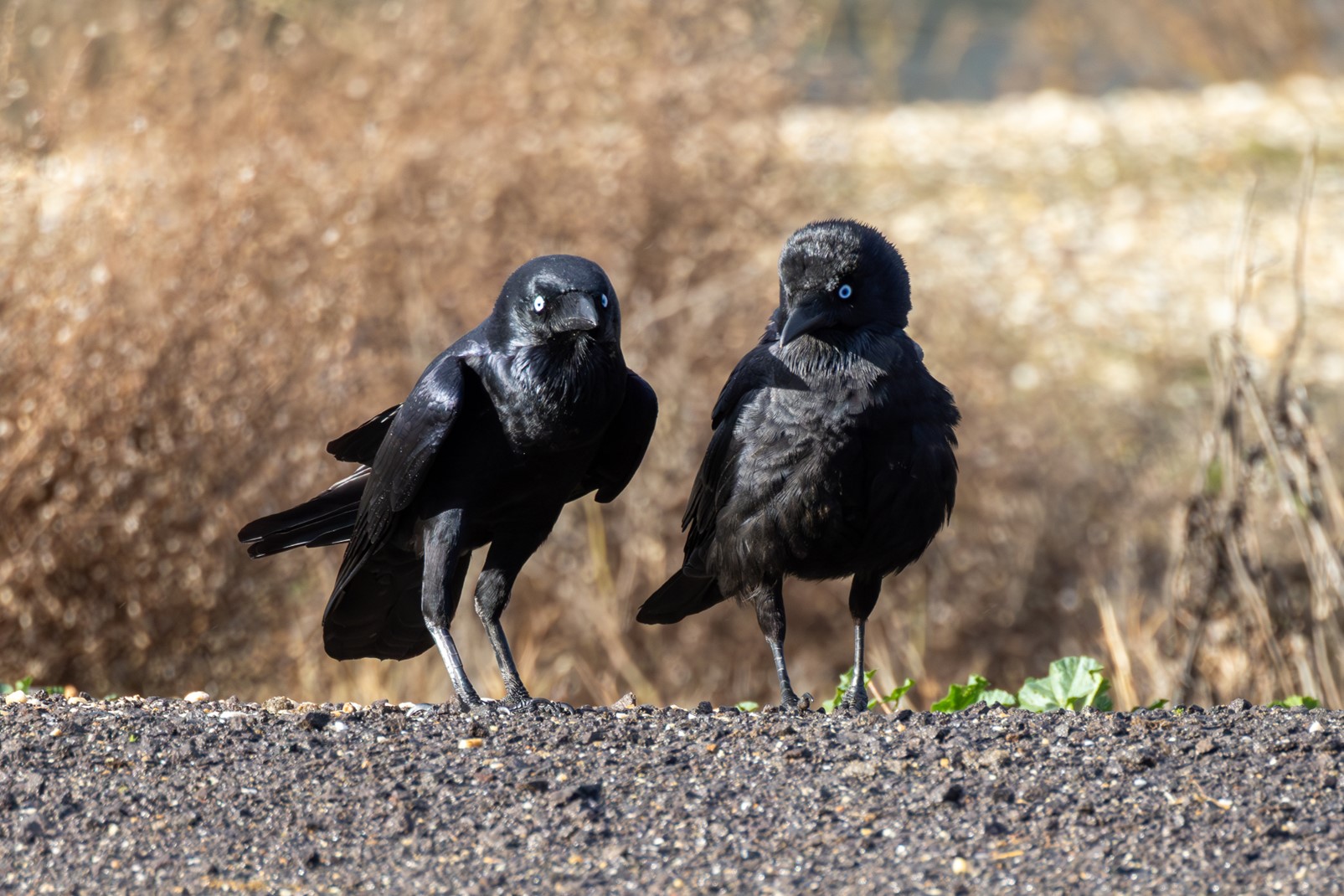
Little Ravens (most likely) at Coliban Waters Castlemaine Water Treatment Plant Bird Hide. (Photo Jane Rusden)
At the brand new bird hide put in by Coliban Water at the treatment plant in Castlemaine *, waterbirds and waders are the obvious focus when bird watching. However, a pair of what I believe are Little Ravens were caught goofing around in a very silly display, quite unlike the often cooler demeanor we usually see in this species. The sighting led us down the Corvid “rabbit hole”. Reading on, you’ll discover why I have not definitively stated which of our two local species the photos are of.
Although ravens are not always popular with people for various reasons, it is important to acknowledge that they perform an important scavenger role in cleaning up dead wildlife as well as eating a variety of agricultural insect pests as well as seeds. They are omnivorous and feed mostly on the ground. Ravens have adapted to a wide variety of habitats and are common around farms as well as cities, and obviously Water Treatment Plants.
Australia has five species – Australian Raven, Little Raven, Forest Raven, Torresian Crow and Little Crow. To quote the Handbook of Australian and New Zealand Birds (HANZAB): “All Australian Corvus are very difficult to distinguish and great care is needed to identify species.” Even the experts can be confused!
Whilst on the face of it all species look similar, in reality it is fairly easy to identify a species based on location – in most areas only one or two species are present. Around the Mount Alexander region we only have two species – Australian Raven and Little Raven and the Little Raven is far more common. Travelling further afield of course can be tricky. And unless you want a bird identification head ache, you don’t want to be in the north coast of NSW where all five can be found.
Locally the Little Raven is the most common and can be seen in large groups out of breeding season. Calls of our two local species are quite different with the Australian Raven tending to be longer and more drawn out than the Little Raven. You are best to listen to the calls on a birding app on your phone to become familiar with each, as trying to describe sounds in words is often not a lot of use.
Working out the age of a bird can be done by checking out the iris of the eye: adults are white with a bluish ring around the pupil, immatures are brown and juveniles blue-grey. Other indicators sometimes used to aid identification such as the throat hackles or colour at the base of feathers are often not much use in the field.
Pairs of Australian Ravens are generally sedentary and defend their territories all year round whereas Little Ravens move a lot, only defending small territories during breeding season and then joining large mobile flocks after breeding. These movements have been recorded over distance of several hundred kilometres at times, specially with juvenile and immature birds.
Nests are usually an untidy collection of sticks with a softer internal lining high up in large trees. Both parents build the nest and feed the young, but only the female does the incubation. Currently there is a pair either renovating or building a nest high up in the Big Tree in Guildford.
In many Aboriginal language groups, the raven is seen as a trickster or hero. Ravens have been recorded using tools such as sticks to retrieve food such as larvae from logs or dropping items on hard surfaces to crack them open. They also store food in caches for later use and can remember the location for long periods. Hikers’ packs are also fair game as ravens have learned to open small pockets and even sealed bags. Some field zoologists have had to stop nest monitoring surveys of threatened bird species (or at least their route between nests) if an Australian Raven is in the area, as they learn to follow the researchers, find the nests and predate the chicks.
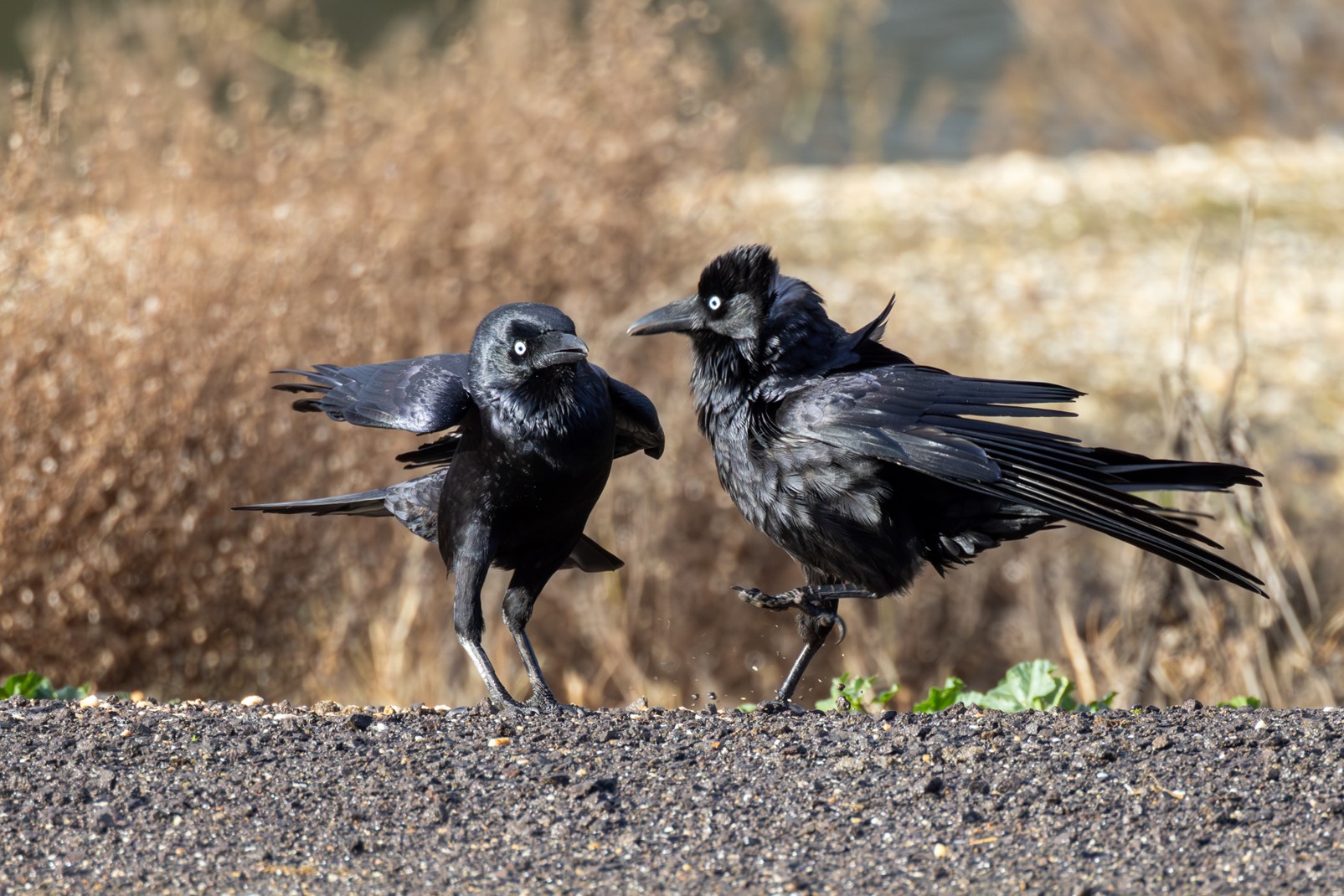
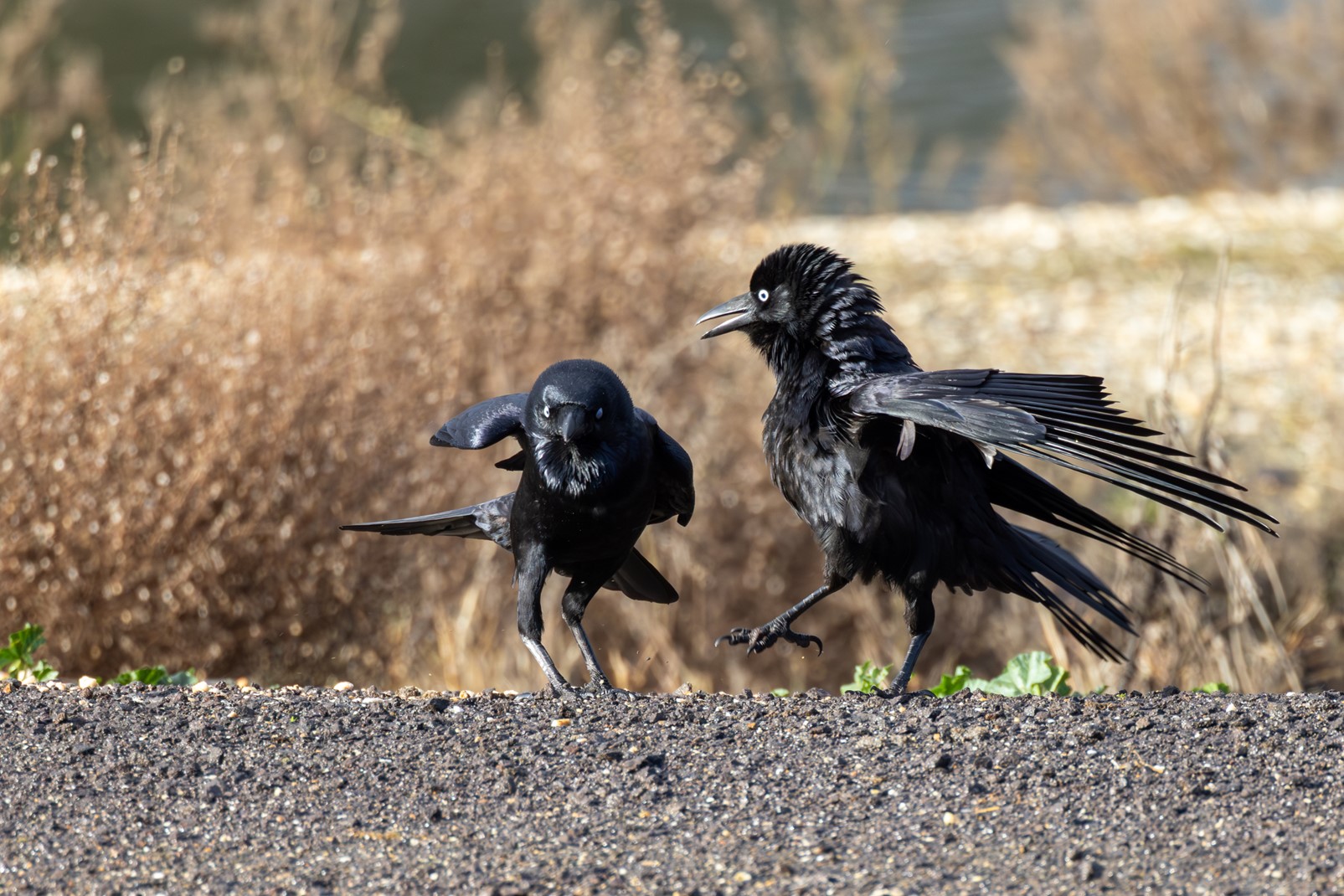
A pair of what we believe are Little Ravens, goofing about … perhaps strengthening their pair bond, at Coliban Waters Castlemaine Water Treatment Plant Bird Hide. (Photo by Jane Rusden)
* Note: to access the birdhide at the Coliban Water Treatment Plant, email communications@coliban.com.au to sign the access agreement form and apply for a key.
Bird of the Month is a partnership between Connecting Country and BirdLife Castlemaine District. Each month we take a close look at one special local bird species. We are blessed to have the brilliant Jane Rusden and Damian Kelly from BirdLife Castlemaine District writing these! We’re excited to join forces to deliver you a different bird each month, seasonally adjusted, and welcome suggestions from the community.


In Kulin Nation Aboriginal culture, Bunjil the (Wedge-tailed) Eagle and Waa the Crow are prominent creator and protector spirits. Bunjil, the Wedge-tailed Eagle, is a creator figure, while Waa, the Crow, is a protector and helper. Not always the clown! And certainly of high status around these parts.
Thanks for this cultural context Lawrie.
I had no idea how interesting crows could be. On one occasion in this area i saw a crow defend a group of small birds from a hawk. The crows are less plentiful in this area recently.
Thank you so so much, Damien. You truly are such a great blessing to us all. How fortunate we are to have these posts about our wonderful environment. Thank you for the photos, Jane. They are an essential companion to Damien’s words.