

Watch the winning films from the Wild by Nature Film Festival
Posted on 26 November, 2020 by Asha
The ‘Wild by Nature’ short film festival celebrated everything people love about Victoria’s incredible outdoors. Our friends at Remember the Wild say: ‘From your local park or creek, to your favourite wild place to escape the busy city, nature plays an important role in all of our lives’. All the films from the winners and finalists are now available for free viewing on Remember the Wild’s website: www.rememberthewild.org.au/wild-by-nature/
Enjoy viewing these excellent short films from the winners and finalists.
Pobblebonk (primary) division
Winner: Killara’s Biodiversity Wonderland, a collective effort by Killara Primary School students
These inspiring students present a documentary-style film about their efforts to create a biodiversity wonderland within and around their school. A truly wonderful story, professionally produced in this film.
Finalists: Phineas Wilton, Nature Never Sleeps; Matisse Turner, Wildlife Recovery; Remy Turner, Heaven’s Pools; Ruby Howse, How I care for Nature.
Swamp Skink (secondary) division
Winner: Listen by Marlowe Wilton
A moving, immersive experience that demonstrates how slowing down, breathing in and listening to nature can be a healing experience in the modern world.
Finalists: Renee Hang, Contaminated You; Abigail Gitsham, Little Girl Lost; Heath Corry, Snorkelling with Spider Crabs; Ruby Biggs, Be the Difference.
Black Swan (adult) division
Winner: Dog Fruit by Andrew Robb and Jessica Gerger
A comic look at the serious problem of dog waste in our natural environment.
Finalists: Richard Lawless, Blessings; Jahvis Loveday, Living Empty; Alastair Trail, Living with Gliders and Tuans; Fatima Measham, Us, Naturally.
New approaches to climate-proof habitat – 27 November 2020
Posted on 25 November, 2020 by Frances
Our colleagues at Biolinks Alliance are holding their 2020 annual general meeting (AGM) online with an opportunity to hear from local ecologist Paul Foreman presenting on ‘New approaches to climate-proof habitat‘.
Paul will speak about an exciting ecological restoration project being developed by the Alliance with the Taungurung people, Parks Victoria and the Heathcote community, the Spring Plains Watershed Repair project. The project integrates a range of restoration techniques that, at least in central Victoria, have never before been combined at a landscape–scale to demonstrate how the health of bushland damaged by gold mining and timber cutting (among other things) can be quickly and cost effectively restored.
Biolinks Alliance AGM 2020
When: Friday 27 November 2020 at 3.00-4.30 pm.
Location: online. For the meeting agenda, documents and zoom link – click here
For more information or to RSVP: contact Peter Evans at Biolinks Alliance (Peter@biolinksalliance.org.au).
We understand the business side of the AGM will be brief. The occasion is a chance to hear about a new project that has potential to be adapted, amplified and repeated in watersheds – large and small – throughout the region.
Bird of the month: Grey Shrike-thrush
Posted on 23 November, 2020 by Ivan
Welcome to our ninth Bird of the month, a partnership between Connecting Country and BirdLife Castlemaine District. Each month we’re taking a close look at one special local bird species. We’re excited to join forces to deliver you a different bird each month, seasonally adjusted, and welcome suggestions from the community. We are lucky to have the talented and charismatic Jane Rusden from BirdLife Castlemaine District writing about our next bird of the month, with assistance from the brilliant Damian Kelly.
Grey Shrike-thrush (Colluricincla harmonica)
The local bush has been bustling with nesting activity, although raising chicks is not always as nurturing and wholesome as you might think. Nests get raided, eggs don’t always hatch and it’s not necessarily easy for the newly fledged chicks. You’ll hear their incessant begging for food and see parents desperately trying to keep up the flow of breakfast, lunch and dinner. It’s a time of learning as fledglings can’t always assess risks and can be a bit ‘young and dumb’, being too bold for their own good and getting confused as they try to make sense of a situation. I witnessed one such occasion during an altercation in my backyard.

Confused young Grey Shrike-thrush getting harried by an angry Fuscous Honeyeater (photo: Damian Kelly)
A newly fledged Grey Shrike-thrush chick had got too close to a Fuscous Honeyeater nest. The poor chick seemed totally confused about the whole situation and didn’t know which way to go. It’s parents waiting just out of harrying range whilst the Fuscous Honeyeaters were on attack level – ‘take no prisoners’! The upshot was the chick finally moved away, the honeyeaters settled down and I got some photos of the action as they were all preoccupied with bird world high stakes politics.
So let’s look at the abundant Grey Shrike-thrush. Probably one of the most familiar, varied and prettiest of songsters to be heard, which perhaps makes up for its brown and grey colouring. I call it soft and subdued but others may call it out as dull. In the past it was known as the Harmonious Thrush and its taxonomic name reflects this: Colluricincla harmonica. Interestingly, their song can exhibit different dialects from place to place.
Individuals can live up to twelve years and it’s known that pairs can reside in one place for up to five years and remain together for longer. They are largely a sedentary species, but may move between altitudes with the seasons.
Taking a really close look will reveal gorgeous black eyelash like bristles around its bill and below the eye. (Lady Gaga attempted a similar look without the nuance. Pretty rad all the same.)

Young Grey Shrike-thrush singing it’s heart out (photo: Damian Kelly)
Present in all but Australia’s driest deserts, it prefers undisturbed treed habitats, including gardens on occasion. It’s often seen foraging for insects and small vertebrates like frogs and lizards, where there is some understorey, tossing leaf litter to find their prey. They will also take eggs and nestlings of small birds, so it’s not surprising the Fuscous Honeyeater was so upset.
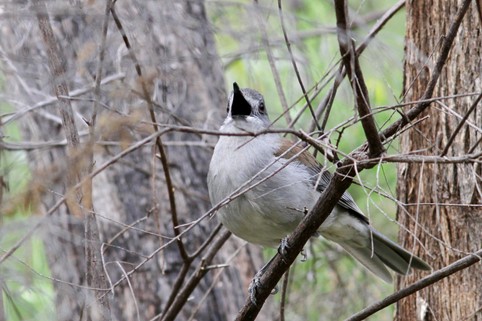
Adult Grey Shrike-thrush doing what they do best, harmoniously singing (photo: Damian Kelly)
To listen to the Grey Shrike-thrush call – click here
A big thank you to contributors to this edition of Bird of the Month – Jane Rusden and Damian Kelly – for their amazing knowledge and skills.
Revegetation and monitoring for success webinar – 25 November 2020
Posted on 23 November, 2020 by Jacqui

Here’s an opportunity that may be of interest to our readers wanting to learn about the latest science on the benefits of revegetation and monitoring. Check out this short webinar hosted by Department of Environment Land Water and Planning (DELWP) through the Arthur Rylah Institute, in collaboration with La Trobe University. The webinar will cover the latest advice for land managers and community groups on how to conduct successful revegetation and how to monitor the outcomes.
Revegetation for Biodiversity: monitoring for success
Hear from experts at La Trobe University in collaboration with the Arthur Rylah Institute for Environmental Research (DELWP) about:
- The latest research on the value of revegetation: how it changes over time, and how it can be undertaken to have the greatest value for biodiversity.
- A standard monitoring protocol designed for land managers and community groups to help assess revegetation outcomes across Victoria.
This webinar is for all audiences and will have a land management focus.
Date: Wednesday 25 November 2020
Time: 1.00 – 2.00 pm
Location: online
To register and for more information: click here
The beautiful and mostly misunderstood snake
Posted on 19 November, 2020 by Ivan
There has been plenty of recent sightings of various beautiful snakes in our region. In fact, there are almost daily appearances at this time of year on our social media platforms and chat pages with many central Victorian locals posting images of snakes spotted in their yards or nearby.
It has been a perfect year for snakes in central Victoria. Late summer rains, autumn growth and a perfect spring break has lead to a healthy population of mice, frogs, lizards, and other tasty treats for snakes. Snakes have emerged as the weather warms up and are now in power-up mode for summer and the mating season. They are more common around our urban fringes and rural areas, owing to an abundance of food (e.g. mice are a favoured food source for Eastern Brown Snakes) or water sources (e.g. Tiger snakes prefer wetlands and creeks). The most common snakes around the Castlemaine region and are Eastern Brown, Tiger, Red-bellied Black, and Copperhead. For a full list, and photos and descriptions of each snake, please click here. For information about snakes locally, and how to be snake-safe on your property and see notes from our snake workshop.
Our partners at Friends of the Box-Ironbark Forests (FOBIF) have recently published an article on a snake sighting around the Castlemaine region, and how to live with snakes. We have shared it below, and a nice photograph that was submitted with the article. Please enjoy, courtesy of FOBIF.
A bit of care, and everyone wins.
They’re out: snakes, we mean.
Which means: look out. It’s important to be careful when in areas likely to be frequented by snakes, for obvious reasons. This is virtually an annual preoccupation, so, at the risk of repeating ourselves, we are now going to repeat ourselves.
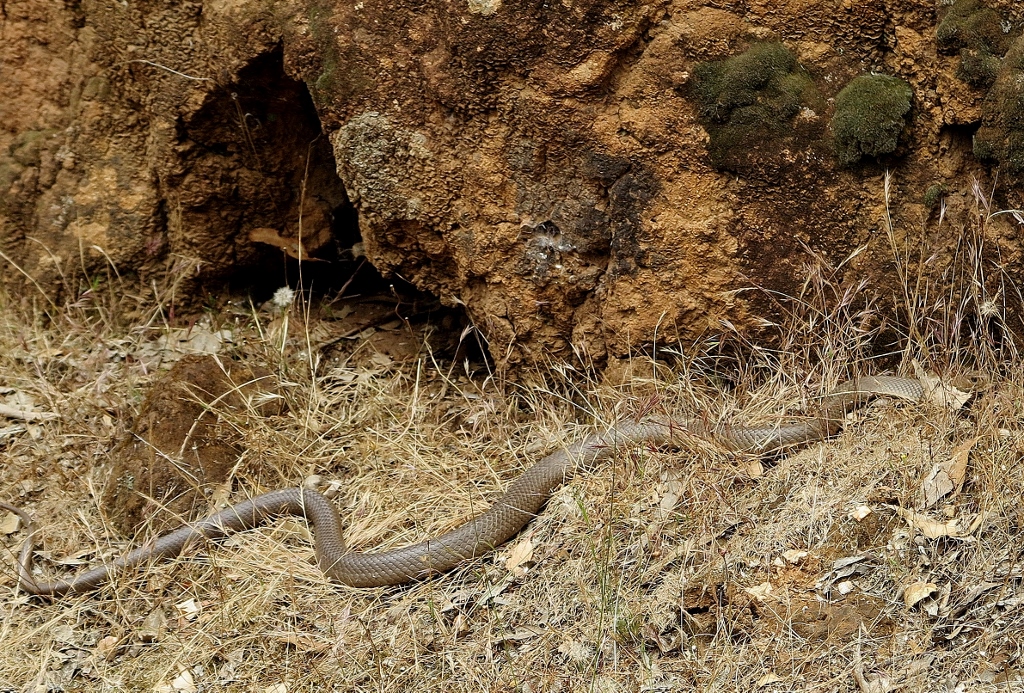
Eastern Brown snake, Gough’s Range SF, November 12 2020: we need to be careful about snakes, but the brute fact is that they are more at risk from us than the other way around.
And here is another great FOBIF snake post from 2014:
‘The Eastern Brown is highly venomous—but it’s not keen on attacking anyone as big as a human, and … will always try to get away if it can. If cornered, however, it is extremely nervous and aggressive. The moral therefore is, don’t approach any snake, and dress appropriately if going into areas where one might be met. The great majority of snakebite deaths have arisen when people unwisely take on the reptile [if you want to get it away from the house, call a snake catcher]. It is, of course, illegal to kill snakes, which are protected animals. For pets, the best advice is, don’t let them roam around the bush ferreting into holes; in any case, dogs should be on a leash in the Diggings Park.
Common sense is the best defence against snake bite, but unfortunately, hysteria is more common than common sense, as witness a 2013 Sydney Telegraph headline: ‘Snakes are raiding the suburbs…Fatal snake bites will become a tragedy repeated this summer as the deadly reptiles—thriving in hot conditions—slither towards the urban sprawl.’ This horror movie scenario doesn’t fit well with the fact that on average less than 3 people per year over the whole of Australia die from snakebite: far more people are killed by bee stings…
…And the odds are stacked against the snake: more than five million reptiles are killed by cars in Australia every year. According to the Australian Museum, ‘countless’ Brown snakes perish in this way, ‘both accidentally and on purpose’.
For other FOBIF material on the subject of snakes, click here and here.
Now is the time to find needle grasses & volunteer opportunity in Castlemaine!
Posted on 19 November, 2020 by Ivan
Needle grasses, and in particular, Chilean Needle Grass (Nassella neesiana), are now in full seed and are becoming a serious pasture and environmental weed in our region. They are very invasive and form dense infestations in pastures, bushland and roadsides. They can tolerate drought and will seed prolifically, including self-pollinated seed in the stem and base of the plant, giving them great potential to spread and over-run existing vegetation. It has been estimated that the potential distribution for Chilean Needle Grass alone exceeds 40 million hectares across Australia.

A large, dense infestation of Texas needle grass near Malmsbury Photo Connecting Country
One of the biggest challenges facing the successful treatment of needle grasses is identifying infestations before they become large and dominating in the landscape. Thankfully, a local community champion recently produced an information sheet on how to differentiate invasive needle and native grasses, titled ‘Distinguishing between needle grasses and native grasses‘. The information sheet has useful photographs and identifying features of needle grasses, and compares these features to a variety of native grasses including spear grasses (Austrostipa species), wallaby grasses (Rytidosperma species) and native tussock grass (Poa labillardieri). Non-native grasses covered include Chilean, Texas and Cane Needle Grass (all members of Nassella genus), and the closely related Espartillo (Amelichloa caudata).

Landowners learning the finer points of needle grass identification at a field day. Photo Connecting Country
Please watch this video on how to identify Chilean Needle Grass, it is from New Zealand but highlights the important points of identifying this invasive grass. Click here
Another helpful information sheet, ‘What to do if you find needle grass’ details first-hand experience of how best to manage these grassy weeds and prevent further spread.
Volunteer opportunity in Castlemaine!
If you would to learn more about Needle Grasses and would like to attend a working bee please contact Margaret Panter on 5470 5072 (7am-7pm). Margaret is holding a socially-distanced working bee in the Castlemaine Botanic Gardens in the next few days, and as needed in the next couple of months. No experience necessary, and volunteers can attend as their availability allows.
Weed management after fire webinar series starts 25 November 2020
Posted on 19 November, 2020 by Jacqui

Jump on and register for this opportunity to learn all about weed management after bushfire, delivered by the Weeds at Early Stages of Invasion (WESI) team and a wealth of expert collaborators. There are four free webinars in total, with each delivering a wealth of knowledge and useful information. It is vital to get on top of weeds after fire, as they usually are the first plants to immerge and have a blank canvas to invade and dominate in the years to come.
Weed management after fire webinar series
After bushfire, our ecosystems are at their most vulnerable to weed invasion. Help us support indigenous flora and fauna by managing weeds in bushfire affected areas.
This webinar* series focuses on sharing practical knowledge so everyone can contribute to bushfire recovery.
Time:
Four webinars on the below dates all from 10:30 am to 12:15 pm.
Dates:
Webinar 1: Wednesday 25 November 2020 – Overview weed management after fire.
Webinar 2: Wednesday 2 December 2020 – Prioritisation of weeds after fire.
Webinar 3: Wednesday 9 December 2020 – Collaborative projects – weed management after fire.
Webinar 4: Wednesday 16 December 2020 – Weed identification and recording after fire.
For more information and to register for these free webinars: CLICK HERE

Collaborators:
- State Wide Integrated Flora and Fauna Teams (SWIFFT)
- Department of Environment, Land, Water and Planning (DELWP) including:
- Weeds at the Early Stage of Invasion (WESI)
- Bushfire Biodiversity Response and Recovery (BBRR)
- Natural Environment Program (NEP)
- Connecting Communities Program (CCP)
- Weeds and Pests on Public Land (WPPL)
- Parks Victoria
- East Gippsland Catchment Management Authority (EGCMA)
- Weed Society of Victoria (WSV)
- Gunaikurnai Land and Waters Aboriginal Corporation (GLaWAC)
- Landcare Victoria
- Trust for Nature
- Regional Roads Victoria
- Department of Jobs, Precincts and Regions (DJPR)
- Australian Association of Bush Regenerators (AABR)
- Foundation for National Parks & Wildlife (FNPW)
* These webinars are funded by the Victorian Government’s $22.5 million Bushfire Biodiversity Response and Recovery program. For more information on the BBRR program, visit www.wildlife.vic.gov.au/home/biodiversity-bushfire-response-and-recovery
How to build a microbat box
Posted on 12 November, 2020 by Frances
Since beginning our nest box program back in 2010, Connecting Country has installed over 450 boxes on private and public land across the Mount Alexander region. The nest boxes were designed specifically for use by the threatened Brush-tailed Phascogale (also known as the Tuan), which is a nocturnal hollow-dependent marsupial native to our area.
The nest boxes provide supplementary habitat for the Tuans and other native animals such as the Sugar Glider. It is anticipated that providing additional nesting sites, albeit artificial, will lead to an increase in local Tuan populations and distribution. The nest boxes were located across the landscape systematically so we can examine some of the factors that influence their use.
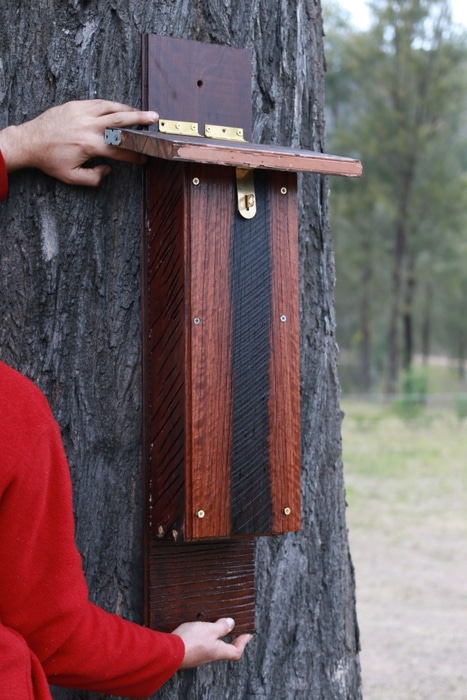
We recently discovered a great article from the creative folk at Milkwood regarding how to build a microbat box, which is similar to a nestbox. Milkwood point out that ‘Microbats are worth encouraging into your garden. Not only are they delightful to watch on dusk – they gobble thousands of mosquitoes, moths and other garden pests each and every night. A single microbat can eat up to 1,200 mosquitoes and small insects in an hour – which has earned them the well-deserved reputation of being nature’s mosquito busters.’
To enjoy the full article on Milkwood’s website – click here
For more information on Connecting Country’s nest box program – click here
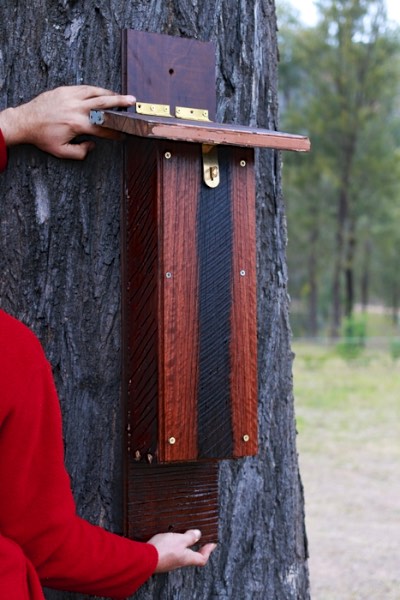
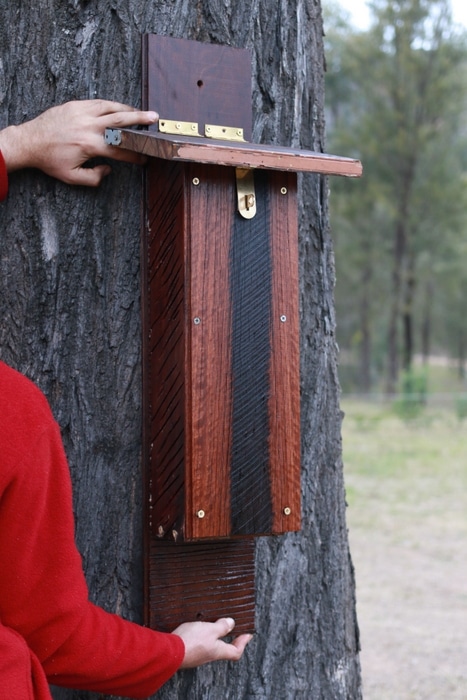
Mount your bat box on a tree, pole or building – high enough to prevent vandalism and protect the bats from predators and floods (photo: Milkwood)
NAIDOC Week 2020
Posted on 12 November, 2020 by Ivan
Always was, Always will be is the designated theme for NAIDOC Week 2020, which is being celebrated across the country from 8-11 November 2020. The acronym NAIDOC stands for National Aborigines and Islanders Day Observance Committee. Each year, NAIDOC Week gives our community the opportunity to celebrate and acknowledge the history, culture and achievements of Aboriginal and Torres Strait Islanders. This year’s theme reminds us that Aboriginal and Torres Strait Islander people have occupied and cared for this land for over 65,000 years, and that their cultures have been recognised as the oldest living cultures in the world.
On a local level, this week presents the opportunity for the community to delve into the history and connections to the land of Indigenous Australians. In our part of Central Victoria, the land we stand upon is that of the Dja Dja Wurrung Nation, who had practised their sustainable land management practices for many centuries. For more information about the Dja Dja Wurrung clan, and their history, cultural practices, current projects and media – click here.
It has been exciting to see the Dja Dja Wurrung Clans Aboriginal Corporation working in partnership with local interest groups, adjoining residents, Djarra community members, and state and local government agencies, to further connect people with nature and protect and improve biodiversity at two key sites:
- Kalimna Park within Castlemaine Diggings National Heritage Park.
- Wildflower Drive area of Greater Bendigo National Park.
For more information about NAIDOC week, and all the events across our many nations, please click on the image below.

Landholder revegetation attracts new birds
Posted on 12 November, 2020 by Frances
We received a lovely message from some local landholders, Mark and Jan Dunn. They’ve made a huge effort to restore habitat on their property near Faraday, in Central Victoria. It’s always heartening to hear about how the hard work of revegetation is really making a difference for our local wildlife.
Here is their story:
Hi Connecting Country
During a recent short stay at our Faraday property (on a bushfire mitigation permit from the Shire), we were delighted to see a bird we haven’t sighted before.
We have owned this 22 acre block for 15 years and in the early years we invested heavily in a major revegetation project. It is now so very satisfying to walk the paddocks and observe many different birds visiting and nesting in the trees and shrubs we planted. They love the habitat we have helped to create – all natives of local provenance.
What bird did we see you ask? This Owlet Nightjar was happy to observe us for quite a while after being disturbed from its quiet dark roost in the shed.
Description:
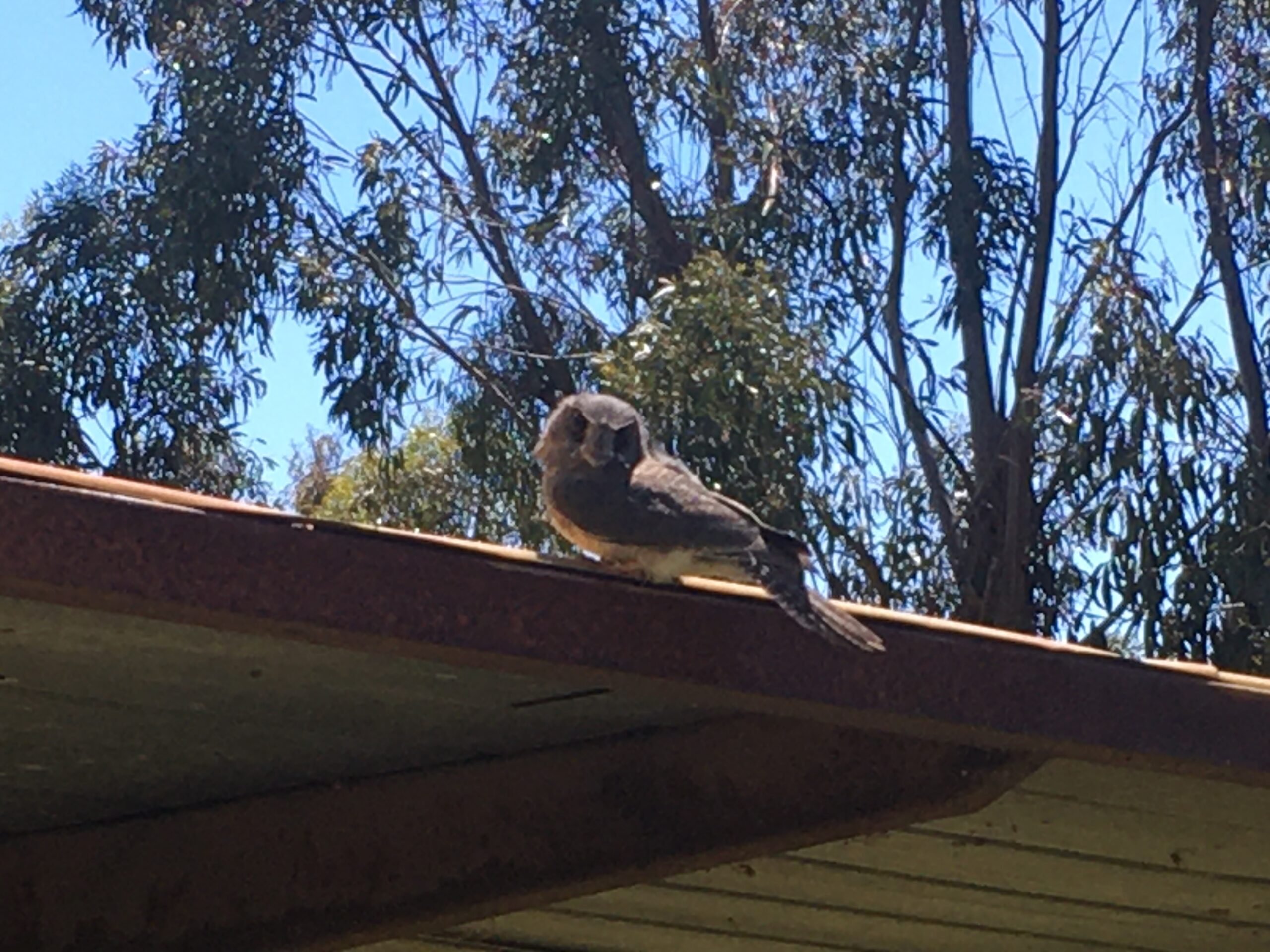
Australian Owlet-nightjar at Faraday (photo: Mark and Jan Dunn)
‘The Australian Owlet-nightjar is the smallest of the nocturnal birds (night birds) found in Australia. Its large brown eyes are non-reflective when exposed to a torch or spotlight (other nocturnal birds give a red reflection). The Owlet-nightjar has two different plumage colourations: russet-brown (rufous), and the more common grey.
In both forms the birds are paler below, and are faintly barred with black. There are two wide black stripes that extend over the head from the top of the eyes, and meet on the back of the neck.
The rufous form is restricted to the female birds, which, even in the grey form, tend to be more rufous-tinged than the males. Young Owlet-nightjars resemble adults, but have less distinct black markings.’
What a delightful little Aussie feathered friend – and how lucky we felt to see it.
Kind regards
Mark & Jan
Survey update from Walking Together – Balak Kalik Manya
Posted on 4 November, 2020 by Ivan
Harley Douglas, Project Manager with Dja Dja Wurrung Clans Aboriginal Corporation, provided an update on results from their community survey and workshops conducted for the Castlemaine and Bendigo communities (Central Victoria) during 2020. The visitor experience and use survey formed part of the Walking Together- Balak Kalik Manya Project, a four-year project committed to writing site-specific management plans for two sites within Dja Dja Wurrung Country: Kalimna Park (Castlemaine) and Wildflower Drive (Bendigo).
To view Harley’s presentation summarising results from the community survey – click here
There were some interesting findings from the surveys. The highest priorities for management actions within the parks were weed management, revegetation and nest box installation, closely followed by cultural burning. The least positive aspects for Kalimna Park were reported to be weed/environmental impact, rubbish and tracks/signage.
Q14: What management actions do you think should be prioritised for Kalimna Park and Wildflower Drive?

Please see the following summary regarding the community consultation, courtesy of Harley.
The visitor experience and use survey was powered by SurveyMonkey and the data collected was collated through the assistance of Parks Victoria’s Social Science Officer. From the 172 responses received, a summary report has been created merging the data into bar graphs, pie charts and other valuable graphics that quickly summarise demographics and usage of the parks.
Djaara community workshops were facilitated remotely to allow for the current COVID-19 restrictions. Two, two-hour sessions were held over Zoom for interested Djaara members to have input into the values, threats, issues, and opportunities associated with both parks. Djaara members workshopped ideas relating to Dja Dja Wurrung’s Goals as listed in ‘Dhelkunya Dja- Dja Dja Wurrung Country Plan 2014-2034.’ The information gathered from our members will be used to develop management strategies, actions, and recommendations.
Issues and opportunities that we discussed in both Djaara and Community workshops:
- Vehicle access and misuse
- Weeds – Onground management
- Cultural heritage (protection of existing and creation of new)
- Illegal firewood collection
- Rubbish dumping
- Track creation/ Illegal track creation
- Cultural burning
- Story telling
- Predators (cats, dogs, foxes)
- Threatened species (Eltham Copper Butterfly, Pink-tailed Worm-lizard, Tuan)
- Signage
- Loop walks
- Djaara employment
- Prospecting
- Creating open space
- Education
- Visitor areas
- Carparking
- Djaara employment
- Community ownership
Like our Djaara members workshops, broader community workshops were facilitated over Zoom due to COVID-19 as well. We held back-to-back sessions with Castlemaine community members one night, and then the Bendigo community members the following night. In total, we had 38 members of the community participate: 26 in Castlemaine, 12 in Bendigo. We worked through a PowerPoint presentation allowing community the opportunity to speak to threats or values from their perspective. We had some productive conversations that may have got carried away and deviated from the original topic, but all very worthwhile information that will help inform our management plans. The idea of facilitating a large community forum online with many differing opinions and views frightened me, but everybody involved was very respectful of each other’s thoughts and opinions- so I just wanted to thank everybody for making the sessions run as smoothly as possible and contributing valuable information that can only come from members of the community.
So, where to from here? Now that we have received input from Djaara members and community members, we have begun drafting our management plans. We are aiming to have a draft version of our management plans available for public comment at the end of November 2020.
Harley Douglas
Project Manager- Dja Dja Wurrung Enterprises Trading as Djandak
Ten ways to improve the natural assets on a farm
Posted on 4 November, 2020 by Asha
Sustainable Farms (an initiative of the Australian National University) has launched their excellent new booklet, ‘Ten ways to improve the natural assets on a farm’. The booklet highlights ten discrete projects that farmers and other landholders can do to improve the health of the natural assets – such as dams, shelterbelts or riparian areas – on their properties. We are particularly excited about the extensive scientific research that has gone into this publication, which gives enough detail, but is also engaging and relatable to the average landholder. Each of the ten actions are achievable and relevant to sustainable farming, and improving farm health, biodiversity and productivity.
The booklet highlights how one small change on a farm could create new habitat for native animals and lead to increased stock productivity. The publication is underpinned by 20 years of long-term research into biodiversity on farms. It represents a long-term collaboration between farmers implementing on-ground management practices, and ANU ecologists supporting the farmers’ observations with science.
To read the booklet online and for more information – click here
‘Let’s Pivot’ program supports community
Posted on 4 November, 2020 by Asha
The Mount Alexander region of Central Victoria is blessed with a highly engaged community, an abundance of active community groups and above average levels of volunteering.
The ‘Let’s Pivot’ program supports local community leaders, groups and individuals to change their strategy without changing their vision. It empowers participants to share knowledge, successes and strategies to reach their audience and achieve their aims. We are particularly excited about the topics of improving online delivery and improving our connectivity with the community. Please read on for more about the ‘Lets Pivot’ program, including the link to their website. Thanks to Mel from Make a Change Australia for sending us this information to share.
‘Let’s Pivot’ is a new program being delivered across rural and regional Victoria by Make a Change Australia, with the aim of supporting community leaders, organisations, and individuals to change their strategy without changing their vision. The program is for not-for-profits, community groups, leaders, and all the great people who like to make a positive impact. It’s also relevant for anyone not involved in a group or organisation, such as people who are supporting their community in other ways (e.g., helping a neighbour, caring for family members or building community in your street).
If you are looking for support to: adapt services and programs; implement new projects; change approaches and plans; build resilience and strengthen community connections; improve online delivery; gain inspiration and ideas; be part of an encouraging network; or simply find out what others are doing… then ‘Let’s Pivot is for you’! Sign up to receive inspiration, information, digital connectivity, adaptation ideas, and real time support to wherever you work best! The program consists of eight info mailers, a series of facilitated Zoom discussions based on peer-to-peer knowledge, a Facebook group, and an Impact Hub packed full of local resources and deep-dive issues.
To subscribe to ‘Let’s Pivot’ updates – click here
To visit their website for more information – click here

Gorse task force develop virtual field day
Posted on 4 November, 2020 by Ivan
You don’t have to go far around our region to see the menace that is the invasive plant Gorse (Ulex Europaeus). It has established in the disturbed sites around our parks and reserves, as well as roadsides and large tracts of private land. Gorse is one of Australia’s worst agricultural and environmental weeds. It infests valuable pastoral land and significantly reduces land values. It’s a haven for rabbits, foxes and feral cats, it clogs waterways and it prevents regeneration of native plants.
During 2019-20 Connecting Country partnered with Taradale Landcare to coordinate a community-driven gorse control project in Taradale in Central Victoria, funded through the Victorian Gorse Taskforce. This resulted in successful treatments of some large tracts of gorse. Tackling gorse takes effort – but doing nothing means it just gets worse. The Taradale area demonstrates a prime example of how bad gorse can get in a short period of time.

Gorse can form dense spiny thickets, with seeds lasting up to 30 years in the soil (photo: Gorse Task Force)
The Victorian Gorse Taskforce (VGT) is a community group that leads the education and extension for gorse management across private and public land. They source funding from across government for community-led activities to reduce gorse in local areas. These groups provide information, financial and practical support to landowners managing gorse and are helping reduce gorse across the Victorian landscape.
The Victorian Gorse Taskforce has recently developed a useful virtual demonstration field day presentation. It gives an excellent overview about the organisation, the main components of a gorse management plan, effective control methods and who can assist in your gorse control efforts. It contains great video footage of how to conduct treatments and control methods, which we thought would be useful for our community.
Please view the virtual field day video below, courtesy of the Victorian Gorse Taskforce.