

Two Grant Opportunities for Sustainable Ag and Volunteers Due Soon!
Posted on 30 November, 2015 by Connecting Country
There are two grant opportunities currently available which are due in the next week – so you need to act now if you are interested.
Sustainable Agriculture Small Grants Round 2015-16
This new grant programme has been announced by the Australian Government called ‘Sustainable Agriculture Small Grants Round 2015-16’. Grants of between $5,500 and $55,000 (GST inclusive) are available.
The programme objective are:
- To increase the capacity and knowledge of farmers and fishers to productively and sustainably manage Australia’s natural resources.
- The adoption of appropriate management practices that will increase the production or improve product quality while maintaining or enhancing the natural resource base.
A range of activities may be eligible, including:
- field days workshops, conferences
- demonstration events or workshops
- training or skill development sessions
- community information or education sessions
- development of decision-making tools
- development of new information channels within the current knowledge system
- conducting surveys.
Being a new programme, it is particularly important to have a good read of the guidelines and FAQ’s. Click here for the application, guidelines, and FAQ’s.
Applications close 2.00pm, Monday 7 December 2015
Strengthening Communities – Volunteer Grants 2015
The Australian Government is inviting organisations to apply for Volunteer Grants through an open process under the Strengthening Communities – Volunteering sub-activity. Funding is expected to be offered to around 5,700 organisations as a result of this process, with grants to be paid by 30 June 2016.
Volunteer Grants enable community organisations to apply for grants of up to $5,000 to purchase small equipment items to assist their volunteers, assist with the reimbursement of fuel costs incurred by volunteers (and transport costs for volunteers with disability who are unable to drive), and contribute towards the cost of training courses and background screening checks for volunteers.
Click here for more information and to download an application form.
Applications close at 2:00pm, Wednesday 9 December 2015
Make Your Passion Your Day Job
Posted on 30 November, 2015 by Connecting Country
Bendigo TAFE is currently recruiting for 2016 students in their Conservation and Land Management courses.
The Certificate III Conservation and Land Management provides students with the opportunity to obtain various certificates used in gaining employment or furthering job positions. You will be able to complete your Farm Chemical Users Certificate (first step in the ACUP process), Operate and Maintain Chainsaws certification. You will gain skills in fencing, operate machinery, provide information on plants and their culture, survey pest animals, conduct site inspections, implement vegetation works and maintain natural areas. We also have sample soils and interpret results, sampling and testing water and recognise fauna. By completing the course or just gaining your certificates students are in a good position for employment with places like Project Fire Fighter (DELWP, Parks Victoria), Councils Parks and Gardens or with Pest Contractors.
Certificate IV Conservation and Land Management provides students with industry experience gained on field trips, and camps. Students are taken in to the field to conduct real life surveys and monitoring with industry partnerships such as Birdlife Australia, North Central Catchment Authority, Department of Environment, Land, Water and Planning and local Landcare Groups and Conservation Management Networks. You will get your Farm Chemical Users Certificate as well as practical experience in revegetation, fencing and pest control. Students learn to monitor biodiversity both Flora and Fauna. Producing maps and using GPS units is used in many different projects throughout the year. Other units that are taught are Develop Interpretive Activities, Support Group and Community Changes in Resource Management as well as Report on a place of potential cultural heritage. With the completion of Certificate IV CLM you will have automatic entry in to the Environmental Education courses at La Trobe University. There are various employment opportunities as well.
The Diploma in Conservation and Land Management provides students with the opportunity to undertake a blend of class room based study with participation in a range of industry projects and field trips as part of their training.
If considering the Diploma does any of the following apply to you? If so you can apply directly, vet–fee help is available (Diploma only).
- Completed previous studies, or
- Relevant industry skills and experience, or
- Just about to finish your undergraduate degree.
There is also an option for part time study (completion over 2 years) or complete the course in 7 months (Full Cert III) to 1 year (Cert IV and Diploma). There is also the Advanced Diploma (new in 2016).
Please phone Terri Williams at Bendigo TAFE on 54341743 to discuss these opportunities further.
The Only Twitcher in the Village
Posted on 25 November, 2015 by Connecting Country

Sean described his younger self as ‘the only twitcher in the village’.
Sean Dooley may have been seen as ‘uncool’ when he was the only birdwatching kid at school… but he is definitely very cool, and rather hilarious, these days. We all enjoyed his tales of birding adventures as he discussed ‘why every kid needs a swamp and every swamp needs a kid’ at Connecting Country’s AGM held on Tuesday 24 October 2015.
It was a delightful evening, with tasty hot soup, lots of catch-ups and discussion between CC members and supporters, and much laughter thanks to Sean.
From the AGM itself, the CC committee elected for 2015-16 comprises:
- Brendan Sydes (president)
- Marie Jones (secretary)
- April Merrick (treasurer)
- Saide Gray, Malcolm Trainor, Deborah Wardle, Jenni Thomas (general committee members).
Special tribute was paid to Paul Hampton who has stepped back from the committee after a contribution of more than 5 years. We currently have one vacancy on the committee, which will be discussed at the next CC committee meeting.

Tanya (standing on right) is running our new Stewards for Woodland Birds project
We were also proud to launch our new “Stewards for Woodland Birds” project funded through the Helen McPherson Smith Trust Foundation. As part of this project, we are looking forward to working more closely with the Landcare groups and other community members in our eleven priority zones to help woodland birds to thrive. More on this exciting new project soon!
For those that couldn’t attend, our 2015 Annual Report is available HERE. Please let us know if you’re interested in further details about any of the stories within it. A short video highlighting some of our achievements was also shown on the night and is available for viewing HERE.
Missed the 2015 Landcare Forum? See It Here
Posted on 24 November, 2015 by Connecting Country
 The Mount Alexander Landcare Forum took place back in June this year, but it’s not too late to benefit from hearing what the presenters had to say (and sing) on the day.
Local videographer Jim Coad (Starfish Video) filmed each presenter at the forum and these have now been made available online via ‘Vimeo’. There are four videos from the Forum, covering the topics:
- Agroforestry & Landcare – Adapting farms for the future with…forestry – Ben Boxshall
- Applying Traditional Fire Knowledge to Pasture Management – Paul Foreman
- Saving the Silver Banksias of Baynton Sidonia – Clare Claydon
- The Lake Bolac Eel Festival & Healing Walk – Una Allendar & Brett Clarke
Each video goes for 30 – 40 minutes so you might not want to sit and watch them through. I would suggest turning up the volume and having a listen while you do the ironing – or something like that!
Click on the titles of the videos in the text above to view them on Vimeo.
A big thank you to Jim for his filming and editing, and to the North Central CMA for making the Forum possible.
Woodland Bird Monitoring Workshop with Chris Tzaros – 9 Dec 2015
Posted on 18 November, 2015 by Tanya Loos
On the first Saturday of December, join a small group of bird observers for a morning with ecologist and photographer Chris Tzaros. Chris shall take us through the ins and outs of monitoring woodland birds – with a special focus on the collection of data for Connecting Country and BirdLife Australia.
We are currently looking for volunteers to carry out regular bird surveys on both private and public land across the Mount Alexander region. In particular we are searching for the feathered five: the Jacky Winter, Painted Button-quail, Hooded Robin, Brown Treecreeper and Diamond Firetail. Attending this workshop would be a great first step in getting involved.
The workshop will cover:
- A background to bird identification and bird fauna of the Mount Alexander region.
- Bird monitoring methods of the monitoring project (including a practical component).
- The role of community volunteers in ecological monitoring projects.
Some experience in bird watching is desired, however we are open to any enthusiastic attendees! Be quick though – we have just a few places left.
When: Saturday 5th December 2015 , 9am-12pm (followed by lunch until 1pm).
Where: Newstead Community Centre, Newstead.
RSVP: Essential! Contact Tanya Loos on 03 5472 1594 or by email tanya@connectingcountry.org.au. Please detail any dietary requirements.

A male Red-capped Robin, by Chris Tzaros
About Chris Tzaros: Chris is a wildlife ecologist and nature photographer for his company; Birds, Bush and Beyond. In 1997 he was awarded Young Australian of the Year in the Victorian environment category in recognition of his commitment to box-ironbark conservation and his dedicated work on threatened birds such as the Grey-Crowned Babbler and Swift Parrot. In 2005, Chris authored a comprehensive book on the Wildlife of Australia’s Box-Ironbark Country. Chris is also an accomplished bird photographer and has contributed many beautiful images to Connecting Country’s Woodland Birds Brochure.
Volunteer Grants 2015 are OPEN
Posted on 18 November, 2015 by Connecting Country
The Australian Government is inviting organisations to apply for Volunteer Grants through an open process under the Strengthening Communities – Volunteering sub-activity. Funding is expected to be offered to around 5,700 organisations as a result of this process, with grants to be paid by 30 June 2016.
Volunteer Grants enable community organisations to apply for grants of up to $5,000 to purchase small equipment items to assist their volunteers, assist with the reimbursement of fuel costs incurred by volunteers (and transport costs for volunteers with disability who are unable to drive), and contribute towards the cost of training courses and background screening checks for volunteers.
Click here for more information and to download an application form.
Applications close at 2:00pm, Wednesday 9 December 2015
Party Like A Cactus Warrior
Posted on 16 November, 2015 by Connecting Country
 It’s 10 years since the Tarrangower Cactus Control Group was officially formed.

On Sunday 29th November, instead of the usual field day, they’re holding a party to thank all of those who have volunteered and supported the group during that time.
Committee member Lee Mead says:
“We would like to invite all previous and current volunteers to help us celebrate all our achievements over the past 10 years. We’re planning a gourmet BBQ, and there’ll be cakes, games and prizes, of course.
Please join us at The Butts Reserve, Mt. Tarrangower Rd, Maldon, from 11:30am.
All you need to bring is a chair and your cold drink of choice.”
In my experience, the Cactus Warriors are never short of three things – humor, creativity and sausages. Hopefully all three will be on display at their birthday party!
You can learn more about the Tarrangower Cactus Control Group and the impacts of Wheel Cactus at the group’s website – http://www.cactuswarriors.org

How to Create Frog Friendly Habitats
Posted on 16 November, 2015 by Connecting Country
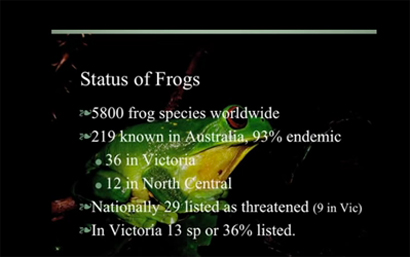
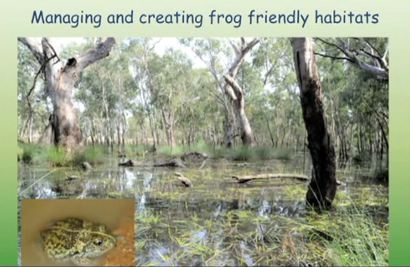
Renowned local ecologists, Elaine Bayes and Damien Cook have produced two terrific youtube videos:’Frogs and their Calls’ and ‘Frogs and their Habitats’. The information is well presented and relevant to our local area. Each goes for about 30 minutes. Click on each image below to view:
Draft MASC Climate Change Action Plan 2015-2019 – Open for Feedback
Posted on 11 November, 2015 by Connecting Country
The Mount Alexander Shire Council has just released the first draft of their Climate Change Action Plan 2015-2019 for public comment. The written public comment period runs for four weeks from Tuesday 10 November 2015 to Tuesday 8 December 2015. Further details are available on their website (click here) and a copy of the draft plan can be downloaded here (click here).
During the written comment period, Council officers will be available for a series of half hour meetings on Monday 30 November to discuss the draft. To book a meeting, the council has requested that people and groups contact Dallas Giles, Healthy Environments Administration Officer, on d.giles@mountalexander.vic.gov.au or call 03 5471 1700.
As stated on their website, once the community input has been considered, a more developed draft will be released for final consideration by the community in early 2016.
Swift Parrots in the news
Posted on 10 November, 2015 by Connecting Country
A few Connecting Country members alerted us to a recent segment on the ABC science program, Catalyst, about the plight of Swift Parrots.
Swift Parrots are one of the iconic species of the Box-Ironbark region. The Mount Alexander shire and surrounds is one of its favoured mainland foraging locations, and its particularly well known from the forests of Muckleford. Local naturalist Deb Worland has released a short documentary video about the species – The Swift Parrots of Muckleford – and its often a focus of Natural Newstead blogs (click here). On the mainland, it’s a migratory visitor during the winter months for non-breeding activities only.
All Swift Parrot breeding activity occurs in Tasmania during the spring-summer months, and this is where the Catalyst story focuses. There is concern that the species could disappear entirely within 16 or so years without dramatic intervention. While habitat loss, fragmentation and a scarcity of suitable hollow trees for nesting have long been known as threatening processes for the Swift Parrot, this program introduces a new threat. I won’t give away the unexpected twist here, but I encourage you to watch the story online (click here for the Catalyst website). (NB: However, it is worth noting that this is new threat is not relevant to the mainland foraging grounds of the Swift Parrot).
2015 Sustainable Agriculture Grants Open
Posted on 10 November, 2015 by Connecting Country
The Federal Government has announced a grant program to increase agricultural industry capacity and support the adoption of productive and sustainable practices. Grants available from the National Landcare Programme Sustainable Agriculture Small Grants Round 2015-16 range between $5500 and $55,000 (GST inclusive). A range of activities may be eligible, including:
- field days workshops, conferences
- demonstration events or workshops
- training or skill development sessions
- community information or education sessions
- development of decision-making tools
- development of new information channels within the current knowledge system
- conducting surveys.
This small grants round supports the implementation of the Agricultural Competitiveness White Paper. Applications are invited from a range of entities, including farming systems groups, community groups and individuals to undertake projects across a variety of agricultural industries, across a variety of agricultural industries, including cropping, livestock, dairy, horticulture, pastoral, aquaculture and fisheries. The application process closes at 2.00pm (AEDT) on Monday 7 December 2015. Further information is available on their website (www.nrm.gov.au/agsmallgrants).
Thank You to the Green Army Team Members
Posted on 9 November, 2015 by Connecting Country

The team, from L to R: Kate Tellefson, Lucas Teasdale, Mark Woods, Kieran Douglas, Luke Archer, Chris Kelly. Absent: Julian Gatt-Menting, Ethan Hamilton-Keane, Kelsey Walsh, Aaron Dole, Ryan Gentle.
The Green Army team that has been working on Landcare projects in the Mount Alexander Shire and elsewhere across the North Central region over past six months finished up with a farewell BBQ on the 5th November 2015.
The BBQ was attended by Glen Terry from Manpower, who were the service providers for the project. Glen handed out certificates to each of the participants and congratulated everyone involved on the success of the project.
Under the supervision of Mark Woods, the team worked on a range of Landcare projects which included building fences, protecting heritage sites, wheel cactus injecting, drilling pines on Mount Alexander, tackling weeds on Barkers Creek and much more . Their help has been greatly appreciated.
Mark was such an excellent team leader that he has already been asked to lead another team further south, but being a Bendigonian we’re hoping he will return to our part of the world soon.
A big thank you must go to Anthony Gallacher from the Loddon Plains Landcare Network who coordinated the sixth month project.
Connecting Country is waiting to hear the outcome of our joint application to have two more teams working on Landcare projects in the Mount Alexander Shire throughout 2016.
Geology of a Special Place – 14 November 2015
Posted on 7 November, 2015 by Connecting Country
Did you know that one side of the Muckleford Valley is older than the other side? And that the reason is a geological fault line running right through it? Have you ever seen the Muckl eford Gorge, where the creek carves a ravine between the a basalt plateau and an upturned Ordovician seabed?
Muckleford is a place of special geological interest and the Muckleford Catchment Landcare group would like to take you on a guided tour with expert geologist Brian Cuffley to explore its unique land forms. Brian will use his special expertise to impart a deeper understanding of the place where we live.
Brian has worked as a mineral exploration geologist in various parts of Australia and overseas. He has also worked for the State Rivers and Water Supply Commission and the Soil Conservation Authority. He studied Environmental Management at LaTrobe University where the subject of his thesis was dryland salinity.
The tour will travel the valley, starting at Mount Gaspard in the north, taking in Chinaman’s Creek valley and conclude at Muckleford Gorge in the south. Participants will be provided with explanatory maps to take home.
A couple of short walks are involved so it is advisable to wear solid shoes/boots, maybe sock protectors and of course bring a hat and water.
When: Saturday, November 14, 2015
Time: 1.30pm – 4 pm.
Where: Muckleford Community Centre, Muckleford-Walmer Road (south of the Castlemaine-Maldon Road).
Booking: Paul Hampton on 0408 566 909 or go to mucklefordlandcare.wordpress.com
Places are very limited so please let Paul know if you are attending. Click here to download a flyer.
The Muckleford Catchment Landcare will be conducting its AGM prior to the bus tour at 11.30am, followed by lunch. All interested community members are welcome to attend.
Upcoming biodiversity events in November
Posted on 6 November, 2015 by Connecting Country
Here’s a selection of opportunities to learn and get involved in various biodiversity activities over the next few weeks.
Great Victorian Koala Count on Saturday 7 November 2015
The Department of Environment, Land, Water and Planning (DELWP) is hosting the Great Victorian Koala Count, and they’d love the community to get involved. They are after citizen scientists (aka Koala counters) to contribute to this project, improving our knowledge of Koalas and where they are located in Victoria. All you need to do is undertake a walk with family or friends and tell DELWP where you did and didn’t see Koalas. To take part in the count, register online (click here) and then download the Great Victorian Koala Count smartphone app to record your findings on the day.
Butterfly Conservation talk on Friday 13 November 2015, and field day on Sat 14 Nov
The guest speaker for November’s Castlemaine Field Naturalists Club meeting is local ecologist Julie Whitfield. The presentation commences from 7.30pm (13 Nov) in the chapel behind the Uniting Church on Lyttleton St. Julie says, “I will discuss with the group the rare and threatened butterfly species of the region, with a particular focus on the Eltham Copper Butterfly conservation works of the past, I will also discuss briefly my travels overseas to learn about butterfly conservation programs.”. All are welcome to attend, and there is no cost for entry.

Julie Whitfield – Presenting at Connecting Country’s Fire and Biodiversity workshop earlier in 2015.
On the following day (14 Nov), Julie will also lead a field excursion, focusing on how to conduct a survey for Eltham Copper Butterflies and areas to target within Kalimna park. She will provide data sheets and maps for future surveys. Again, everyone is welcome. Meet at the car-park for the Kalimna Park rotunda at 1.40pm (at the southern end of park, along Kalimna Tourist Rd).
Contact Max for further details (mschlachter@outlook.com.au).
Waterbug Workshop on Friday 20 November 2015
The North Central CMA is running a workshop for people with a particular interest in becoming a Community Volunteer Waterbug Monitors. This a long-running program to monitor waterway health. If this is something you would be interested in then this workshop is for you! It is being held at Baringhup, along the Loddon River. Further info is available in the flyer attached (click here), or fill in the Expression of Interest form (click here) and send it back to the North Central CMA info@nccma.vic.gov.au or call 035448 7124 to register before Thursday 12 November 2015.
Eucalypt Symposium on Friday March 18, 2016
The Bjarne K Dahl Trust and the Royal Society of Victoria are presenting a one day symposium, ‘Conserving Eucalypts – The How and the Why’, highlighting eucalypt diversity and conservation. It aims to provide scientific insights to the future of Australian forests, woodlands and biota and to engage scientists, forest managers and anyone interested in the response of eucalypt forests and woodlands to environmental threats. For more details, and to register, see the symposium website (Click here).
And some of the others….
Plus, there are the multitude of other events coming up that we’ve highlighted previously, including the rabbit control field day in Metcalfe on 22 November (click here), the Future Directions Conference: Food and Fibre Production and Environment being held in Bendigo on the 18th November (click here), and Andrew Skeoch’s Nature Sound Recording Workshop for Beginners being held in Newstead on 28-29 November (click here).
Position Vacant – Mount Alexander Landcare Facilitator
Posted on 4 November, 2015 by Connecting Country
 Many of you will have heard that the Mount Alexander Landcare Facilitator, Max Schlachter, has decided to resign to pursue other opportunities. As Max said in his recent Landcare newsletter “It was a very difficult decision to make, but I think that now is the right time for me to hand over the keyboard to a new person. It’s been a wonderful job to do and I’m very grateful for the time that I’ve had in the position.”. Max will finish in the role at the end of 2015. Connecting Country thank him for his valued contributions to the role over the past 3-4 years.
We are sad to see Max go, but also it’s an exciting time for a new person to take on this important and full-filling role. Connecting Country has a contract from DELWP to host this part-time role (0.6 FTE) through until 30 June 2016, and there is a good probability that this contract will be extended.
If you are interested in applying for this role, or know someone else who might be, a copy of the Position Description can be downloaded (CLICK HERE). This contains more information about Connecting Country, the Landcare Facilitator role and its requirements.
Applications are due by 8pm Sunday 22 November 2015, and should include a brief cover letter, a resume and a short response to the Selection Criteria. Applications are to be sent to info@connectingcountry.org.au or by post to Connecting Country, Landcare Facilitator Position – Confidential, PO Box 437, Castlemaine, VIC 3450.
If you have any questions about the role, contact Chris Timewell at the email address above, or call 03 5472 1594 during business hours.
Know your weeds and what to do with them!
Posted on 2 November, 2015 by Connecting Country

David Cameron stresses that proper identification of weeds is essential
Did you know that there are at least 3 distinct species of Blackberry found in our area? Each of these have a different physiology and hence may require a different type of control. The importance of proper identification of weeds when deciding on appropriate management actions was stressed by DELWP Senior Botanist, David Cameron, at our “Back from the Brink” weeds workshop on Sunday 25 October 2015.
Alongside David, local contractor Matt McEachran, and Landcarers Frances Cincotta and Maurie Dynon shared their considerable wisdom and practical experience to help participants learn to identify weeds and the most appropriate techniques to managing them, from herbicide use to re-vegetation with native plants.
To find out more about the workshop session or to access some of the useful resources that were provided, please click here.
This workshop concludes our 2015 education program. If you missed out, summaries and resources from all sessions are provided in our education pages. Planning for the 2016 program is now underway – feel free to contact Krista on 5472 1594 or krista@connectingcountry.org.au to offer your suggestions or to find out more.

The 2015 workshop program was supported by Connecting Country through funding from the Australian and Victorian governments.
Rabbit Control Field Day in Metcalfe – Sunday 22nd November
Posted on 30 October, 2015 by Connecting Country
 The Metcalfe Landcare Group and the Department of Economic Development, Jobs, Transport & Resources (DEDJTR) are holding a field day to provide land owners with information and practical demonstrations on rabbit control methods.
The field day will include a talk by a rabbit control expert and demonstration of control techniques.
A flyer for the event can be downloaded HERE.
Please contact Debbie Farmer, Secretary at metcalfe.landcare@gmail.com for further information.
I f you or your Landcare group would like resources on controlling rabbits, Connecting Country still has copies of the ‘Ute Guide to Rabbit Control’ that it produced in 2013.
It’s a nice easy-to-use guide that explains the different methods of rabbit control available, and what might be most suitable for your situation.
Contact Connecting Country at info@connectingcountry.org.au or 5472 1594 to arrange collection.
October 2015 edition of North Central Chat
Posted on 30 October, 2015 by Connecting Country
The latest issue of the NCCMA’s newsletter, the North Central Chat, is now available for download (click here).
It contains stories of events that have taken place across the North Central region during October including the official launch of the North Waterwatch Program’s – River Detectives Website, the National Landcare Programmes – Sub Soil Manuring Field Day at Kamarooka and the Yates Junior Landcare Awards; plus a story about European Wasp control. It also outlines some events coming up in November: The Cohuna Catch-a-Carp Day, the Agreed Level Taxonomy Waterbug Workshops, the annual Chicks in the Sticks event and a Rabbit Control Field Day hosted by the Metcalfe Landcare Group.
Why every kid needs a swamp. And why every swamp needs a kid.
Posted on 24 October, 2015 by Connecting Country
Sean Dooley, Editor of Australian Birdlife magazine and author of The Big Twitch, will talk about how important local wild spaces are for developing a sense of connection with nature. Growing up next to a suburban swamp may not be some people’s idea of an idyllic childhood but for Sean, the window into the wonders of the natural world that it opened up to him was to profoundly affect the rest of his life in some unexpected and sometimes amusing ways.

What can you see in the reeds?
All are welcome to attend this free evening presentation hosted by Connecting Country on the evening of Tuesday 27 October 2015 at the Castlemaine Golf Course clubhouse (on Rilens Rd, Muckleford). Sean’s talk will commence from 7.30pm, with locally-made vegie soup served with bread from 7pm. RSVPs are preferred for catering purposes (contact chris@connectingcountry.org.au).
For Connecting Country members and other interested supporters, our AGM will be held beforehand from 6.30pm to 7pm. A copy of the agenda is attached (click here).
Connecting Country’s 2015 Annual Report – Out Now
Posted on 22 October, 2015 by Connecting Country
Spring in central Victoria is a time of the year when plants are flowering and growing, woodland birds and other native fauna are busily raising the next generation, and – hopefully – the rain is falling and the creeks are flowing.
It’s also the time when Connecting Country looks back over the past 12 months and brings together some of the best stories and achievements. This year’s Annual Report includes an original drawing on the cover from award-winning local author Trace Bella, a story from Muckleford landholders who have worked with the CC Works Crew to incorporate habitat restoration into their working farm, and well as updates and photos from all of our staff about other projects and programs – plus our aims for the year ahead.
A copy of the Annual Report is available for downloading (click here). We hope you enjoy reading all that you have helped support! We couldn’t have done it without you.
A small number of hard copies of the Annual Report will be available on the evening of the AGM. Don’t forget to come along to this special evening, even if just to hear our guest speaker Sean Dooley. As well as being chief editor of ‘Australian Birdlife’ magazine, a comedy writer and a regular bird-expert radio guest, Sean is also the author of The Big Twitch, Cooking with Baz and Anoraks to Zitting Cisticolas (an A to Z of Australian birds and birdwatching). This celebratory evening event is being held on Tues 27 October at the Castlemaine Golf Course clubhouse (Rilens Rd, Muckleford). The AGM commences from 6.30pm, yummy vegie soup is served after the AGM from 7pm, and with Sean speaking from 7.30pm. Friends, family and other ‘non-members’ are welcome. For more details, see our earlier blog (click here).