

Bird of the Month – Weebill
Posted on 22 July, 2025 by Bonnie Humphreys
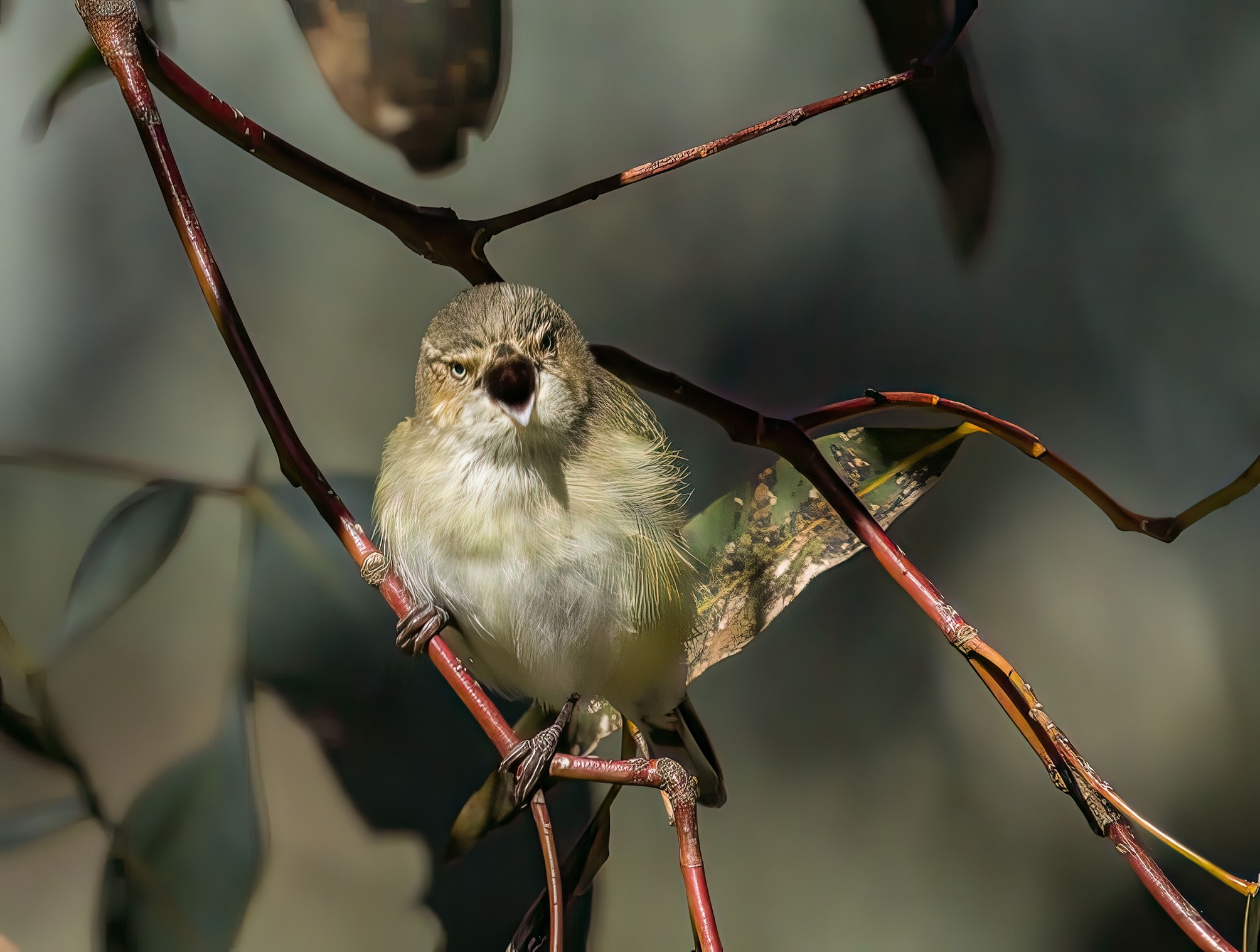
Weebill ‘shouting’, Photo by Damian Kelly
Written by Damian Kelly and Jane Rusden
In the local Box-Ironbark forest it’s fairly rare to go for a walk without hearing the Weebill. Although seeing it can be tricky, as typically they are in constant motion as they forage in amongst foliage. A give away is their hover, similar species don’t exhibit this behaviour. The best interactions I’ve had with Weebills, is when I’ve been sitting quietly nature journaling in my sketchbook, and a flock moves through the scrub around me. In these instances they can come very close to you and no binoculars are required to get fantastic views of the tiny but sometimes bold bird.
Measuring from bill tip to tail at 80mm and weighing in at just 6 grams, the Weebill is Australia’s smallest bird, but not by far with the Brown Thornbill just 1 gram heavier on average. As its name implies the bill is also very small and and stumpy which makes it easy to distinguish in the field from other Thornbills that invariably have longer, pointy thorn-like bills. It has been placed in a different genus to the other Thornbills.
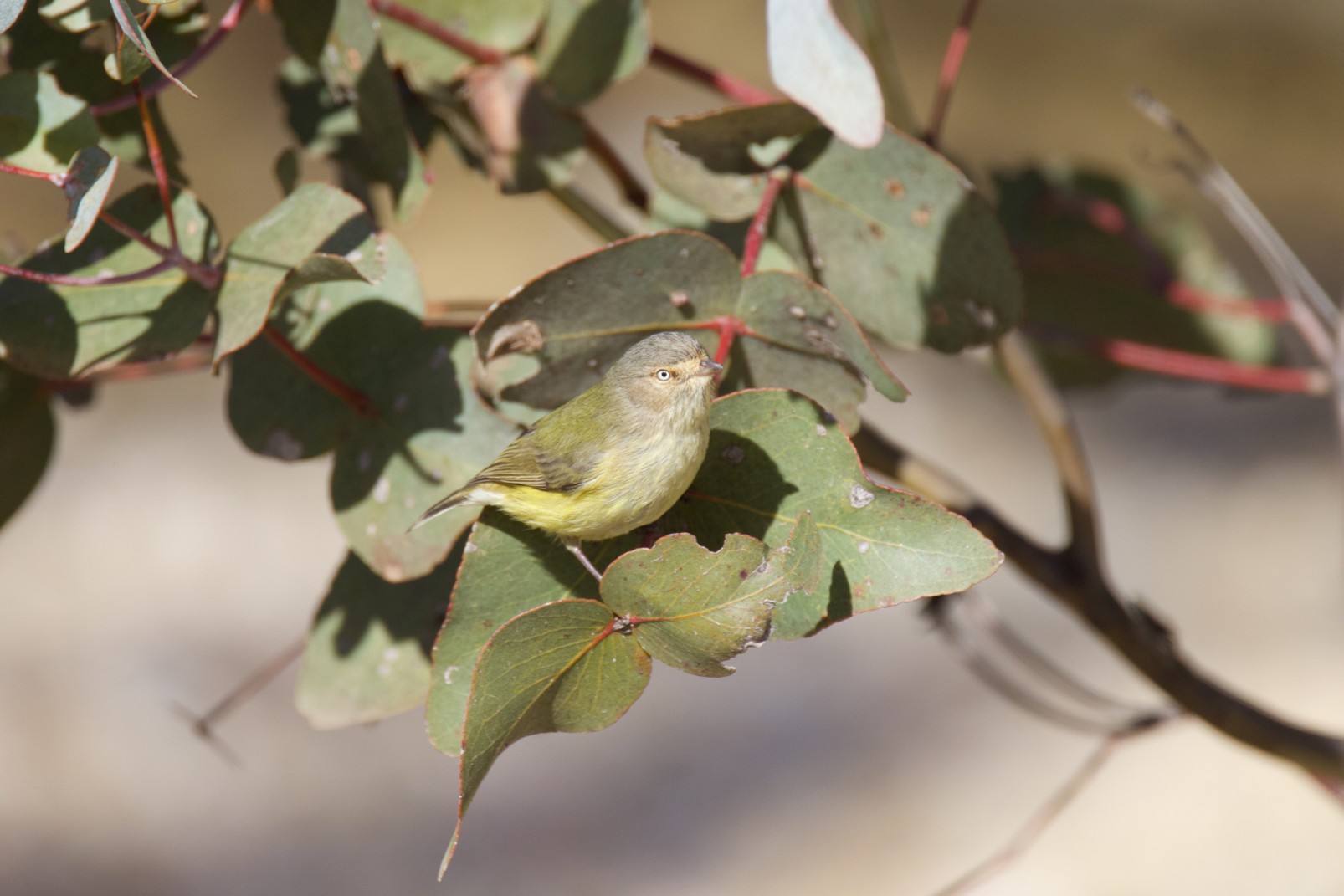
Weebill foraging in a stunted Box tree, at the Ochre Pits. Photo by Jane Rusden
A glance at the distribution map for the Weebill shows that it is widespread throughout Australia apart from some inland deserts and tropical rain forest areas. Detailed banding studies have shown the Weebill is a sedentary species with little local movements. Recoveries of banded birds have shown the 99% were recorded less than 10km form original locations. And surprisingly for such a small bird, some recoveries have been of birds over 7 years old.
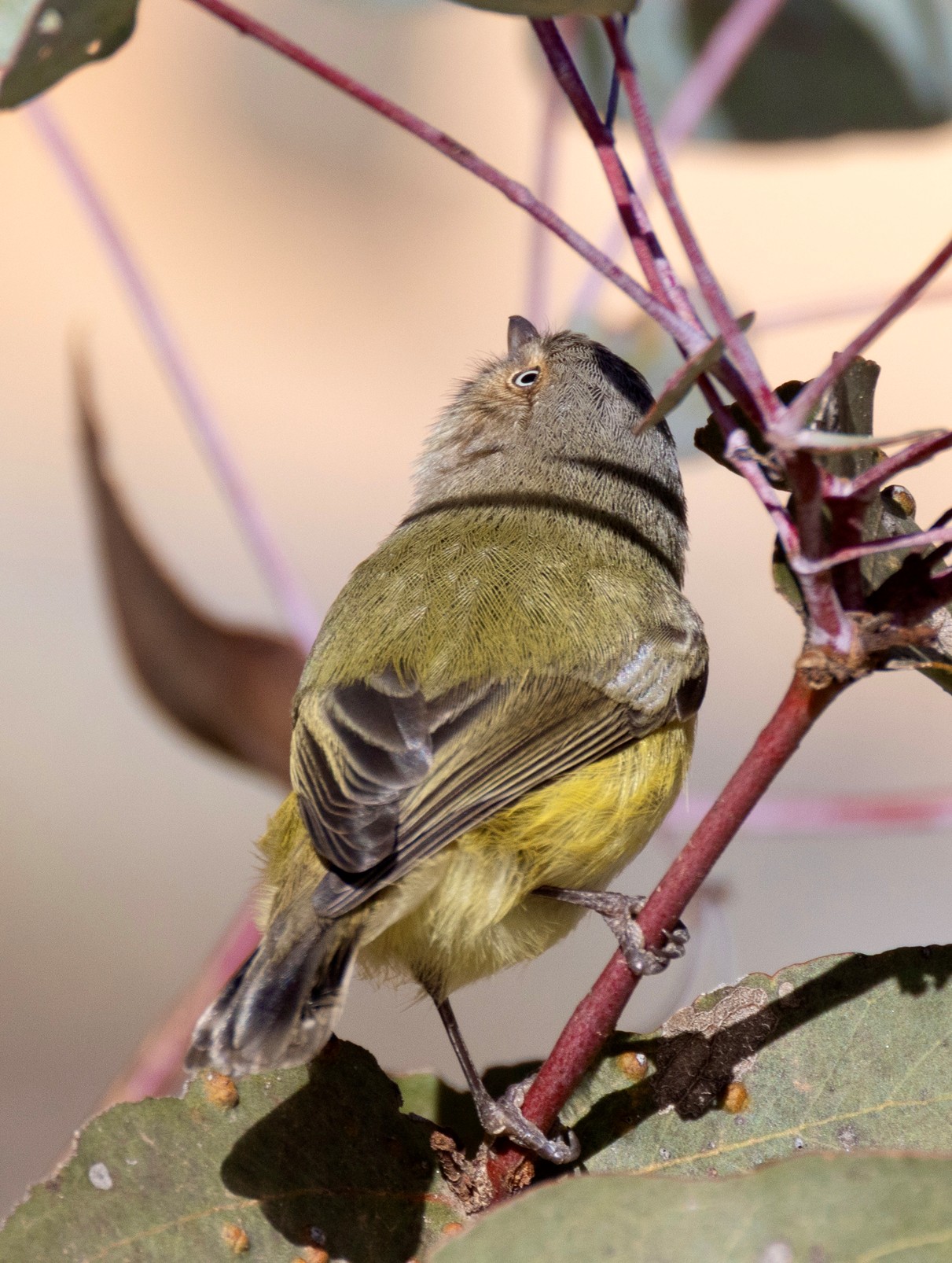
Weebill foraging, perhaps for lerp. Photo by Jane Rusden
Food is mostly insects of various kinds, although at times seeds are also taken. Breeding usually occurs August-December, although nesting has been observed at any time of the year when conditions are suitable. Nests are dome-shaped and are built mainly in eucalypt foliage. Clutch size ranges from 2-4 eggs. Both females and males incubate and feed the young.
Calls are quite loud for such a small bird with a whistled song that is quite distinctive and can sound like it’s calling its own name, “Weebill”.
Bird of the Month is a partnership between Connecting Country and BirdLife Castlemaine District. Each month we take a close look at one special local bird species. We are blessed to have the brilliant Jane Rusden and Damian Kelly from BirdLife Castlemaine District writing these! We’re excited to join forces to deliver you a different bird each month, seasonally adjusted, and welcome suggestions from the community.
Protecting large, old habitat trees in Metcalfe
Posted on 27 June, 2025 by Bonnie Humphreys

Sarah lives on her family’s farm in Metcalfe. The 30 hectare property has been managed for sheep grazing for many years. While sheep are still agisted within the property, Sarah has her eye on habitat creation and the restoration of indigenous flora across the property – ‘We’ve been adding to the remnant and revegetated areas every year and are already seeing a big increase in birds.’ Saray says.
Sarah’s property has an ephemeral (seasonal) creek line, grassy paddocks, and scattered large old Eucalypt trees, mainly Yellow Box (Eucalyptus melliodora), River Red-gum (Eucalyptus camaldulensis), Long-leaf Box (Eucalyptus goniocalyx) and some Manna Gum (Eucalyptus viminalis). Sarah loves these large old trees ‘These giant old trees are so precious, it’s so good to see them fenced off and protected from hard hooves and nutrient overload, and to see the understory we have planted start to grow up underneath which will soon be full of birds’.
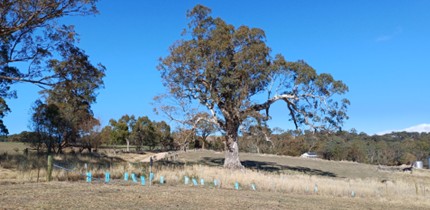
Connecting Country has been very lucky to secure support from the Ian Shirly Norman Foundation in partnership with the Victorian Government NatureFund to run a program over the past 2 years to protect large old Eucalyptus trees within farmland in the Mount Alexander Shire, and to provide succession for the next generation of these to mature. These large old trees are scarce in our landscape, largely due to historic gold-mining, timber harvesting and clearing for agriculture. These trees are so critical for habitat for a range of animal species, particularly threatened species such as the Brush-tailed Phascogale that relies on tree hollows for nesting.
Some key actions within the project included;
- Fencing to exclude stock. Stock increase nutrient loads around trees, as well as introducing weeds and compacting the soil.
- Retaining fallen limbs and leaf litter. These provide homes for insects, foraging resources for small animals and birds, and protection for the soil.
- Planting of understorey species around the trees. This helps provide resources and habitat for animals, who in turn, help manage pests. These plants also provide some direct protection for these large trees.
- Installation of nest boxes. Phascogale nestboxes were installed throughout the property support the threatened species to breed and move through the landscape.
- Providing stock proof guards to protect strategic recruitment of trees within paddocks.
- Controlling pests such as weeds and rabbits


With funding from our project partners, Connecting Country was able to support Sarah to be a step closer to achieving her goals and vision for the property. In June last year she held a planting day. ‘We had around thirty people come and help plant the trees and had a bush dance the evening inviting everyone in Metcalfe. It was so much fun and people are excited to come back next year, see how far the trees have come and plant lots more’.
The plants are off to a great start, especially given the extended dry we have been having and are already popping out of the guards. ‘I can’t think of many better feelings than watching a fairly barren, grazed landscape come back to life, shoot up and begin bursting with biodiversity again’.
Connecting Country is very proud to be able to support properties like Sarah’s and to work with such an enthusiastic and committed community. We acknowledge and are very grateful to the Ian and Shirley Norman Foundation and the Victorian Government (through the Nature Fund) for supporting this valuable work.


Staff changes at Connecting Country
Posted on 19 June, 2025 by Bonnie Humphreys
Connecting Country has sadly said goodbye to some fantastic colleagues over recent months – Anna Senior and Hadley Cole.

Anna Senior
Anna joined the Connecting Country crew in 2022 and immediately became a very valuable asset to the team.
With a doctorate in terrestrial ecology, she shared her passion for the conservation of lesser-known species, particularly reptiles. She never shied away from getting involved in the diverse range of things Connecting Country does. She began in an organsiational support role but quickly took on additional projects such as planting out and monitoring climate future plots, engaging in schools education programs, developing community education resources and running events. In late 2023, she took over Connecting Country Monitoring Program running seamless concurrent bird monitoring and nest box monitoring programs.
With a new found passion for birds, she jumped at the chance to help coordinate the inaugural Feathery Festival in 2024 to sell-out crowds and most recently ran a Rainbow Bird Walk with Castlemaine Pride with great success.
Anna brought valuable knowledge of ecology, data analysis and technological skills along with her ability to be flexible and help out wherever is needed.
We wish Anna all the best at her new role as the Threatened Mallee Bird Coordinator at BirdLife Australia and are happy to know that she won’t be gone for good from our community, as she is still keen to help out on the occasional event and with some volunteer monitoring.


Hadley Cole
 Hadley resigned from the Mount Alexander Region Landcare Facilitator role in May to set off on a wonderful adventure around Australia with her young family.
Hadley held the role for only four years, but was able to achieve a lot, even during the challenging COVID years and developed good relationships with the many environmental groups and stakeholders in our region. She fostered and helped with the delivery of a range of projects to build capacity of Landcare, increase knowledge, raise awareness of environmental concerns and connect people with nature. This included pollinator education and plantings, seed collection and propagation activities, field days, numerous Landcare link-ups and National Tree Day plantings.
With her calm and democratic nature, Hadley helped many a group through challenges including the challenging new income tax laws impacting on non-profit groups and changes in leadership.
A big passion of Hadleys was to bring the aspirations of Landcare and Traditional Owners together in healing country. She fostered relationships between Landcare, DJAARA and Nalderun through activities such as cultural competency training for Landcare and and walks on country with DJAARA and we hope to continue this legacy.
Hadley was sent off at a lovely lunch in late May, surrounded by a big representation from our local Landcare community highlighting the appreciations and connections she made in the role. Best wishes Hadley.


Bird of the Month: Brown Quail
Posted on 19 June, 2025 by Bonnie Humphreys
Written by Damian Kelly and Jane Rusden
Brown quail is an elusive bird that prefers to skulk rather than fly, but with patience they can be found in their preferred habitat. This species is best summed up as widespread but cryptic. They are actually fairly common around Castlemaine but are not often observed. Preferred habitat includes moister areas along water courses and swampy areas where there is good ground cover with taller grasses. They will venture into woodland but prefer areas with grassy tussocks. They can also be found in cultivated fields such as grain areas feeding on spilled grain and even in potato crops.

Photo by Damian Kelly
They are active during the day and usually move about in small groups on the ground. However their streaked brown colouration blends in with the terrain and they are hard to spot. If surprised they will fly up with a whirring of wings but land quickly in the nearest dense vegetation patch.
Within Australia, Brown Quail can be found right across northern and eastern Australia, south-west Western Australia, Tasmania and some Bass Strait Islands. They are absent from the very dry interior of Australia as they prefer dense grasslands, often on the edges of open forest. Their range also extends north of Australia into Papua-New Guinea and other islands off the northern coast. They have been introduced into New Zealand.
Little is know of their movements but they tend to be resident in wetter areas, whilst movements vary in drier regions depending on moisture. Bird banding records confirm this. Food includes some insects but the seeds of grasses and herbs are the main items in their diet, generally gleaned from the ground and low foliage.
Nesting occurs on the ground in dense foliage usually in a depression in the soil that is lined with grass and leaves. Clutch sizes recorded have ranged from 4-12 eggs. The female does all the incubating but both parents feed and brood the young away from the nest.
This species can sometimes be found with Stubble or King Quail as they share similar habitat preferences. Brown Quail are also captive bred and kept in aviaries. In this situation they are sometimes known to cross-breed with King Quail and produce young.

Brown Quail in a hurry, photo by Damian Kelly
Bird of the Month is a partnership between Connecting Country and BirdLife Castlemaine District. Each month we take a close look at one special local bird species. We are blessed to have the brilliant Jane Rusden and Damian Kelly from BirdLife Castlemaine District writing these! We’re excited to join forces to deliver you a different bird each month, seasonally adjusted, and welcome suggestions from the community.
Weed of the Month: Blackberry
Posted on 16 June, 2025 by Bonnie Humphreys
Most people can recognise a blackberry plant, but did you know that what we consider to be Blackberry consists of around 26 different species we refer to as an aggregate – Rubus fruticosus agg. These plants were first imported to Australia in the 1830s for gardens, as hedgerows, and as food plants. In the 1850s they were recommended to be used for erosion control along creeks but by the 1880s, they were recognised as weeds. Harbouring rabbits and reducing the quality of farm land they were listed as noxious in Victoria in 1894.
Blackberry originates from Europe, North America and Asia. It is a prickly woody shrub which sends out long woody canes that take root and spread. It also grows from roots and root fragments, and from seed readily eaten and spread by many animals including birds and foxes. It effectively grows in sun and shade and can successfully compete and overtake existing vegetation. Blackberrys usually have a period of dormancy throughout the year, and in our area, this usually occurs over winter.
It is listed under the Catchment and Land Management Act 1994 as ‘regionally controlled’ which means that landholders and managers have ‘a responsibility to prevent the growth and spread of this plant’.
It is also considered a weed of national significance (WONS) which means that it is considered noxious across the whole of Australia. There is a taskforce especially formed to deal with community education and the control of this species across Victoria – Click here
Herbicide application is the most common form of control, with an integrated approach usually most successful. Manual removal is limited to very specific situations due to the plants ability to regrow from most parts of the plant and in particular root fragments. Spraying and slashing may be used for extensive infestations, but will require follow up. As it is a woody weed the ‘cut and paint’ method of control is very effective. Any herbicide application should only occur when the plant is healthy and actively growing.
Further information can be found within the Blackberry Control Manual – Click here
Or on the Castlemaine Field Naturalists Website – Click here
The Weed of Month article is a segment from Connecting Country’s ‘Partnerships Against Pests’ project funded by Agriculture Victoria in 2024-25. Through this program, Connecting Country is working closely with local community groups, such as Landcare, to raise awareness of local pest plant and animal issues, with the aim to empower community with the skills to address these threats. The project includes seasonal awareness campaigns around key pest issues as well as workshops, and market stalls across the region.

Photos: Castlemaine Flora website
Nature Journaling Campout 23-25 May, Wedderburn
Posted on 12 May, 2025 by Bonnie Humphreys
Birdlife Castlemaine District would like to invite you to their annual Nature Journaling Campout.

Male Hooded Robin painted by Jane Rusden
Nature journaling is the practice of recording observations and experiences with nature through drawing, writing, or any combination of these methods. It’s a way to connect with the natural world, develop observation skills, and document the details of your surroundings in a creative and personal way.
This year we are very lucky to be visiting an incredible private property, within 10 minutes of Wedderburn. Habitats include huge areas of Mallee, stands of Bull Mallee with enormous roots and massive areas of indigenous flora, rich from direct seeding, supporting vibrant bird communities. Birds seen over Easter include White-browed Babblers, Red-capped Robins, Grey Goshawk, Hooded Robin and Southern White-face.

Wedderburn property, photo by Jane Rusden
Cost: $15 CASH ONLY per person which goes towards the upkeep and rehabilitation of the property. It is a labour of love and a huge amount of work and expense, so you may choose to give more than $15. Sorry, no receipts.
To participate, email Jane Rusden. Property details will only be sent to registered parties.
Nature Journaling Program:
Campers arrive from 3:00pm Friday 23 May. The gate will be locked prior to this, so there is no point coming earlier.
Saturday 24 May 9:00am – 4:00pm
Sunday 25 May 9:00am – 2:00pm
Accommodation: Book accommodation in Wedderburn or camp on the property. The campsite on the property has a large bush shelter, one pit toilet and Telstra phone reception.
It’s likely to be cold and may be wet, so rug up well and bring waterproofs. Bring your own camping gear, including:
- Food, drinking water and cooking equipment.
- Warm sleeping bag and sleeping mat.
- Tent, caravan or camper trailer.
- Chair and camp table
- Warm clothing and waterproofs, warm socks and sturdy footwear, long trousers. Warm hat and sun hat.
- Torch
- Binoculars
- Camera
- Art materials such as watercolours, coloured pencils and sketchbook
Wedderburn has a good cafe, a pub, IGA supermarket, service station, caravan park and hotel. It also has some very beautiful bird murals around town.
Please note: we have been told not to walk off track in the Mallee habitat by the landowner, because it is very easy to get lost as it all looks the same and there are no landmarks. However, there is plenty of beautiful bush and birds to see, and we can view the Mallee area from its edge. Malleefowl, Diamond Firetails and Hooded Robins have all been seen many times, outside the Mallee vegetation.
Weed of the Month: Willow
Posted on 1 May, 2025 by Bonnie Humphreys
Willows (Salix species) are a weed of national significance (WONS) and are listed as a ‘restricted’ noxious weed in Victoria under the Catchment and Land Protection Act 1994. Willows were introduced to Australia in the 1860’s by European settlers as ornamental plants and then for erosion control. They occur worldwide but are mostly indigenous to the Northern Hemisphere. In Australia there are around 100 species (including hybrids and cultivars), with around 15 occurring in Victoria, and many are very serious environmental weeds. They grow as trees and shrubs and due to the frequency of hybridization they can be very difficult to tell apart.
Willows grow in moist situations and thrive along streams and wetlands where they are particularly invasive. The CRC for Australian Weed Management believe that they have only invaded about 5% of their potential range within temperate Australia, meaning that without control their reach could be much more extensive. Willows change the function of our stream systems and wetlands in many ways, impacting the ability of our native fauna to use the systems, and reducing the presence of our native vegetation. They can impact native ecosystems by;
- The production of dense fibrous roots which slows the flow of water and covers the bed of streams, smothering rocky crevices and feeding grounds for fish and animals instream.
- Their deciduous leaves, unlike our local flora, drop at one time of year, smothering and then starving our macroinvertebrates who break down this matter.
- Crowding out native flora resulting in reduced resources for fauna.
Willows spread through seed and also stem fragments, which, when disturbed, readily break off and grow.
Finding the right control method for your situation is important to reduce spreading plants further. This may include a combination of methods such as ‘drill and fill’, ‘cut and paint’ or manual removal. As willows are dormant for some of the year (mostly over winter) it is important to only apply herbicide when they are actively growing. If treating with chemicals, it is also important to leave plants in place after treatment to ensure the chemical moves through the plant and completely kills the plant. If using manual removal remove any stem fragments to stop them from taking root and growing in a different place.
For more information head to the Weeds Australia website – click here
To access the Willows Fact Sheet, head to the North Central Catchment Management Authority (NCCMA) website – click here
The Weed of Month article is a segment from Connecting Country’s ‘Partnerships Against Pests’ project funded by Agriculture Victoria in 2024-25. Through this program, Connecting Country is working closely with local community groups, such as Landcare, to raise awareness of local pest plant and animal issues, with the aim to empower community with the skills to address these threats. The project includes seasonal awareness campaigns around key pest issues as well as workshops, and market stalls across the region.
Photo: Connecting Country archives
A vote for the environment: re-purposing old corflute signs as tree guards
Posted on 30 April, 2025 by Bonnie Humphreys
It is well and truly election time!! With only a few days left until we find out Australia’s political direction, we have all no doubt come across some corflute signs.
Rob Chapman from Campaspe Valley Landcare Group has approached Connecting Country to help share his innovative idea for reusing old campaign signs as tree guards to protect revegetation and help with the reduce, reuse and recycle philosophy we all try to live by!
‘Fellow Landcarer’s and Habitat restorers, here is an idea that I have found works well.
I have asked for old political corflute signs that are no longer relevant from political election campaigns, and turned them into Tree Guards or ‘Politically Correct Tree Guards’ as I call them. They are simple to make and cost only your time. Great as a group activity as they don’t demand a great deal of skill.
Ask the people who hand out the how to vote cards who to contact to get corflute (post election), remember it does not matter what Party they come from, you can turn them inside or out. It is repurposing a resource and helping a tree to grow that matters.
We have made a video with step by step instructions for construction.

Rob on his property busy planting
Thanks Rob, for sharing this novel idea.
New “Securing Woodland Birds’ project and exciting employment opportunity
Posted on 11 March, 2014 by Bonnie Humphreys

In 2012-13 Connecting Country undertook a preliminary Woodland Birds program. The success of this program and its high level of community support led us to invest in the development of a large, scientifically-rigorous program to restore woodland bird habitat across the Mount Alexander Shire and immediate surrounds.
This new program was described by Geoff Park at Connecting Country’s AGM in September 2013, and involves undertaking woodland restoration activities in 11 priority zones that are considered to be critical habitat for 5 ground-foraging bird species (Diamond Firetail, Hooded Robin, Brown Treecreeper, Painted Button-quail, Jacky Winter). A range of training events, bird monitoring activities and other bird-related activities are also to be undertaken as part of this program, which anyone and everyone can become involved in.
A couple of weeks ago, Connecting Country was informed that it had successfully secured funding to implement the first stage of this large project through the Victorian Government’s Communities for Nature initiative. More information on the “Securing Threatened Woodland Birds in the Mount Alexander Shire – Stage 1” project is available here.
Connecting Country is now seeking an experienced and enthusiastic Woodland Birds Project Officer to coordinate the implementation of this funded project. This person would also have a leading role in implementing Connecting Country’s existing biodiversity monitoring activities.
For a copy of the full position description and key selection criteria, click here. The part or full time (0.8-1 FTE) role is a 2-year fixed term position, commencing in April 2014.
Applications including a CV and addressing the key selection criteria to be submitted by 9am Thursday 27 March 2014 to chris@connectingcountry.org.au or mailed to Connecting Country, PO Box 437, Castlemaine, VIC, 3450.
For more information regarding the project and the position, contact Chris on (03) 5472-1594 or email chris@connectingcountry.org.au.