
Frogs of Mount Alexander Region
We acknowledge Djaara and Taungurung as the traditional owners of the Mount Alexander region. Use of Dja Dja Wurrung language in this resource has been approved by Djali Balak (Djaara language repatriation committee) and the content has been informed in discussions with Djaara people. Permission for reprinting or use of language outside of these resources should be sought from Djali Balak.
This learning resource aims to support educators to teach students about local frog species, learn to recognise them from their calls, and understand how they use their different bodies to move. There are over 250 species of frogs in Australia. We are going to learn about 6 species that you are likely to see and hear near school, the local park or your home in the Mount Alexander area. Keep in mind that there are other frogs you might find in the region – about 11 in total.
Background:
- This activity can be taught in conjunction with the frog life cycle. The National Geographic Kids webpage has some great information for teaching about the frog life cycle.
- Frogs are a type of amphibian, which means they have two parts to their life cycle. Amphi-bian means ‘both life’. The first part of an amphibian’s life is spent in water during the larval stage, and the second is on land. Amphibians go through metamorphosis, which means their bodies change dramatically. When they start life they have gills for breathing under water, and then they develop lungs when they are older and can breathe the air.
- There are other kinds of amphibians around the world, like toads, newts, salamanders and caecilians, but in Australia we just have native frogs. Frogs start out as eggs and hatch into tadpoles that live in water. They then grow two arms and two legs, and their tail disappears inside their body and they become a frog.
- Frogs have very sensitive skin and you should never touch them as it can make them sick.
- You are more likely to see a frog at night, as they are mostly nocturnal.
Activity/lesson:
The frogs in our area can be divided into four different groups, based on where they like to live and how they move around. These are:
- Climbing tree frogs
- Hopping ground frogs
- Walking frogs
- Digging frogs
The way they move around has affected what their legs and toes look like in a process called adaptation. We can tell them apart by looking closely at their feet. You can learn about each group using the description and photos in the supplied resource (Frogs of Mount Alexander Region). Perhaps you can look at a new group each week.
Resources
Frogs of the Mount Alexander Region Presentation (with links to calls)
Frog Legs Activity
Can you match the four different sets of frog legs with the four different groups: Climbing, Hopping, Digging and Walking? Look at the different sizes and shapes of the legs and toes, and whether the toes are webbed or not.
Frogs Legs Activity Answer Sheet
Notes for Answers
- Walking frogs have short legs with short toes as they don’t really need any specialised equipment to help them slowly meander along their way.
- Digging frogs have big strong legs to help them move earth.
- Climbing frogs have sticky round pads on the end of their toes to help them grip onto surfaces. They also often have webbing between their toes to help them swim, like tiny flippers.
- Hopping frogs have long toes to help them push forward when leaping.
Although they do all look different to the trained eye – it is far easier to tell frogs apart from their calls rather than what they look like. This activity also aims to familiarise kids with the distinct sounds that frog species make, and the variety of sounds.
Frog Sounds
Each species has a different call which we are going to learn. Ask the students/ or children the following observational questions and think through the answers together
Q. Have you heard frogs calling before? Does anyone know why frogs call?
A. They call to attract a mate. It is only the males that call, and the females hear the sound and know where to look for the males. Frogs have evolved different calls so they can tell each other apart and don’t mate with the wrong species. This also means we can use their calls to tell them apart.
Q. We are going to listen to some frog calls. Can you think of some words to describe the sounds you are hearing?
A. Play the 6 different frog sounds from the Frog ID app.
The Eastern Banjo Frog sounds a bit like someone plucking a low banjo string. ‘Bonk Bonk.’ This frog is also called the ‘Pobblebonk’. This frog is known as ‘dum’ in Dja Dja Wurrung Language. Can you hear why this might be?
The Common Eastern Froglet sounds a bit like many tiny crickets calling. Usually you will hear more than one calling at a time. ‘crick crick crick.’
The Spotted Marsh Frog is a strange sounding frog. Sometimes it sounds like two rocks being hit together. ‘Kuk kuk kuk.’
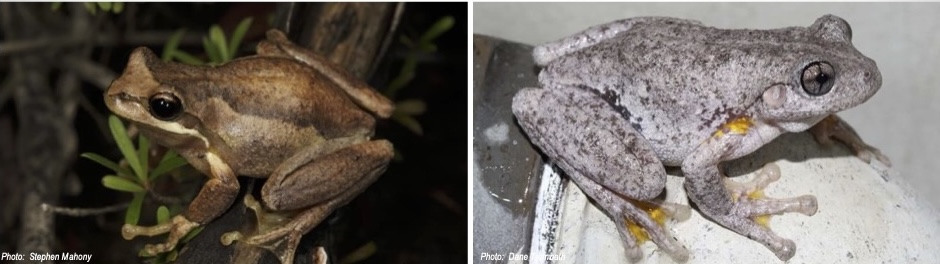
Brown Tree Frog. This frog can be very loud at times and makes a sound like ‘Creeee cree cree cree cree.’
Peron’s Tree Frog. This frog can sound a bit like someone laughing. Sometimes people call it the laughing frog or maniacal cackle frog! ‘hahahahaha.’
Bibron’s Toadlet has a lovely, soft sounding croak. ‘re-ek’ re-ek.’